
Archimedean Solids & the Rhombicosidodecahedron
June 6, 2026
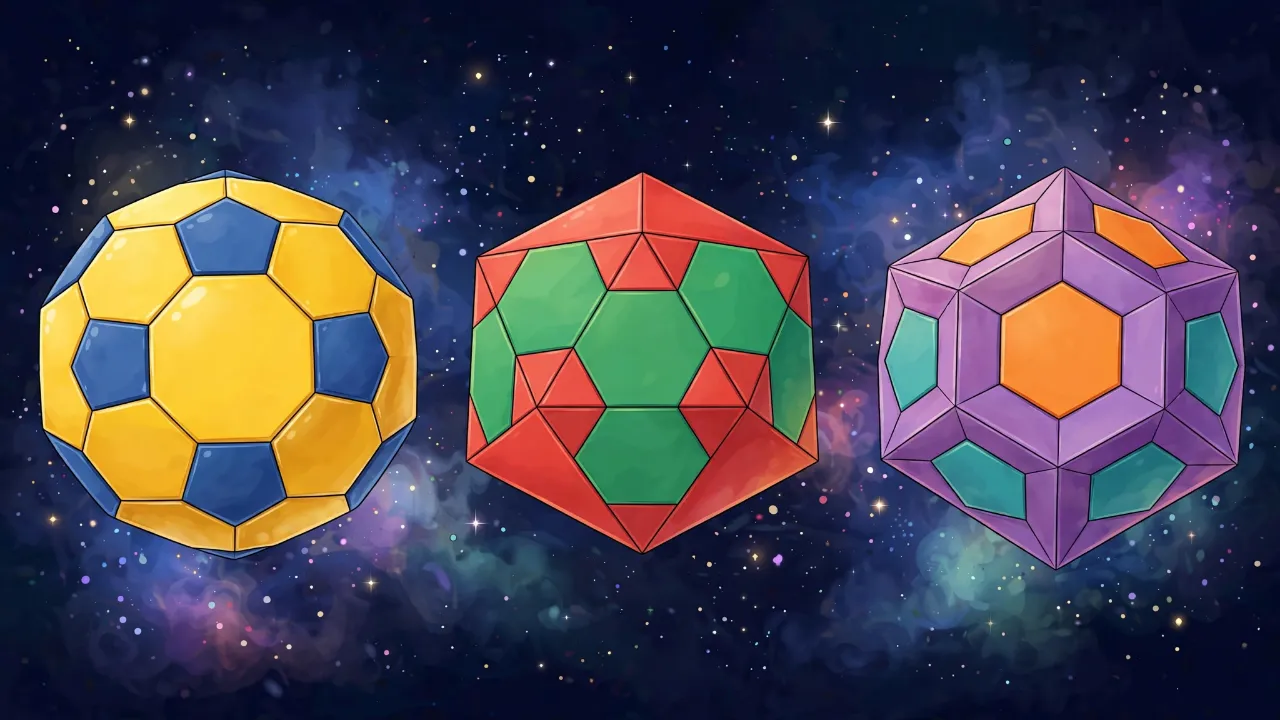
Look at This Shape! 🤩
This shape has lots of flat sides. Some are triangles, some are squares, and some have five sides.
It has 62 sides! A box has only 6.
Five Shapes
A clever man named Archimedes found it long ago in Greece.
The Shape With the Long Name! 📐
Try saying this: rom-bih-co-sih-doe-deck-a-HEE-dron. It is one of the longest words in math! This shape uses THREE different shapes for its faces.
What Makes It Special?
Every corner looks the SAME! A tiny ant walking on this shape would find the same pattern at every corner: triangle, square, pentagon, square.
The 5 Platonic Solids
Simpler shapes called Platonic solids use only ONE type of face:
A Magic Rule! ✨
For ANY of these shapes: corners − edges + faces = 2. Try it with a cube: 8 corners − 12 edges + 6 faces = 2. Magic!
The Most Fascinating Shape in Math 🔷
Meet the rhombicosidodecahedron (rom-bih-co-sih-doe-DECK-a-HEE-dron). Yes, that is a real word. It is one of 13 special 3D shapes called Archimedean solids, named after the ancient Greek mathematician Archimedes who studied them around 250 BC.
By the Numbers
- 62 faces: 20 equilateral triangles, 30 squares, and 12 regular pentagons
- 120 edges
- 60 vertices (corners)
- Vertex configuration: 3.4.5.4. At every single corner, a triangle, square, pentagon, and square meet, in that exact order
What Makes a Shape "Archimedean"?
To be an Archimedean solid, a shape must follow two rules:
- Every face must be a regular polygon (all sides equal, all angles equal), but you can MIX different types
- Every vertex must look exactly the same: the same types of faces meet in the same order at every corner
There are exactly 13 shapes that follow these rules (not counting the Platonic solids and prisms).
The 5 Platonic Solids: The Starting Point
Before Archimedean solids, let's meet their simpler cousins. Platonic solids use only ONE type of regular polygon:
Euler's Formula: The Magic Equation ✨
In 1758, the mathematician Leonhard Euler discovered that for ANY convex polyhedron:
Vertices minus Edges plus Faces always equals 2
Let's check it for our shapes:
| Shape | V | E | F | V−E+F |
|---|---|---|---|---|
| Tetrahedron | 4 | 6 | 4 | 2 ✓ |
| Cube | 8 | 12 | 6 | 2 ✓ |
| Dodecahedron | 20 | 30 | 12 | 2 ✓ |
| Rhombicosidodecahedron | 60 | 120 | 62 | 2 ✓ |
Where Do You See These Shapes?
- ⚽ Soccer balls: truncated icosahedron
- 🏛️ Architecture: geodesic domes (like the Epcot ball)
- 💎 Gemstones: many gem cuts follow Archimedean patterns
- 🦠 Viruses: many virus capsids are icosahedral
- 🧪 Molecules: buckminsterfullerene (C₆₀) is a truncated icosahedron
62 Faces of Mathematical Beauty
The rhombicosidodecahedron is one of the most visually striking objects in all of mathematics. With its 62 faces (20 equilateral triangles, 30 squares, and 12 regular pentagons), it sits at the sweet spot between simplicity and complexity, and it has fascinated mathematicians from Archimedes to the present day.
The Rules of the Game
An Archimedean solid satisfies two conditions:
- All faces are regular polygons (equilateral triangles, squares, regular pentagons, hexagons, etc.), but unlike Platonic solids, you can mix different types.
- Vertex-transitivity: every vertex is surrounded by the same arrangement of polygons in the same order. For the rhombicosidodecahedron, that arrangement is 3.4.5.4: triangle, square, pentagon, square.
These two constraints are extremely restrictive. Out of all possible combinations, only 13 shapes qualify as Archimedean solids.
The Complete Family of 13
| Archimedean Solid | Config | F | E | V | V−E+F |
|---|---|---|---|---|---|
| Truncated tetrahedron | 3.6.6 | 8 | 18 | 12 | 2 ✓ |
| Cuboctahedron | 3.4.3.4 | 14 | 24 | 12 | 2 ✓ |
| Truncated cube | 3.8.8 | 14 | 36 | 24 | 2 ✓ |
| Truncated octahedron | 4.6.6 | 14 | 36 | 24 | 2 ✓ |
| Rhombicuboctahedron | 3.4.4.4 | 26 | 48 | 24 | 2 ✓ |
| Truncated cuboctahedron | 4.6.8 | 26 | 72 | 48 | 2 ✓ |
| Snub cube | 3.3.3.3.4 | 38 | 60 | 24 | 2 ✓ |
| Icosidodecahedron | 3.5.3.5 | 32 | 60 | 30 | 2 ✓ |
| Truncated dodecahedron | 3.10.10 | 32 | 90 | 60 | 2 ✓ |
| Truncated icosahedron | 5.6.6 | 32 | 90 | 60 | 2 ✓ |
| Rhombicosidodecahedron | 3.4.5.4 | 62 | 120 | 60 | 2 ✓ |
| Truncated icosidodecahedron | 4.6.10 | 62 | 180 | 120 | 2 ✓ |
| Snub dodecahedron | 3.3.3.3.5 | 92 | 150 | 60 | 2 ✓ |
Euler's Formula: A Universal Truth
Every row in that table confirms Euler's formula: V − E + F = 2. This isn't a coincidence. It's a deep topological fact. Any convex polyhedron, no matter how complex, satisfies this equation. Leonhard Euler proved this in 1758, and it became one of the founding results of topology.
Rhombicosidodecahedron: 60 − 120 + 62 = 2 ✓
Truncated icosahedron: 60 − 90 + 32 = 2 ✓
Snub dodecahedron: 60 − 150 + 92 = 2 ✓
The Golden Ratio Connection 🌀
✨ The Golden Ratio: φ = (1 + √5) / 2 ≈ 1.618
The rhombicosidodecahedron's vertices can be described using the golden ratio φ. This isn't a coincidence: all the Archimedean solids related to pentagons and icosahedra have deep connections to φ, because the regular pentagon's diagonal-to-side ratio is exactly φ.
The Five Platonic Solids
Archimedean solids are built on top of the Platonic solids. Many can be created by "truncating" (cutting corners off) a Platonic solid:
Vertex-Transitive Polyhedra and the Archimedean Classification
The Archimedean solids represent a natural extension of the Platonic solids: convex polyhedra with regular polygon faces and vertex-transitive symmetry (every vertex is equivalent under the symmetry group of the solid). While Platonic solids are additionally face-transitive (all faces are the same polygon), Archimedean solids relax this to allow multiple polygon types.
The Classification Proof
Why exactly 13? The proof proceeds by exhaustion of vertex configurations. At each vertex of a convex polyhedron, at least 3 faces meet, and the sum of face angles must be strictly less than 360° (otherwise the vertex would be flat or reflex). With regular polygons, the interior angle of an n-gon is (n−2)·180°/n. We enumerate all vertex configurations (p₁.p₂.p₃...) where:
- Each pᵢ ≥ 3 (minimum polygon is a triangle)
- At least 3 faces meet
- Sum of interior angles < 360°
- The configuration can be extended to a complete, closed, convex polyhedron
The fourth constraint is the hardest. Many valid angle combinations cannot tile a sphere: they fail to close into a polyhedron. The 13 Archimedean solids are exactly those that succeed, a result fully established by the early 20th century.
Vertex Coordinates via the Golden Ratio
The 60 vertices of a rhombicosidodecahedron centered at the origin can be expressed using the golden ratio φ = (1+√5)/2. With unit edge length, the vertices include all even permutations of:
(±φ², ±φ, ±2φ)
(±(2+φ), 0, ±φ²)
where φ = (1+√5)/2 ≈ 1.618, φ² ≈ 2.618, φ³ ≈ 4.236
The "even permutations" refer to the cyclic permutations of coordinates: (x,y,z), (y,z,x), (z,x,y). Each base triplet with its sign choices generates 8 vertices, and 3 cyclic permutations gives 24 from each class. The third class has one zero coordinate, yielding only 4 sign choices × 3 permutations = 12 vertices. Total: 24 + 24 + 12 = 60. ✓
Euler's Formula and the Dehn–Sommerville Relations
Euler's relation V − E + F = 2 for convex polyhedra is a topological invariant: it holds for any polyhedron homeomorphic to a sphere, regardless of the specific face structure. For the rhombicosidodecahedron:
We can verify the edge count independently. Each triangular face has 3 edges, each square has 4, each pentagon has 5. But each edge is shared by exactly 2 faces:
Similarly, at each vertex exactly 4 faces meet (configuration 3.4.5.4), so the total vertex-face incidences equal 4V = 4·60 = 240. Summing face sides: 20·3 + 30·4 + 12·5 = 240. Consistent. ✓
The Platonic Foundation
Dual Polyhedra
Every Archimedean solid has a dual (a Catalan solid) formed by placing a vertex at the center of each face and connecting adjacent face-centers. The dual of the rhombicosidodecahedron is the deltoidal hexecontahedron, which has 60 identical kite-shaped faces. While the rhombicosidodecahedron is vertex-transitive (all vertices equivalent), its dual is face-transitive (all faces equivalent).
From Archimedes to Algorithmic Geometry: The Complete Story
Archimedes of Syracuse (c. 287–212 BC) is credited with the first systematic study of what we now call the Archimedean solids. His original work, referenced by Pappus of Alexandria in the 4th century AD, has been lost. The solids were independently rediscovered by Johannes Kepler in 1619, who published them in Harmonices Mundi, and the modern classification (confirming exactly 13) was established in the early 20th century.
Formal Definition and Classification
An Archimedean solid is a convex polyhedron satisfying: (1) all faces are regular polygons, (2) the solid is vertex-transitive under its symmetry group: every vertex can be mapped to every other by a symmetry of the solid. This is stronger than merely requiring the same vertex configuration at each vertex; it demands a global symmetry operation carrying one vertex to any other.
This distinction matters: the elongated square gyrobicupola (Johnson solid J37, sometimes called the "pseudo-rhombicuboctahedron") has vertex configuration 3.4.4.4 at every vertex, identical to the rhombicuboctahedron, yet is not vertex-transitive. Its vertices fall into two orbits under the symmetry group. This is why the Archimedean classification requires vertex-transitivity, not merely local vertex uniformity.
The Golden Ratio Embedding
The rhombicosidodecahedron belongs to the icosahedral family of Archimedean solids, all of which have symmetry group Ih (order 120). Its vertex coordinates involve the golden ratio φ = (1+√5)/2, reflecting the deep algebraic connection between icosahedral symmetry and the field extension ℚ(√5).
(±1, ±1, ±φ³) | (±φ², ±φ, ±2φ) | (±(2+φ), 0, ±φ²)
φ = (1+√5)/2 ≈ 1.61803..., yielding 24 + 24 + 12 = 60 vertices
The golden ratio appears because the regular pentagon (a constituent face) has diagonal-to-side ratio φ. This propagates through the vertex coordinates, edge lengths, and circumradius of every icosahedral-family solid. The circumradius of the unit-edge rhombicosidodecahedron is √(11 + 4√5)/2 ≈ 2.233.
The ℚ(√5) Connection
All vertex coordinates of icosahedral-family polyhedra live in ℚ(√5). This is not coincidental: the icosahedral rotation group I ≅ A₅ (the alternating group on 5 elements) is the smallest non-abelian simple group, and its faithful 3D representation requires the quadratic extension ℚ(√5)/ℚ. The golden ratio is the fundamental unit of this number field.
Combinatorial Verification
The face-edge-vertex data of the rhombicosidodecahedron satisfies multiple independent consistency checks:
Edge count: (20·3 + 30·4 + 12·5)/2 = 240/2 = 120 ✓
Vertex-face incidence: 4·60 = 240 = 20·3 + 30·4 + 12·5 ✓
Vertex-edge incidence: 2E = 240 = 4·60 ✓ (4 edges per vertex)
The Complete Archimedean Family
| Solid | Config | Sym | V | E | F | Dual (Catalan) |
|---|---|---|---|---|---|---|
| Truncated tetrahedron | 3.6.6 | Td | 12 | 18 | 8 | Triakis tetrahedron |
| Cuboctahedron | 3.4.3.4 | Oh | 12 | 24 | 14 | Rhombic dodecahedron |
| Truncated cube | 3.8.8 | Oh | 24 | 36 | 14 | Triakis octahedron |
| Truncated octahedron | 4.6.6 | Oh | 24 | 36 | 14 | Tetrakis hexahedron |
| Rhombicuboctahedron | 3.4.4.4 | Oh | 24 | 48 | 26 | Deltoidal icositetrahedron |
| Truncated cuboctahedron | 4.6.8 | Oh | 48 | 72 | 26 | Disdyakis dodecahedron |
| Snub cube | 3.3.3.3.4 | O | 24 | 60 | 38 | Pentagonal icositetrahedron |
| Icosidodecahedron | 3.5.3.5 | Ih | 30 | 60 | 32 | Rhombic triacontahedron |
| Truncated dodecahedron | 3.10.10 | Ih | 60 | 90 | 32 | Triakis icosahedron |
| Truncated icosahedron | 5.6.6 | Ih | 60 | 90 | 32 | Pentakis dodecahedron |
| Rhombicosidodecahedron | 3.4.5.4 | Ih | 60 | 120 | 62 | Deltoidal hexecontahedron |
| Truncated icosidodecahedron | 4.6.10 | Ih | 120 | 180 | 62 | Disdyakis triacontahedron |
| Snub dodecahedron | 3.3.3.3.5 | I | 60 | 150 | 92 | Pentagonal hexecontahedron |
Applications and Appearances
Beyond pure mathematics, Archimedean solids appear in:
- Chemistry: The truncated icosahedron is the cage structure of buckminsterfullerene (C₆₀), discovered in 1985 by Kroto, Curl, and Smalley (Nobel Prize 1996). Larger fullerenes correspond to other truncated icosahedral forms.
- Virology: The capsids of many icosahedral viruses, including adenoviruses and herpes simplex, approximate icosahedral and rhombicosidodecahedral symmetry. Caspar-Klug theory (1962) explains how icosahedral symmetry optimizes capsid assembly from a minimum number of distinct protein subunits.
- Architecture: Buckminster Fuller's geodesic domes are triangulations of icosahedral forms. The Montreal Biosphère (1967) and Epcot's Spaceship Earth (1982) are famous examples.
- Materials science: Quasicrystals, discovered by Dan Shechtman in 1982 (Nobel Prize 2011), exhibit icosahedral symmetry, long thought impossible in crystals. Their diffraction patterns show the same five-fold symmetry as the regular pentagon.
- Gaming: The rhombicosidodecahedron is sometimes used as a 62-sided die. Several tabletop RPG systems use Archimedean solid dice for non-standard probability distributions.
The Platonic Foundation
Sources
- Cromwell, P.R. Polyhedra. Cambridge University Press, 1997.
- Grünbaum, B. "An enduring error." Elemente der Mathematik, 64(3), 89–101 (2009).
- Coxeter, H.S.M. Regular Polytopes. Dover, 1973.
- Caspar, D.L.D., Klug, A. "Physical principles in the construction of regular viruses." Cold Spring Harbor Symposia, 27, 1–24 (1962).
- Kroto, H.W. et al. "C60: Buckminsterfullerene." Nature, 318, 162–163 (1985).