
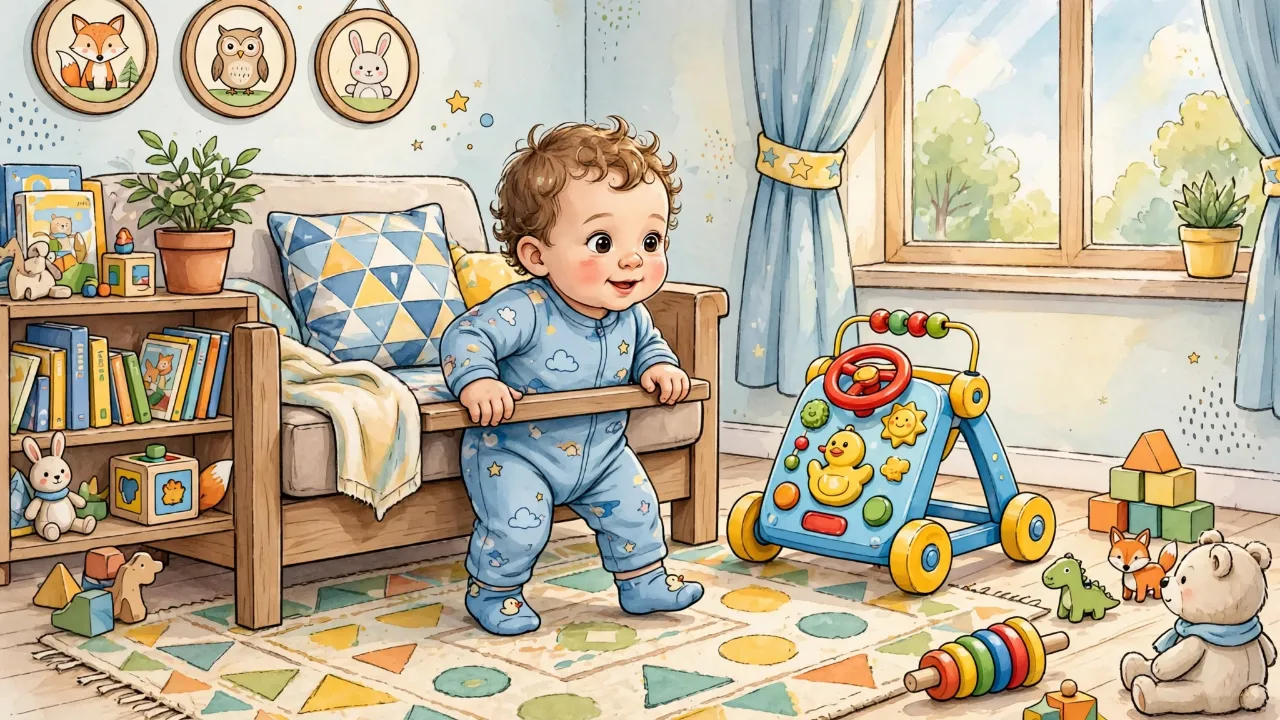
Babies learn to walk by themselves! First they roll, then sit, then crawl, and then they WALK! 🎉
The floor is the best place to practice. Crawling makes arms and legs strong! 💪
A chair with wheels looks fun, but it does not teach walking. Play on the floor!
What Is a Baby Walker?
A baby walker is a little seat on wheels. A baby sits in it and zooms around the room by pushing with their feet. 🏎️
Does It Help Babies Walk?
Here is a surprise: scientists found that walkers do NOT help babies walk sooner. Babies who use walkers a lot may even start walking a little later.
Why?
In a walker, the seat holds the baby up, so their muscles do not work hard. Crawling on the floor uses the whole body. It makes arms, legs, and tummy muscles strong, and strong muscles help a baby stand and walk. 🦵💪
What Should Babies Do Instead?
Tummy time, floor time, toys on the ground, and pulling up on furniture. You can hold a baby's hands and let them practice stepping. That is better than any walker! 🤝
The Big Question
You have probably seen those baby walkers: a little seat on wheels where babies can sit and scoot around the room. Lots of parents buy them because they think walkers will help their baby learn to walk sooner. But does the science agree?
What Scientists Found
Researchers studied hundreds of babies to find out. They compared babies who used walkers to babies who did not. The results were surprising:
- Walkers do NOT help babies walk sooner. Not a single good study has shown that walkers make babies walk earlier.
- Walkers might actually slow things down. One study of 190 babies found that every 24 hours of total walker time was linked to a 3-day delay in walking on their own.
- Floor time is the real winner. Babies who spend more time crawling, rolling, and pulling up on furniture build the muscles they need to walk.
Why Walkers Do Not Work
Think about it this way: when a baby sits in a walker, the seat holds up their body weight. They just push with their toes. But walking requires balancing on one foot at a time, using your core muscles, and coordinating your whole body. A walker does not practice any of those things.
It is a bit like trying to learn to ride a bike by sitting in a wagon. You might move forward, but you are not learning to balance!
The Safety Problem
Walkers are also dangerous. Babies in walkers can move 3 feet per second, which is faster than most adults can react. They roll into stairs, bump into hot stoves, and reach things they should not touch. Canada actually banned baby walkers completely in 2004. The American Academy of Pediatrics says they should be banned in the United States too.
What Works Better
The best thing for a baby learning to walk? Lots of floor time, holding a grown-up's hands to practice steps, and push toys (the kind where the baby walks behind it and pushes it, not the kind where they sit in it). These activities build real balance and real strength.
The Walker Paradox
Baby walkers seem like they should help babies walk. They give babies upright mobility before they can walk on their own. But the scientific evidence points in the opposite direction: walkers either have no effect on walking onset or they slightly delay it. How can a device designed for walking make walking harder?
The Evidence
The research base is surprisingly thin. A 2017 systematic review searched four major databases and found only 9 studies that met their inclusion criteria out of over 2,000 initial results. Here is what those studies showed:
| Study | Babies | Design | Result |
|---|---|---|---|
| Kauffman & Ridenour, 1977 | 12 | Twin trial | No difference |
| Ridenour, 1982 | 30 | Twin trial | No difference |
| Siegel & Burton, 1999 | 109 | Cohort | Delay in sitting, crawling, walking; lower Bayley scores |
| Garrett et al., 2002 | 190 | Cross-sectional | 3.3-day delay per 24h of walker use |
| Chagas et al., 2011 | 26 | Cross-sectional | No difference |
| López Ros et al., 2025 | 649 | Retrospective | No significant difference |
Three Mechanisms of Delay
Scientists have proposed three reasons why seated walkers might hinder rather than help:
- Visual deprivation. Most modern walkers have a wide opaque tray that blocks the baby's view of their own legs. Research on motor development shows that watching your limbs move is important for learning to control them. One study found that babies using "occluding walkers" (cannot see feet) scored significantly lower on mental and motor development tests than babies using older "see-feet" designs.
- Muscle bypass. The walker seat supports the baby's weight, so their core, hip, and leg muscles do not have to work as hard. Walking requires single-leg balance, hip stability, and trunk control. A 2020 study using the Segmental Assessment of Trunk Control found that walker-using babies had significantly weaker trunk balance than non-users.
- Opportunity cost. Every minute in a walker is a minute not spent crawling, pulling up, cruising along furniture, or falling and recovering. These activities build the neural pathways and muscle memory needed for independent walking.
The Safety Data Is Unambiguous
Even if the developmental evidence is mixed, the safety data is not. Between 1990 and 2014, over 230,000 children under 15 months were treated in US emergency departments for walker-related injuries. Babies in walkers can move 3 feet per second. The most common injuries are skull fractures and head trauma from stair falls. Canada banned walkers entirely in 2004. The AAP has called for a US ban since 2001. The CPSC issued mandatory safety standards in 2010, which reduced injuries but did not eliminate them.
Better Alternatives
Push walkers (where the baby stands behind and pushes a wheeled toy) are fundamentally different from seated walkers. They require the baby to bear their own weight, maintain balance, and control their movement. A 2024 study found that "child-controlled supported walking" (including pushing toys and cruising along furniture) was associated with earlier independent walking.
Stationary activity centers (exersaucers) are safer than mobile walkers but come with their own concerns about overuse limiting floor time.
The consensus: floor time is king. Crawling, pulling up, cruising, and supervised hand-held walking practice build the real skills babies need.
Baby Walkers: A Case Study in How Not to Read Research
The baby walker debate is a useful case study for understanding how scientific evidence works (and how it gets distorted). At first glance, the research seems contradictory: some studies say walkers delay development, others say they do not. A cursory reader might conclude "the science is mixed" and move on. But a closer look reveals a consistent pattern that the superficial reading misses.
The Evidence Hierarchy
The two randomized controlled trials (Kauffman & Ridenour 1977; Ridenour 1982) found no difference. This sounds compelling because RCTs are the gold standard. But both used tiny samples (12 and 30 infants) and were underpowered to detect anything short of a massive effect. When a study has 6 subjects per arm, it could miss a real delay of several weeks.
The observational studies are larger but methodologically weaker. Siegel & Burton's 1999 cohort study (109 infants) is the most frequently cited: walker users sat, crawled, and walked later, and scored lower on Bayley mental and motor scales. But it was not randomized, so confounding variables (parenting style, socioeconomic status, time spent in other devices) could explain some of the association.
The 2025 López Ros study is the largest at 649 children but is retrospective, relying on parent recall years after the fact, which introduces significant recall bias.
The Dose-Response Signal
The most compelling piece of evidence is the dose-response relationship in Garrett et al. (2002). Among 190 children, each aggregated 24 hours of walker use was associated with a 3.3-day delay in walking alone (95% CI: 2.5-4.1) and a 3.7-day delay in standing alone (95% CI: 2.9-4.4). Dose-response relationships are harder to explain away with confounders because they show that more exposure = more effect, which is exactly what you would expect if the exposure is causal.
The Visual-Motor Hypothesis
Siegel & Burton's study tested an elegant hypothesis: that walkers harm development because their opaque trays prevent infants from seeing their moving legs, disrupting visual-motor feedback that is critical for motor learning. They compared three groups: babies using "occluding walkers" (modern design, opaque tray), "see-feet walkers" (older design, visible legs), and no-walker controls.
The results partly supported the hypothesis: occluding walker users scored significantly lower on Bayley mental (P < .003) and motor (P < .000) scales than see-feet or no-walker groups. But see-feet walkers did not improve development relative to no walkers. This suggests visual occlusion makes things worse, but even the "better" walker design does not help. The problem is not just what you cannot see; it is what the baby is not doing while sitting in the device.
The 6-to-9-Month Sensitive Period
One of the most striking findings from the Siegel & Burton data is that walker use appeared to exert its greatest negative influence on mental development during the 6-to-9-month period. Furthermore, frequent early use continued to predict comparatively lower mental scores for as long as 10 months after initial exposure (P < .001). If replicated, this suggests a sensitive developmental window where the opportunity cost of walker use is especially high.
Meta-Analytic Synthesis
A pooled analysis of the four studies with sufficient data suggested a delay of between 11 and 26 days in walking onset. Is this clinically significant? Probably not for most families. The typical range for first independent steps is 9 to 17 months, and a two-week variation is well within normal. But the key insight is not the magnitude of the delay but the direction: no study has demonstrated that walkers accelerate walking onset. The best-case scenario is that they have no effect. The worst case involves measurable developmental delays plus a well-documented injury risk.
The Policy Divergence
Canada banned the sale and import of baby walkers in 2004 under the Hazardous Products Act. The AAP has called for a US ban since 2001. The CPSC declined to ban them, instead issuing increasingly strict mandatory safety standards (2010, updated 2022). This policy divergence illustrates a recurring tension in consumer safety: how much evidence of harm is enough to justify removing a popular product from the market? Canada applied the precautionary principle (no demonstrated benefit + documented harm = ban). The US applied a risk-management approach (mitigate the worst harms with design standards while preserving consumer choice).
Bottom Line
If someone asks "do baby walkers help babies walk?" the honest answer is: the evidence consistently says no, and the injury data says they are dangerous. The magnitude of any developmental delay is probably small, but the direction of the evidence is one-way. Floor time, crawling, cruising, push toys, and holding hands are all better developmental investments.
Infant Walkers and Motor Development: A Meta-Analysis of the Evidence
Between 50% and 77% of parents with infants aged 3-12 months report using baby walkers. The devices are marketed as entertainment and developmental aids. The question is straightforward: does walker use accelerate, delay, or have no effect on the onset of independent walking? And are there broader developmental consequences?
Systematic Review Evidence
Two systematic reviews have attempted to answer this question. Badihian, Adihian, and Yaghini (2017) searched PubMed, Google Scholar, EMBASE, and Scopus and identified only 9 studies meeting inclusion criteria from over 2,000 initial results. Their conclusion: "Evidence against baby walker is not enough regarding its negative effect on child development." A separate mini-review using Cochrane, Embase, CINAHL, and Medline identified 2 RCTs and 2 cohort studies and concluded with a pooled estimate of 11-26 days of delay in walking onset, noting that "these studies lend no support to the argument that walkers aid the development of walking."
The evidence base is thin, methodologically heterogeneous, and largely observational. No large, well-powered RCT has been conducted. This is itself informative: the ethical constraints on randomizing infants to a device with documented injury risks effectively preclude the kind of study that would settle the question definitively.
Study-Level Analysis
Randomized Controlled Trials
Kauffman & Ridenour (1977): 6 pairs of male/female twins. One twin per pair used a walker for ~2 hours/day. Outcome: age of independent walking (4 steps). No significant difference. PEDro scale: 5. Major limitation: mean baseline age of 10 months (late for walker initiation). Sample size: 12.
Ridenour (1982): 15 pairs of twins. Same design, earlier start (mean 4 months), walking defined as 3 independent steps. No significant difference. PEDro scale: 5. Sample size: 30. Both RCTs were severely underpowered.
Cohort Studies
Siegel & Burton (1999): 109 infants (56 walker users, 53 controls), cross-sectional/longitudinal hybrid. Walker users sat (P < .001), crawled (P = .03), and walked (P = .02) later. Lower Bayley mental and motor scores. Critical finding: occluding walkers (opaque tray, no view of legs) produced significantly lower Bayley mental (P < .003) and motor (P < .001) scores than see-feet walkers or no-walker controls. See-feet walkers did not facilitate development vs. controls. Most severe effects during 6-9 month period. Effects on mental development persisted 10+ months post-exposure (P < .001). Published in Journal of Developmental & Behavioral Pediatrics.
Cross-Sectional Studies
Crouchman (1986): 66 infants. High walker use associated with delayed prone locomotion. No difference in sitting or walking onset. Small subgroups.
Thein et al. (1997): 185 infants (167 walker users). Denver Developmental Screening Tool: 12 abnormal + 6 questionable results among walker users vs. 0 in non-users. No control group.
Garrett et al. (2002): 190 children, published in BMJ. Dose-response: each aggregated 24 hours of walker use associated with 3.3-day delay in walking alone (95% CI: 2.5-4.1) and 3.7-day delay in standing alone (95% CI: 2.9-4.4). Crawling, standing alone, and walking alone all delayed. Walker use not associated with sitting (supported or unsupported) or walking with support.
Chagas et al. (2011): 26 infants. No significant difference in gait acquisition (5 independent steps). Underpowered.
Schopf et al. (2015): 20 infants. Walker users had earlier walking onset (11.44 vs. 13.44 months, P = .044) but no difference in current motor development (AIMS). Only study showing positive walker effect; severely underpowered, qualitative methodology.
Recent Large-Scale Study
López Ros et al. (2025): 649 schoolchildren aged 3-12, retrospective parent-reported survey (Alicante, Spain). No statistically significant difference in crawling or walking onset between walker users and non-users. Largest study to date but limited by recall bias over years. Pre-print.
Trunk Control Study
Yalcinkaya et al. (2020): 48 infants (29 walker users, 19 controls). Walker users had significantly lower AIMS percentage scores (P = .014) and weaker trunk balance on the Segmental Assessment of Trunk Control reactive score (P < .05). This study directly measured the proposed mechanism: walker seats support body weight, reducing the demands on trunk musculature that are essential for independent walking.
Proposed Mechanisms
- Visual-motor deprivation. Modern walker trays occlude the infant's view of their moving legs. Held & Hein's classic 1963 kitten carousel experiment demonstrated that visual feedback during self-produced movement is necessary for normal motor development. Siegel & Burton's data partially supports this: occluding walkers produced worse outcomes than see-feet walkers. However, even see-feet walkers did not improve on the no-walker control, suggesting visual occlusion is an aggravating factor, not the sole mechanism.
- Precocious locomotion. Walkers provide mobility before the infant has developed the postural control, balance, and strength required for independent locomotion. This may interfere with the natural developmental sequence (prone play → rolling → sitting → crawling → pulling up → cruising → walking) by bypassing critical intermediate stages.
- Opportunity cost. Time spent in a walker is time not spent on the floor. Floor time provides the essential substrate for motor development: prone play strengthens extensors, crawling develops reciprocal limb coordination, pulling up develops hip and knee extensors, and cruising develops single-leg balance. A 2018 video analysis of 107 infants in walkers found that 91% displayed abnormal gait patterns, 85% leaned forward at ~45 degrees, and 96% had poor or moderate head control.
Safety Evidence
The safety case against walkers is substantially stronger than the developmental case:
- 230,000+ ER visits for walker-related injuries in children under 15 months, 1990-2014 (US NEISS data).
- Annual average of 2,467 injuries requiring ER treatment, 2021-2023 (CPSC 2024 nursery products report; includes jumpers/exercisers in category).
- 75% of injuries involve stair falls resulting in head/neck trauma.
- Infants in walkers can travel 3 feet/second (0.9 m/s), exceeding adult reaction time.
- Additional risks: burns (reaching stovetops, hot liquids), poisoning (reaching high shelves), drowning (rolling into pools/bathtubs), finger entrapment.
- Canada banned manufacture, sale, and importation in 2004 under the Hazardous Products Act.
- AAP called for a US manufacturing and sales ban in 2001 (Committee on Injury and Poison Prevention policy statement, Pediatrics, September 2001).
- CPSC declined ban (3-0 vote), instead issuing mandatory safety standards in 2010 (updated 2022) requiring braking mechanisms, width exceeding doorways, and leg-entrapment protections.
- Post-2010 injuries declined 23% but continued at ~2,000/year.
Alternatives: What the Evidence Supports
Push walkers (behind-the-child wheeled toys) are mechanically distinct from seated walkers: they require weight-bearing, balance, and self-directed movement. A 2024 study of 50 eleven-month-olds found that "child-controlled supported walking" (including push toys, cruising, and caregiver hand-holding) predicted earlier independent walking onset, while the amount of supported walking did not predict walking proficiency, suggesting these are complementary but distinct motor skills.
Stationary activity centers (exersaucers) eliminate the mobility-related injury risk but share the opportunity-cost concern. A 2025 Weill Cornell review (Injury Prevention) found emerging concerns about motor development and language acquisition impact with extended exersaucer use. The recommendation: limit to 15-20 minutes per session.
Floor time remains the evidence-based consensus recommendation. Prone play, supervised tummy time, and unrestricted exploration provide the progressive loading, sensory feedback, and motor challenge that drive the sitting → crawling → standing → walking developmental sequence.
Clinical Bottom Line
No study has demonstrated that seated baby walkers accelerate independent walking onset. The best available evidence suggests either no effect or a modest delay (pooled estimate: 11-26 days). The developmental evidence is limited by small sample sizes, observational designs, and heterogeneous outcome measures. The safety evidence is robust and unambiguous: walkers cause thousands of preventable injuries annually.
The AAP, the Canadian government, and Harvard Health all recommend against walker use. The risk-benefit calculus is clear: at best, walkers provide no developmental benefit; at worst, they delay development and cause injuries. Floor time, push walkers, and caregiver-supported walking are the evidence-based alternatives.
Sources
- Badihian, S., Adihian, N., Yaghini, O. "The Effect of Baby Walker on Child Development: A Systematic Review." Iranian Journal of Child Neurology, 11(4), 1-6 (2017). PMC5703622.
- Siegel, A.C., Burton, R.V. "Effects of Baby Walkers on Motor and Mental Development in Human Infants." Journal of Developmental & Behavioral Pediatrics, 20(5), 355-361 (1999).
- Garrett, M., McElroy, A.M., Staines, A. "Locomotor Milestones and Babywalkers: Cross Sectional Study." BMJ, 324, 1494 (2002).
- Kauffman, I.B., Ridenour, M. "Influence of an Infant Walker on Onset and Quality of Walking Pattern of Locomotion." Perceptual and Motor Skills, 45, 1323-1329 (1977).
- Ridenour, M.V. "Infant Walkers: Developmental Tool or Inherent Danger." Perceptual and Motor Skills, 55, 1201-1202 (1982).
- Thein, M.M., Lee, J., Tay, V., Ling, S.L. "Infant Walker Use, Injuries, and Motor Development." Injury Prevention, 3(1), 63-66 (1997).
- Crouchman, M. "The Effects of Babywalkers on Early Locomotor Development." Developmental Medicine & Child Neurology, 28(6), 757-761 (1986).
- Yalcinkaya, E.Y., et al. "Evaluation of the Effects of Using a Baby Walker on Trunk Control and Motor Development." Turkish Journal of Physical Medicine and Rehabilitation, 66(4), 442-447 (2020). PMC7786023.
- López Ros, P., et al. "Analysis of the Influence of Walker and Playpen Use During Infancy on the Acquisition of Crawling and Independent Walking." Research Square pre-print (2025). doi:10.21203/rs.3.rs-6706091/v1.
- American Academy of Pediatrics, Committee on Injury and Poison Prevention. "Injuries Associated With Infant Walkers." Pediatrics, 108(3), 790-792 (2001).
- Khare, S. "Exersaucers: A Comprehensive Review of Their Developmental and Safety Implications." Injury Prevention, 31(5), 424-427 (2025).
- Schecter, R.A., et al. "Are Baby Walker Warnings Coming Too Late?: Recommendations and Rationale for Anticipatory Guidance at Earlier Well-Child Visits." Global Pediatric Health, 5 (2018).
- U.S. Consumer Product Safety Commission. "Nursery Products Annual Report." (2024).
- Held, R., Hein, A. "Movement-Produced Stimulation in the Development of Visually Guided Behavior." Journal of Comparative and Physiological Psychology, 56(5), 872-876 (1963).