
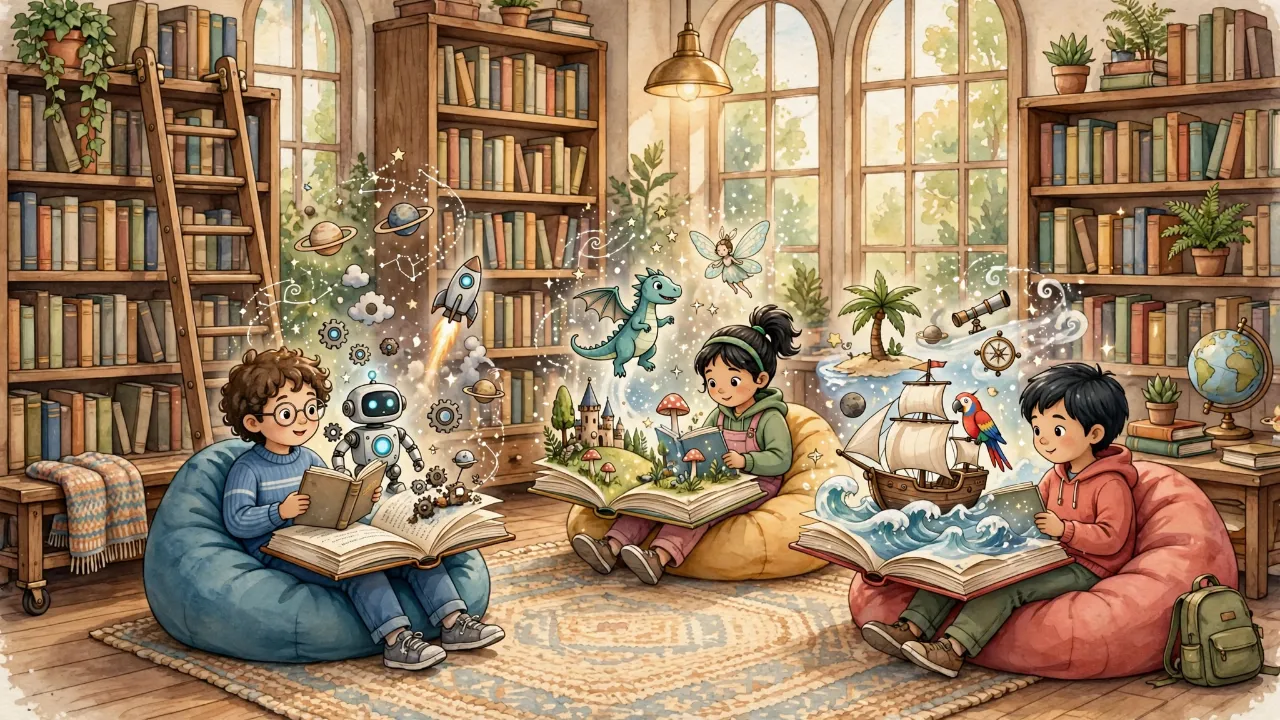
Good Books! 📚
Swim Team is about Bree. She is scared of water, but she learns to swim.
Dog Man is half dog, half police officer. So silly!
The Wild Robot lives with animals and looks after a baby goose. 🥚
What book will you read next?
Some Great Books!
Here are two fun books, and two more to try.
🏊 Swim Team
Swim Team is a graphic novel. It tells the story with pictures and words, like a comic. A girl named Bree moves to Florida. She is scared of water, but a kind neighbor named Etta teaches her to swim. Soon Bree joins the school swim team.
🏝️ Breakout! Escape from Alcatraz
Breakout! is a true story. Alcatraz was a prison on a tiny island near San Francisco. In 1962, three men dug through the walls, made a raft, and floated away in the dark. Nobody ever found them.
More Books to Try
🐶 Dog Man by Dav Pilkey. A dog and a police officer become one funny hero.
🦋 The Wild Robot by Peter Brown. A robot washes up on an island and learns to live with the animals.
Two Great Book Picks
A reader sent us a note: "Some good books to read are: Swim Team, Breakout at Alcatraz." Great taste. Here is why, plus ten more.
🏊 Swim Team by Johnnie Christmas
The story: Bree moves to Florida and lands in a swim class, even though she cannot swim and the water scares her. A neighbor named Etta, once a swim team captain, teaches her in secret. Bree turns out to be a natural, and she leads her school team against a rich rival.
Why we like it: It is a graphic novel, so you read the pictures too, and the water almost looks like it is moving. Bree and Etta become real friends across a big age gap. It also tells the true history of Black Americans kept out of pools.
Best for: ages 8 to 12.
🏝️ Breakout! Escape from Alcatraz by W.W. Murphy
The story: Alcatraz was a prison on a rocky island in San Francisco Bay, circled by cold water and strong currents. People said nobody could escape. On June 11, 1962, three men dug through their cell walls with sharpened spoons, left fake heads in their beds, floated off on a raft of raincoats, and vanished.
Why we like it: Every wild part really happened, and the book shows real photographs. The FBI never solved the case.
Best for: ages 7 to 10.
📚 Ten More Books to Try
- New Kid by Jerry Craft: Jordan draws cartoons at a fancy school where he feels out of place.
- Hatchet by Gary Paulsen: Brian survives a plane crash with one small axe.
- Percy Jackson by Rick Riordan: A boy learns his father is a Greek god.
- Wings of Fire by Tui T. Sutherland: Five young dragons escape the cave they grew up in.
- The Last Kids on Earth by Max Brallier: A treehouse, monsters, and a lot of jokes.
- Diary of a Wimpy Kid by Jeff Kinney: Greg's funny journal about middle school.
- Smile by Raina Telgemeier: A true story about knocking out her front teeth.
- Amulet by Kazu Kibuishi: A magic amulet pulls Emily into a world of robots.
- Dog Man by Dav Pilkey: A police officer and his dog become one hero.
- The Wild Robot by Peter Brown: A robot washes ashore and learns to live with wild animals.
One book a week from this list would keep you reading all year.
Two Picks, Two Genres, Both Excellent
The book recommendations that inspired this article: "Swim Team" and "Breakout at Alcatraz." One is a graphic novel about identity, community, and sports. The other is narrative nonfiction about the most famous prison escape in American history. Both are page-turners. Here's what makes them work, followed by a broader reading list.
🏊 Swim Team by Johnnie Christmas (2022)
Bree moves to Florida and gets dumped into Swim 101 at Enith Brigitha Middle School. She can't swim, she's terrified of the water, and she's the new kid. Her neighbor Etta, a former competitive swimmer now in her eighties, becomes her secret coach. Bree discovers genuine talent, joins the underfunded Mighty Manatees, and faces off against Holyoke Prep, a private school with every advantage money can buy.
Christmas layers in real history without it feeling like a lecture. The school is named after Enith Brigitha, a Curaçaoan-Dutch swimmer who was the first Black woman to medal in Olympic swimming (1976). Etta's backstory touches on segregated pools and the systemic exclusion of Black Americans from swimming, which the CDC has documented as a contributing factor to drowning disparities that persist today. Black children ages 10-14 drown at 7.6 times the rate of white children.
The art sells the water. Christmas uses panel layouts that shift from rigid grids (anxiety, school hallways) to fluid, borderless spreads (freedom, water). The underwater scenes are genuinely beautiful. Kirkus, Publishers Weekly, and Booklist all gave starred reviews.
🏝️ Breakout! Escape from Alcatraz by W.W. Murphy
June 11, 1962. Frank Morris and brothers John and Clarence Anglin crawled through holes they'd spent months carving in the concrete walls of their cells with sharpened spoons and a homemade electric drill made from a stolen vacuum cleaner motor. They climbed utility pipes to the roof, descended 50 feet, and inflated a raft made from over 50 stolen raincoats cemented together with contact adhesive. They placed papier-mâché dummy heads (painted with flesh-toned art supplies, topped with real human hair swept from the prison barbershop floor) in their bunks. Then they paddled into San Francisco Bay and were never seen again.
The FBI officially closed the case in 1979, declaring the men "presumed drowned." But the Anglin family has always maintained the brothers survived. In 2013, the San Francisco Chronicle reported that the case was reopened after the U.S. Marshals Service received a letter allegedly from John Anglin. The mystery remains unsolved. Murphy captures this tension well for a Step into Reading Level 4 book, balancing historical detail with the pacing of a thriller.
📚 10 More Books Worth Your Time
1. New Kid by Jerry Craft (2019). Jordan Banks at Riverdale Academy Day School, navigating code-switching, microaggressions, and the universal awkwardness of being the new kid. Won both the Newbery Medal and the Coretta Scott King Author Award. The first graphic novel to win the Newbery since the award started in 1922.
2. Hatchet by Gary Paulsen (1987). Brian Robeson's 54 days alone in the Canadian wilderness after a bush plane crash. Paulsen spent time in the Minnesota and Canadian wilderness himself. The survival details are accurate enough that people have used this book as a rough guide. Newbery Honor, over 4.5 million copies sold.
3. Percy Jackson and the Lightning Thief by Rick Riordan (2005). Percy has ADHD and dyslexia, which turn out to be signs of his demigod heritage. Riordan originally created Percy as bedtime stories for his son, who has ADHD and learning differences. The Greek mythology is accurate. The action is relentless. Five-book main series, plus spin-offs.
4. Wings of Fire: The Dragonet Prophecy by Tui T. Sutherland (2012). Five dragonets raised in a cave for a prophecy they didn't choose. Sutherland writes from the dragons' perspective, which works better than it should. The world-building is deep: seven dragon tribes, each with distinct abilities and cultures. Over 15 million copies sold across the series.
5. The Last Kids on Earth by Max Brallier (2015). Monster apocalypse meets middle school humor. Jack Sullivan narrates with the confidence of someone who's watched too many action movies. Hybrid format (text + illustration) makes it great for reluctant readers who want visuals but are ready for more text than a pure graphic novel.
6. Smile by Raina Telgemeier (2010). Memoir about dental trauma and middle school. Telgemeier fell face-first in sixth grade and spent years dealing with surgeries, braces, and the social consequences. Spent over 5 years on the New York Times bestseller list. Her follow-ups, Guts (anxiety) and Drama (theater kid life), are equally good.
7. Amulet: The Stonekeeper by Kazu Kibuishi (2008). Fantasy graphic novel series with genuinely cinematic art. Emily and her brother Navin follow their kidnapped mother into an underground world. The amulet gives Emily power but also slowly corrupts her. Nine books, and the moral complexity deepens with each one.
8. Dog Man by Dav Pilkey (2016). Officer Knight and his police dog Greg get surgically combined. The result is the greatest crime-fighter in history (according to Dog Man). Pilkey draws in a deliberately childlike style and includes flip-o-rama animation pages. The books also have chapters teaching kids to draw their own comics.
9. The Wild Robot by Peter Brown (2016). Roz, a robot, activates on a remote island and must learn to survive among wild animals. She adopts a gosling named Brightbill. The prose is clean and precise. Became a critically acclaimed DreamWorks animated film in 2024. Sequel: The Wild Robot Escapes.
10. Diary of a Wimpy Kid by Jeff Kinney (2007). Greg Heffley's illustrated journal about the social hierarchy of middle school. Kinney originally created it as an online comic on Funbrain.com before it became a book. 17 books, translations in 65+ languages, over 275 million copies sold worldwide. One of the best-selling children's series in history.
Two Texts, Two Rhetorical Strategies
A handwritten note recommended two books: "Swim Team" and "Breakout at Alcatraz." At first glance, a middle-grade graphic novel and a leveled reader seem like an odd pairing. But both operate through the same narrative engine: confinement leading to transformation.
🏊 Swim Team by Johnnie Christmas
Christmas uses the graphic novel medium to embed historical argument within a sports narrative. Bree's aquaphobia isn't random. It's contextualized through Etta's backstory, which references the systematic exclusion of Black Americans from public swimming pools throughout the 20th century. The historical record is well-documented: in 1964, the manager of the Monson Motor Lodge in St. Augustine, Florida poured muriatic acid into his pool while Black and white civil rights protesters were swimming together. The photograph made the front page of newspapers nationwide. Jeff Wiltse's Contested Waters (2007) traces how municipally funded pools were desegregated on paper but abandoned through white flight to private swim clubs, creating a generational gap in swimming ability that persists today.
Christmas's visual rhetoric reinforces this. Panel borders function as confinement. In early chapters, Bree's panels are tight, boxed, claustrophobic. As she gains confidence in water, panels widen and eventually dissolve entirely during swimming sequences. The school's name, Enith Brigitha, is itself a historiographic gesture. Brigitha was the first Black swimmer to win Olympic medals (two bronzes, 1976 Montreal, 100m and 200m freestyle). The East German swimmers who finished ahead of her were later revealed to have been part of a state-sponsored doping program, meaning Brigitha may have deserved gold. Naming the school after her is quiet defiance.
The book received starred reviews from Kirkus, Publishers Weekly, Booklist, and School Library Journal. It appeared on the ALA Notable Children's Books list. Within the graphic novel form, it joins Jerry Craft's New Kid in demonstrating that comics can carry the weight of serious social commentary while remaining genuine page-turners.
🏝️ Breakout! Escape from Alcatraz
The Alcatraz escape of June 11, 1962 is one of the most thoroughly investigated unsolved cases in FBI history. Frank Morris (IQ reportedly 133, convicted of bank robbery at age 13) masterminded the plan. The Anglin brothers, John and Clarence, had attempted escapes from other prisons. Allen West, the fourth conspirator, failed to fully remove his cell wall grating in time and was left behind.
The engineering is remarkable for men working with stolen materials and improvised tools. They built a 6x14-foot raft and individual life vests from over 50 raincoats, using contact cement from the prison's glue dispensary. They constructed a periscope from a stolen mirror and cardboard to monitor the guard's location. The dummy heads used a mixture of soap, toilet paper, and concrete dust, painted with flesh-toned pigments from the art program and topped with hair clippings.
The FBI's official position is that the men drowned. Evidence: a packet of letters and photos belonging to the Anglins was found floating in the Bay. The raft was never recovered. Water temperature that night was approximately 50°F (10°C), cold enough to induce hypothermia within 30-60 minutes. However, a 2014 study by Dutch scientists using hydrodynamic modeling suggested that if the men launched between 11:30 PM and midnight (consistent with the timeline), the outgoing tide could have carried them to Angel Island or Marin County. The U.S. Marshals Service keeps the case open.
Murphy's adaptation distills this complexity into accessible narrative nonfiction. For a Step into Reading Level 4 book, it maintains impressive fidelity to the historical record while generating genuine suspense. The unsolved ending is pedagogically valuable: it teaches young readers that some questions remain genuinely open.
📚 A Reading List Built on Pattern
If you liked these two, the through-line is: protagonists navigating systems that weren't built for them. Here are ten books that explore variations of that theme with increasing sophistication:
1. New Kid by Jerry Craft. Code-switching as survival strategy. Jordan performs different versions of himself for home, school, and the street. Craft uses panel composition to literalize this: Jordan is frequently drawn in between spaces, in doorways, on thresholds.
2. Hatchet by Gary Paulsen. Survival as self-discovery. The hatchet is both literal tool and metaphor. Brian's relationship with it mirrors his growing competence. Paulsen's prose is deliberately sparse, matching the environment.
3. Percy Jackson and the Lightning Thief by Rick Riordan. Neurodivergence reframed as divine inheritance. ADHD becomes battlefield reflexes. Dyslexia becomes a brain wired for ancient Greek. The metaphor is obvious but effective.
4. Wings of Fire: The Dragonet Prophecy by Tui T. Sutherland. Destined heroes who reject their destiny. The dragonets were raised to fulfill a prophecy, but the story becomes about choosing your own purpose. Subtle critique of chosen-one narratives from within the genre.
5. The Last Kids on Earth by Max Brallier. Apocalypse as liberation fantasy. Jack is an orphan bouncing between foster homes before the monsters arrive. Post-apocalyptic freedom is more appealing than his pre-apocalyptic life, and the series knows this is both funny and sad.
6. Smile by Raina Telgemeier. Memoir as exposure therapy. Telgemeier's dental trauma becomes a lens for examining middle school social dynamics. The visual medium forces her to draw herself in every humiliating moment, creating an act of vulnerability that resonates with readers experiencing their own versions of the same thing.
7. Amulet: The Stonekeeper by Kazu Kibuishi. Power and corruption in a fantasy framework. Emily's amulet gives her abilities but slowly erodes her judgment. Over nine books, Kibuishi builds a coherent argument about the relationship between power and responsibility that's more nuanced than most adult fiction on the topic.
8. Dog Man by Dav Pilkey. Deliberately subversive. Pilkey, who has ADHD and dyslexia, writes books that celebrate the exact kind of creative, rule-breaking thinking that traditional schooling punishes. The "how to draw" sections aren't filler; they're invitations to create rather than consume.
9. The Wild Robot by Peter Brown. Belonging as learned behavior. Roz has no instinct, only observation and imitation. Her journey to becoming part of the island ecosystem is a precise metaphor for immigration, adoption, or any experience of entering a community where you weren't born.
10. Diary of a Wimpy Kid by Jeff Kinney. Unreliable narrator as comedic engine. Greg Heffley is frequently wrong about social situations, and the humor comes from the gap between his self-perception and reality. Kinney lets the reader figure this out without ever breaking the first-person voice.
What Your Kid Just Recommended to You
A handwritten note: "Some good books to read are: Swim Team, Breakout at Alcatraz." Your child is curating a reading list. That impulse, the desire to share what you've read and convince others to read it too, is one of the strongest predictors of lifelong reading engagement. Let's take their picks seriously and build on them.
🏊 Swim Team by Johnnie Christmas
This graphic novel tackles a topic with real public health implications. The CDC reports that drowning is the leading cause of unintentional death for children ages 1-4. The disparity is stark: Black children ages 5-19 drown at 2.6 times the rate of white children, and in swimming pools specifically, the rate is 5.5 times higher (CDC, 2024).
This isn't genetic. It's historical. Jeff Wiltse's Contested Waters: A Social History of Swimming Pools in America (University of North Carolina Press, 2007) documents how public pools were de facto segregated through the mid-20th century. When desegregation orders came, many municipalities closed public pools rather than integrate them. Private swim clubs filled the gap for white communities. Black communities lost access. The generational effect: parents who never learned to swim couldn't teach their children, couldn't model water safety, and were statistically less likely to enroll children in swim lessons.
Christmas embeds this history in an engaging sports narrative. Bree's journey from aquaphobia to competitive swimmer is both personal triumph and structural critique. The school's name, Enith Brigitha, honors a swimmer whose achievements were initially diminished by racially charged doping accusations that were later called into question. The book has been praised by the American Library Association and appeared on multiple best-of lists.
Practical takeaway: If your child is reading Swim Team and shows interest in swimming, the Brenner et al. (2009) study in Archives of Pediatrics and Adolescent Medicine found that formal swim lessons reduced drowning risk by 88% in children ages 1-4. Swim lessons are one of the highest-impact safety investments you can make.
🏝️ Breakout! Escape from Alcatraz
Your kid is reading about one of the most famous unsolved cases in American criminal justice. The book is nonfiction and historically accurate. The 1962 escape by Frank Morris and the Anglin brothers involved genuine engineering ingenuity (homemade tools, a raincoat raft, dummy heads), and the case remains officially unsolved by the U.S. Marshals Service.
The educational value goes beyond the heist narrative. The book introduces concepts of primary sources (photographs, FBI reports), inference from incomplete evidence (did they survive?), and the difference between "presumed drowned" and "confirmed dead." These are foundational critical thinking skills for evaluating evidence and uncertainty.
📚 10 Books for the Shelf
Based on your child's two picks, they enjoy: visual storytelling, adventure with stakes, real-world connections, and stories where underdogs navigate systems bigger than themselves. Here's what to get next:
1. New Kid by Jerry Craft. First graphic novel to win the Newbery Medal (2020). Addresses race, class, and code-switching at a prestigious private school. Relatable across demographics. Ages 8-12.
2. Hatchet by Gary Paulsen. Solo wilderness survival. Newbery Honor. Paulsen drew from his own experiences living in remote Minnesota. Teaches resourcefulness and self-reliance. Ages 10-14.
3. Percy Jackson and the Lightning Thief by Rick Riordan. Greek mythology adventure. Riordan created Percy for his ADHD-diagnosed son, and the character's learning differences are portrayed as strengths. Enormous series with high re-readability. Ages 9-13.
4. Wings of Fire: The Dragonet Prophecy by Tui T. Sutherland. Fantasy series with complex world-building and moral ambiguity. 15+ books. Great for kids ready for longer series with deeper themes. Ages 9-13.
5. The Last Kids on Earth by Max Brallier. Hybrid text-and-illustration format. Monster apocalypse with humor. Animated Netflix series. Good bridge from graphic novels to prose-heavy books. Ages 8-12.
6. Smile by Raina Telgemeier. Memoir graphic novel about dental trauma and social anxiety. Telgemeier's other works (Guts, about anxiety; Drama, about theater) are equally strong. Ages 8-13.
7. Amulet: The Stonekeeper by Kazu Kibuishi. Fantasy graphic novel series with stunning art. Themes of power, responsibility, and family. Nine books. Ages 8-13.
8. Dog Man by Dav Pilkey. The creator of Captain Underpants. Deliberately silly, deliberately creative. Includes DIY comic-making tutorials. Research by Stephen Krashen and others suggests that comic reading builds vocabulary and reading stamina in reluctant readers. Ages 6-10.
9. The Wild Robot by Peter Brown. Quiet, philosophical adventure. A robot learns to belong. Themes of nature, adoption, identity. DreamWorks animated film (2024) is excellent and faithful to the source. Ages 8-12.
10. Diary of a Wimpy Kid by Jeff Kinney. Comedic journal format. Over 275 million copies sold. Often dismissed as "not real reading" by some educators, which is wrong. The illustrated journal format builds visual literacy, the humor requires inference (Greg is frequently an unreliable narrator), and the series' popularity means your child will have common ground with peers. Ages 8-12.
A Note on Reading Habits
A 2024 Scholastic Kids & Family Reading Report found that 57% of children ages 6-17 say their favorite books were ones recommended by friends or family, not by algorithms or teachers. Your child writing a handwritten list of books to read is exactly the kind of peer-to-peer recommendation that drives reading engagement. The best thing you can do: read one of the books they recommended and talk about it together.
Sources
- CDC. "Drowning Facts." cdc.gov
- Wiltse, Jeff. Contested Waters: A Social History of Swimming Pools in America. UNC Press, 2007.
- Brenner, R.A. et al. (2009). "Association between swimming lessons and drowning in childhood." Archives of Pediatrics and Adolescent Medicine, 163(3), 203-210.
- Scholastic. "Kids & Family Reading Report." 7th Edition, 2024.
- NPD BookScan. "Children's graphic novel sales data 2019-2022."
- FBI. "Escape from Alcatraz." Case file. fbi.gov
- Krashen, Stephen. The Power of Reading. Libraries Unlimited, 2004.