
🍬🍫
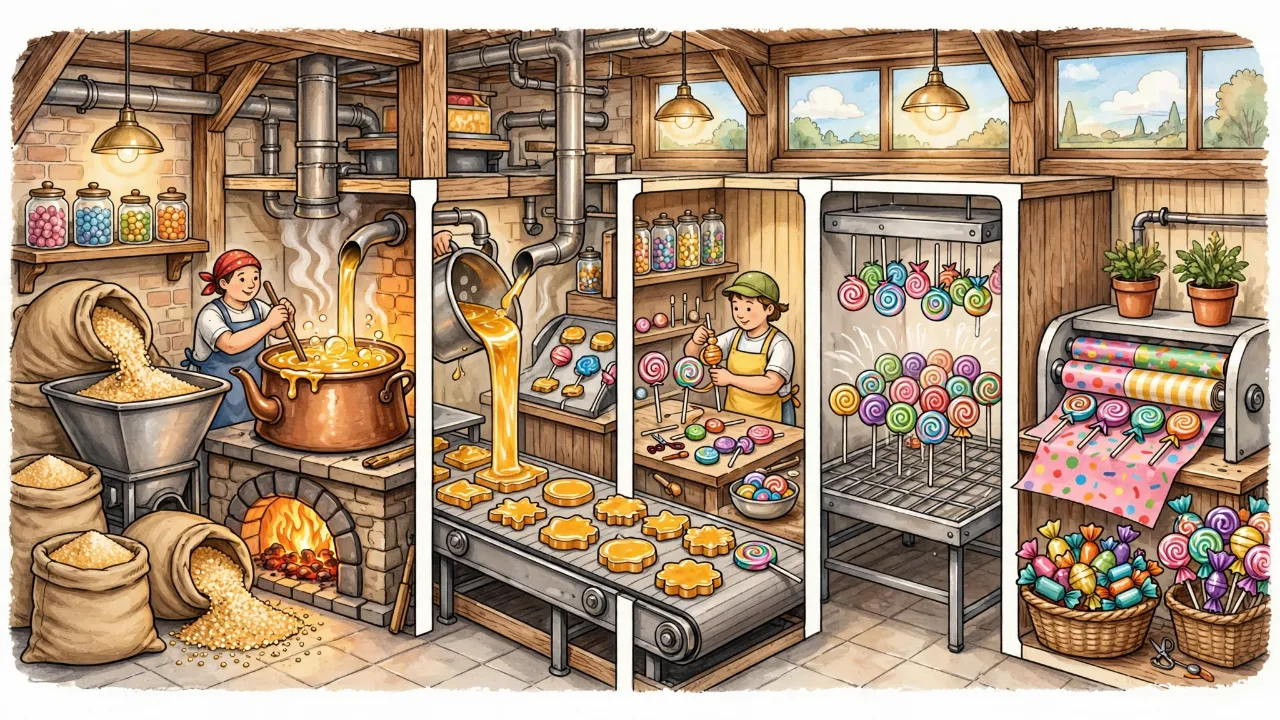
Candy is made from sugar! Sugar comes from a tall plant called sugarcane. 🌿
When you cook sugar, it can become gooey, hard, or stretchy! 😮
What is YOUR favorite candy? 🌈🤤
What Is Candy Made Of?
Almost all candy starts with sugar, a white crystal that tastes sweet. Heat sugar in water and it melts into a syrup.
Soft Candy and Hard Candy
Cook sugar a little, and it stays soft and chewy, like caramel or taffy. Cook it a lot, and it gets super hard, like lollipops and candy canes.
Why Does Chocolate Melt?
Chocolate is made to melt right at body temperature. That is why it feels smooth and creamy in your mouth, and why it turns into a puddle in the sun. ☀️🍫
Cotton Candy Magic
Cotton candy is melted sugar spun really fast. It flies out through tiny holes as thin threads that look like a fluffy cloud. Cotton candy is mostly air, so a huge puff weighs almost nothing. 🎀
Candy Is Chemistry!
Every piece of candy you eat is the result of a chemistry experiment. Seriously! Candy-making is all about what happens when you heat sugar to different temperatures. The science is so precise that professional candy makers use thermometers just like scientists use in labs.
The Temperature Secret
Sugar behaves differently at different temperatures. Candy makers have special names for each stage:
- Thread stage (230°F): Thin, syrupy, used for glazes
- Soft ball (240°F): Squishy like fudge
- Firm ball (250°F): Chewy like caramel
- Hard ball (260°F): Stretchy like taffy and nougat
- Soft crack (270°F): Bendy like butterscotch
- Hard crack (300°F): Shatter-hard like lollipops and candy canes
The Chocolate Story
Chocolate comes from cacao beans, which grow inside large pods on cacao trees in tropical countries like Ghana, Côte d'Ivoire, and Ecuador. The beans are fermented, dried, roasted, and ground into a paste called chocolate liquor (no alcohol!). This paste is then mixed with sugar, milk, and cocoa butter to make the chocolate bars we know.
One of chocolate's coolest properties is its melting point: about 93°F (34°C), just below human body temperature (98.6°F). That is why chocolate literally melts in your mouth but stays solid in your hand. Well, mostly!
Gummy Bears: A Wobbly Wonder
Gummy candies get their bounce from gelatin, a protein made by boiling animal bones and skin (yes, really!). Gelatin molecules form a tangled web that traps water and sugar, creating that signature gummy wobble. Each gummy bear contains about 2% gelatin, enough to hold its shape but soft enough to chew.
How Much Candy Do We Eat?
The average American eats about 25 pounds of candy per year. That's roughly the weight of a medium dog! Halloween alone accounts for about $4.6 billion in candy sales in the US. The most popular Halloween candy? Reese's Peanut Butter Cups, followed by M&Ms and Snickers.
Sugar Science: Why Candy Works
Candy-making is applied chemistry, and the central molecule is sucrose (C₁₂H₂₂O₁₁), a disaccharide composed of glucose and fructose linked by a glycosidic bond. Everything that happens in candy-making, from fudge to lollipops to caramel, comes down to how you manipulate sucrose's behavior in water at different temperatures.
Supersaturation and Crystallization
The key concept is supersaturation. Sugar's solubility in water increases with temperature. At room temperature, you can dissolve about 200g of sugar in 100mL of water. At 100°C (boiling), you can dissolve about 480g. When you heat a sugar solution, dissolve more sugar than cold water could hold, then cool it down, you've created a supersaturated solution, an unstable state where there's more dissolved sugar than the water "wants" to hold.
What happens next determines what candy you get:
- Controlled crystallization → Fudge, fondant. You cool the syrup while stirring, encouraging many small crystals to form simultaneously. Smaller crystals = smoother texture. Good fudge has crystals smaller than 25 micrometers, below what your tongue can detect individually, which is why it feels creamy.
- No crystallization → Hard candy, lollipops. You heat sugar past 300°F (hard crack stage), then cool it rapidly without disturbing it. The sugar molecules don't have time to organize into crystals. Instead, they freeze in a disordered state: an amorphous solid, technically a glass. Hard candy is sugar glass.
Caramelization vs. Maillard Reaction
Two different browning reactions are responsible for candy flavors:
- Caramelization: Pure sugar decomposition at 320-360°F. Sucrose breaks down into hundreds of compounds, including diacetyl (buttery flavor), furanones (caramel flavor), and maltol (toasty). This is what happens when you make caramel from plain sugar.
- Maillard reaction: A reaction between sugars and amino acids (proteins) at 280-330°F. This produces even more complex flavors and brown colors. This is what makes toffee (sugar + butter, which contains milk proteins) taste different from plain caramel.
Chocolate Tempering
Chocolate tempering is one of the most demanding processes in candy-making. Cocoa butter, the fat in chocolate, can crystallize into six different crystal forms (polymorphs), numbered I through VI. Only Form V produces chocolate with the properties we want: glossy appearance, clean snap, smooth mouthfeel, and melting point just below body temperature.
Tempering involves heating chocolate to melt all crystals (about 50°C), cooling it to encourage Form IV and V crystal formation (27°C), then gently reheating to melt the unstable Form IV crystals while keeping Form V (31°C). When the chocolate sets, it's dominated by Form V crystals. If you just melt and cool chocolate randomly, you get a mix of polymorphs, resulting in dull, crumbly chocolate with white "bloom" on the surface, harmless but unappetizing.
The Candy Industry
The global confectionery market is worth over $230 billion annually. The industry is remarkably concentrated: Mars, Mondelēz International (Cadbury/Oreo), Nestlé, Ferrero, and Hershey control the majority of the global market. The most produced candy ingredient globally is cocoa, with about 5 million metric tons harvested annually, approximately 70% from West Africa, where labor practices, including child labor, remain a serious and ongoing concern.
Candy: Materials Science You Can Eat
Candy-making is arguably the oldest form of materials science practiced by humans. Every confectionery process (crystallization, glass transition, emulsification, polymorphic control) has a direct analogue in industrial materials engineering. Understanding candy means understanding phase transitions, nucleation kinetics, and polymer science. The fact that the end product is delicious is a bonus.
Phase Transitions in Sugar Solutions
The "candy stages" (thread, soft ball, hard ball, soft crack, hard crack) correspond to water activity levels in the final product. As a sugar solution is heated, water evaporates, increasing sugar concentration. The boiling point rises with concentration (boiling point elevation, a colligative property). At each stage, the ratio of sugar to water determines the physical properties of the cooled product:
- Soft ball (112-116°C): ~85% sugar by weight. Enough water remains for sugar crystals to form in a soft matrix. Product: fudge, pralines.
- Hard crack (146-154°C): ~99% sugar. Almost no water remains. Sugar solidifies as an amorphous glass rather than a crystalline solid because molecular mobility is too low for crystal nucleation at this concentration. Product: lollipops, brittles.
Chocolate Polymorphism
Cocoa butter's six polymorphic forms are a textbook case of polymorphism in lipid crystallography. The crystal forms differ in molecular packing arrangement and, consequently, in melting point, density, and mechanical properties:
- Form I: Tm = 17.3°C (unstable, grainy)
- Form II: Tm = 23.3°C (unstable, soft)
- Form III: Tm = 25.5°C (unstable)
- Form IV: Tm = 27.3°C (somewhat stable)
- Form V: Tm = 33.8°C (stable, glossy, good snap: the target)
- Form VI: Tm = 36.3°C (most stable thermodynamically, but causes bloom)
Tempering is a controlled crystallization process: the chocolatier creates a specific thermal history that nucleates Form V crystals preferentially. The process exploits Ostwald's rule of stages: metastable polymorphs tend to crystallize first, then transform to more stable forms over time. Proper tempering seeds the chocolate with Form V nuclei, ensuring that this form dominates in the final product. The transformation from Form V to Form VI (bloom) occurs slowly at room temperature over weeks to months, which is why stored chocolate eventually develops a white surface coating.
Gelatin and Hydrocolloid Science
Gummy candies exploit the properties of gelatin, a protein derived from partial hydrolysis of collagen. Gelatin forms thermoreversible gels: the protein chains create a triple-helix structure at temperatures below ~35°C, trapping water in a three-dimensional network. Above ~35°C, the helices denature and the gel melts, which is why gummy candy softens and becomes sticky in your mouth.
The gummy candy industry has driven significant innovation in hydrocolloid chemistry. Alternatives to gelatin (which is not vegetarian) include pectin (from fruit cell walls), starch (corn, tapioca), carrageenan (from seaweed), and agar (also seaweed). Each produces a different texture: pectin gummies are shorter and more brittle; starch-based gummies are softer and stickier; agar gummies are firmer and more elastic. The formulation challenge is matching gelatin's unique combination of clarity, elasticity, body-temperature melting, and flavor release.
The Neuroscience of Sugar Craving
Sugar activates the brain's reward system through a well-characterized pathway. Sweet taste receptors (T1R2/T1R3 heterodimer) on the tongue send signals via the gustatory cortex to the nucleus accumbens, triggering dopamine release. This is the same reward circuitry activated by social bonding, achievement, and, notably, addictive drugs. The question of whether sugar is "addictive" in the clinical sense is debated: rat studies show binge/withdrawal/craving cycles with intermittent sugar access (Avena et al., 2008), but human studies are less clear-cut, and the American Psychiatric Association does not currently recognize sugar addiction as a diagnosis.
What is not debated is that the human preference for sweetness is innate and universal. Neonates (within hours of birth, before any learning) show positive facial responses to sweet solutions and negative responses to bitter ones. This makes evolutionary sense: in the ancestral environment, sweetness correlated with caloric density and the absence of toxins. The candy industry, in essence, exploits a cognitive shortcut that served our ancestors well in a calorie-scarce environment but misfires in a world of abundant refined sugar.
Ethics: Cocoa and Child Labor
The chocolate supply chain has a documented child labor problem that the industry has repeatedly pledged, and failed, to solve. The Harkin-Engel Protocol (2001) was a voluntary agreement by major chocolate companies to eliminate the "worst forms of child labor" from West African cocoa production by 2005. The deadline was extended to 2008, then 2010, then 2020. NORC's 2020 assessment found approximately 1.56 million children in hazardous child labor in cocoa production in Côte d'Ivoire and Ghana. The problem has not been solved; by some metrics, it has worsened as cocoa production expanded.
Certification schemes (Fair Trade, Rainforest Alliance, UTZ) cover a fraction of global production and have shown mixed results on child labor reduction. The fundamental economic driver is that cocoa farmers earn an average of $1-2 per day, well below the poverty line, making child labor an economic necessity for many families. Structural solutions (living income pricing, mandatory due diligence legislation, as in the EU's forthcoming Corporate Sustainability Due Diligence Directive) address root causes more directly than consumer certification labels.
Candy: The Materials Science, Neuroscience, and Human Cost of Sweet Things
Writing about candy for kids is fun. Writing about candy for adults means grappling with the fact that one of childhood's simplest pleasures sits at the intersection of sophisticated food science, neurochemistry, and serious human rights issues. All three threads are worth pulling.
Sugar as Material
Candy-making is materials engineering in a kitchen. The core principle is that sucrose solutions behave as a phase diagram: water content, temperature, and cooling rate determine whether the final product is crystalline (fudge, rock candy), amorphous/glassy (hard candy, lollipops), or a controlled emulsion (caramel, toffee). A candy thermometer is literally measuring position on a phase diagram.
The most fascinating example is hard candy as a glass. Glasses are not crystals: they're supercooled liquids in which molecular motion has become so slow that the material behaves as a solid without ever achieving crystalline order. Hard candy has a glass transition temperature (Tg) of approximately 60-65°C for pure sucrose systems, modifiable by the addition of glucose syrup (which acts as a plasticizer and crystal inhibitor). Below Tg, hard candy is brittle with a characteristic conchoidal fracture pattern. Above Tg, it flows. This is identical in principle to silicate glass (windows), metallic glasses (specialty alloys), and polymer glasses (plastics). The physics is universal; the candy just tastes better.
Chocolate: A Polymorphism Case Study
Cocoa butter's six crystal polymorphs are the standard example used in food science textbooks to teach polymorphism, and for good reason: the practical differences between forms are immediately perceptible. Form V (Tm = 33.8°C, stable, glossy, good snap) is the target of tempering. Form VI (Tm = 36.3°C, thermodynamically most stable) produces surface bloom, that white, chalky coating on old chocolate.
The physical chemistry of tempering was worked out in detail by Wille and Lutton (1966) and refined by subsequent work using differential scanning calorimetry (DSC) and X-ray diffraction (XRD). The process exploits the kinetics of nucleation and crystal growth: by cycling through specific temperatures, the chocolatier preferentially nucleates Form V crystals, which then serve as templates for the bulk of the crystallizing fat. It's a process that experienced chocolatiers have done by intuition for centuries; the science came after the practice, not before it.
Industrial chocolate manufacturing has largely automated tempering using continuous tempering machines that precisely control the thermal profile. But artisan chocolatiers still temper by hand, testing readiness by spreading a small amount on marble and observing the set time and gloss, a sensory evaluation that correlates with Form V crystal content.
Sugar and the Brain
The neuroscience of sugar reward is well-characterized at the receptor and circuit level. Sweet taste perception begins with the T1R2/T1R3 heterodimeric receptor on type II taste cells. Signal transduction proceeds via gustducin (a G-protein) → phospholipase Cβ2 → IP3 → TRPM5 cation channel → ATP release → afferent nerve activation. The signal projects to the nucleus of the solitary tract, then to the gustatory cortex (insula/operculum), and from there to the nucleus accumbens and ventral tegmental area: the mesolimbic dopamine pathway.
The "sugar addiction" debate is genuinely unresolved. Avena, Rada, and Hoebel's 2008 rat studies demonstrated that intermittent access to sugar solutions produced dopamine surges in the nucleus accumbens that diminished over time (tolerance), behavioral signs of withdrawal when sugar was removed, and cross-sensitization with drugs of abuse. But rat models of addiction have significant translational limitations: rats in these studies were food-restricted, the access pattern (12h deprivation/12h access) was designed to maximize binge behavior, and the neurochemical responses, while real, are quantitatively smaller than those produced by drugs like cocaine or amphetamine. The scientific consensus, as expressed by the 2019 NeuroFAST consensus paper, is that "sugar addiction" is not supported as a clinical entity, but that processed food more broadly can produce patterns of compulsive consumption in susceptible individuals.
The Cocoa Supply Chain Problem
Any honest adult-level treatment of candy must address the labor conditions that produce its core ingredient. Approximately 60% of the world's cocoa comes from Côte d'Ivoire and Ghana. The NORC/University of Chicago 2020 survey (funded under the Harkin-Engel Protocol) found approximately 1.56 million children engaged in hazardous child labor in cocoa production in these two countries, an increase from the previous 2013-14 survey. The children are primarily the farmers' own children, not trafficked (though trafficking exists), and the root cause is poverty: the average cocoa farmer earns approximately $1,900 per year, far below any reasonable living income estimate.
The industry's response has been a 25-year cycle of voluntary pledges, missed deadlines, and repackaged commitments. The Harkin-Engel Protocol (2001) set a 2005 deadline for eliminating the worst forms of child labor. It failed. The deadline was extended to 2008 (failed), 2010 (failed), and then replaced by a "framework of action" targeting a 70% reduction by 2020 (also failed by the NORC survey's measurement). Individual companies (Mars, Nestlé, Hershey, Mondelēz, Ferrero) have their own sustainability programs, but the aggregate numbers have not improved.
The most promising structural approaches are: (1) EU Corporate Sustainability Due Diligence Directive (adopted 2024), which makes companies legally liable for human rights abuses in their supply chains; (2) Living income differential pricing, as attempted by Côte d'Ivoire and Ghana's joint $400/ton premium on cocoa starting in 2020; and (3) Direct-trade models used by craft chocolate makers (e.g., Dandelion, Raaka, Taza) that pay farmers multiples of the commodity price. The structural problem remains that the global chocolate market is a buyer's oligopsony: a handful of companies control purchasing, giving individual farmers no pricing power.
Sources
- Hartel, R.W. Crystallization in Foods. Springer (2001).
- Beckett, S.T. The Science of Chocolate. Royal Society of Chemistry (3rd ed., 2018).
- Wille, R.L., Lutton, E.S. "Polymorphism of cocoa butter." Journal of the American Oil Chemists' Society, 43(8), 491-496 (1966).
- Avena, N.M., Rada, P., Hoebel, B.G. "Evidence for sugar addiction: Behavioral and neurochemical effects of intermittent, excessive sugar intake." Neuroscience & Biobehavioral Reviews, 32(1), 20-39 (2008).
- Hebebrand, J., et al. "'Eating addiction', rather than 'food addiction', better captures addictive-like eating behavior." Neuroscience & Biobehavioral Reviews, 47, 295-306 (2014).
- NORC at the University of Chicago. "Assessing Progress in Reducing Child Labor in Cocoa Production in Cocoa Growing Areas of Côte d'Ivoire and Ghana." (2020).
- Fountain, A.C., Hütz-Adams, F. "Cocoa Barometer 2022." VOICE Network.
- Minifie, B.W. Chocolate, Cocoa and Confectionery: Science and Technology. Springer (3rd ed., 1989).
- EU Corporate Sustainability Due Diligence Directive (CSDDD), adopted 2024.