
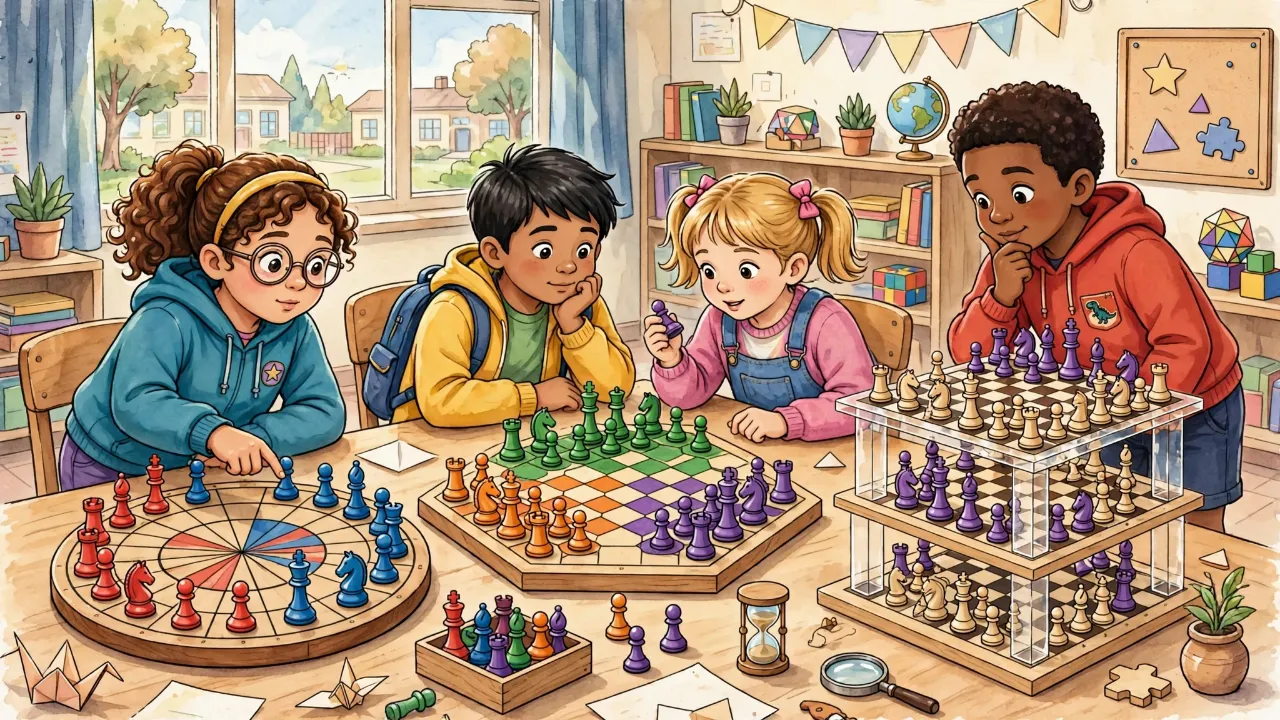
♟ Chess is a game with kings, horses, and towers!
What if the pieces start in new spots? That is a chess variant! Same game, new way! 🎲
Some games let pieces go BOOM! 💥 Some use TWO boards at once! You can play chess so many ways!
What Is a Chess Variant?
Regular chess always starts the same way. A chess variant changes the rules. Some mix up where the pieces start. It is a game you know with a fun twist. 🔀
What Is Chess960?
A famous player named Bobby Fischer thought chess had gotten boring. So he shuffled the back row into a random order before every game. There are 960 ways to set it up. 🎲
Other Fun Versions
In Bughouse, you play on two boards with a partner and use the pieces your partner captures. In Atomic Chess, a capture goes boom and clears the squares nearby. 💥 In King of the Hill, you win by walking your king to the middle.
Why Make New Versions?
Trying new things is fun. You can even make up your own rules with friends. 🧠✨
Why Change Chess?
Chess has been played for about 1,500 years, and the modern rules have been mostly the same since the late 1400s. That is a LONG time to play one game the same way! Over the centuries, players have invented hundreds of variants that change the starting position, the rules, the board shape, or even how many players can join. These variants keep chess feeling fresh and force players to think creatively instead of relying on memorized moves.
Fischer Random (Chess960)
Bobby Fischer is one of the greatest chess players in history. He became World Champion in 1972 by beating Boris Spassky in a match that the whole world watched. But later in life, Fischer became frustrated. He believed top-level chess had turned into a contest of who could memorize more opening moves from books, not who could think better at the board.
In 1996, Fischer announced his solution: randomize the starting position. In Fischer Random (also called Chess960), the eight pieces on each player's back row are shuffled into one of 960 possible arrangements. The only rules are that the king must be between the two rooks, and the two bishops must be on different colored squares. Pawns stay in their normal spots. After that, you play regular chess!
Bughouse Chess
Bughouse is played by four people on two boards. You team up with a partner who sits at the other board and plays the opposite color. When your partner captures a piece, they hand it to you, and on your turn you can place it anywhere on your board instead of making a normal move! Games are fast and loud because partners are constantly yelling at each other to capture specific pieces they need.
More Wild Variants
Crazyhouse: Like Bughouse, but for two players on one board. When you capture a piece, you can later place it on the board as your own.
King of the Hill: You can win by checkmate OR by moving your king to one of the four center squares (d4, d5, e4, e5). This completely changes strategy because suddenly the king wants to go forward, not hide.
Atomic Chess: When a piece is captured, it "explodes" and removes ALL pieces on the surrounding squares (except pawns). You can even win by blowing up the enemy king!
Three-Check Chess: Give check three times and you win, even without checkmate. This makes aggressive play much more important.
Why Variants Matter
Playing variants makes you a better chess thinker. Instead of memorizing opening sequences, you have to calculate, improvise, and adapt. Many grandmasters play Fischer Random to sharpen their skills. The World Fischer Random Championship has been an official event since 2019, with world champions like Magnus Carlsen competing.
The Problem Fischer Saw
By the late 20th century, competitive chess at the highest levels had become heavily dependent on opening preparation. Top grandmasters would memorize 20, 30, or even 40 moves deep into specific openings, relying on computer analysis to find tiny advantages in positions that had been played thousands of times before. Bobby Fischer, who had beaten Boris Spassky for the World Championship in 1972 in one of the most famous intellectual contests in history, grew increasingly disillusioned. He argued that chess was "dying" because creativity at the board was being replaced by rote memorization at home.
Fischer's frustration was not just philosophical. Opening theory had exploded in volume after the rise of chess databases in the 1980s and 1990s. A player who spent more time studying known positions gained a significant advantage before any original thinking even began. Fischer wanted to level the playing field by making preparation impossible.
How Chess960 Works
In 1996, Fischer publicly unveiled his variant in Buenos Aires. The rules are simple: the eight back-rank pieces are arranged randomly for each game, subject to three constraints. First, the king must be placed somewhere between the two rooks (so that castling is always possible). Second, the two bishops must occupy squares of different colors (one on a light square, one on a dark square), preserving the bishop's fundamental role. Third, both players get the same arrangement (White's setup is mirrored on Black's side).
Castling in Chess960 works differently from standard chess. Regardless of where the king and rooks start, castling always moves the king and rook to the same final squares as in regular chess (king to c1/g1, rook to d1/f1). This can look strange when the king barely moves or when the rook jumps over multiple pieces, but it preserves the strategic purpose of castling: king safety and rook activation.
The Bughouse Phenomenon
Bughouse chess is arguably the most popular social chess variant in the world. It requires four players and two boards. Partners sit next to each other, one playing White and the other Black. Captured pieces are passed to your partner, who can place them on their board as their own pieces on any open square (with the restriction that pawns cannot be placed on the first or eighth rank).
The strategic implications are significant. Material advantage on one board can mean nothing if your partner is losing badly on the other. Communication between partners is legal and constant: "I need a knight!" or "Don't trade bishops!" Bughouse rewards tactical alertness, speed (it is almost always played with very short time controls), and teamwork. It is enormously popular at chess clubs, schools, and online platforms like lichess.org, where thousands of bughouse games are played daily.
Crazyhouse and the Drop Mechanic
Crazyhouse adapts the bughouse concept for two players. When you capture an opponent's piece, it goes into your "reserve" and can be placed on the board later as one of your own pieces. This fundamentally changes how the game works. In standard chess, trading pieces usually simplifies the position and reduces attacking chances. In Crazyhouse, captures give you more ammunition. A player who is behind in material on the board might have a massive advantage in reserve pieces, ready to drop them into the opponent's position for a devastating attack.
Explosive, Vertical, and Three-Check
Atomic Chess adds a destruction mechanic: every capture creates an "explosion" that destroys all non-pawn pieces on the eight surrounding squares, including the capturing piece itself. If the explosion catches the enemy king, the game is over. This means that trading queens on adjacent squares would destroy both queens, both capturing pieces, and anything else nearby. Strategy revolves around proximity and chain reactions.
King of the Hill adds an alternative win condition: move your king to d4, d5, e4, or e5. In standard chess, the king spends most of the game hiding behind pawns. In King of the Hill, the king becomes an active piece that marches toward the center. This creates fascinating tension between protecting your king and advancing it aggressively.
Three-Check Chess rewards aggressive play by letting you win after delivering check three times, even without achieving checkmate. Every check counts, which means piece sacrifices that deliver check become much more valuable. Defensive play becomes riskier because you are always just a few checks from losing.
Why Variants Keep Growing
Online platforms have been a massive accelerator for chess variants. Lichess.org, one of the largest free chess servers, offers Chess960, Crazyhouse, King of the Hill, Three-Check, Atomic, Antichess (where you try to LOSE all your pieces), and Racing Kings (where both kings race to the eighth rank) with full matchmaking and ratings. Chess.com hosts regular Chess960 tournaments. The World Fischer Random Championship, organized by FIDE (the international chess federation), has been held annually since 2019, with prize pools exceeding $400,000. Magnus Carlsen, the highest-rated classical chess player in history, has been a vocal advocate for Fischer Random, saying it better tests pure chess understanding.
Fischer's Diagnosis of Classical Chess
Bobby Fischer's critique of standard chess was not the complaint of a casual player bored with the game. It came from arguably the most talented chess player of his generation, someone with an estimated peak rating above 2780 (using retroactive Elo calculations), who had won the 1972 World Championship by defeating Boris Spassky 12.5 to 8.5 in Reykjavik. Fischer's argument was specific: the opening phase of competitive chess had calcified into a contest of preparation depth rather than board skill. By the 1990s, grandmaster games routinely followed known theoretical lines for 25 or more moves before original play began. Fischer called this "prearranged chess" and proposed randomization as the cure.
Fischer's solution was not entirely novel. Shuffling starting positions had been proposed before (notably by Benko in 1978), but Fischer's specific constraint system (king between rooks, bishops on opposite colors) was elegant because it preserved castling rights and bishop dynamics while eliminating opening theory. The name "Chess960" came from Hans-Walter Schmitt, who organized Fischer's 1996 announcement event in Buenos Aires.
The Combinatorics of 960
The derivation of 960 starting positions is a clean combinatorial exercise. Place one bishop on one of 4 light squares and the other on one of 4 dark squares: 16 configurations. The queen goes on one of the 6 remaining squares. The two (identical) knights fill 2 of the remaining 5 squares: C(5,2) = 10 ways. The final 3 squares receive king and two rooks, and the constraint that the king sits between both rooks allows exactly 1 valid assignment. Total: 4 x 4 x 6 x 10 x 1 = 960.
Bughouse: Game Theory of a Team Sport
Bughouse introduces game-theoretic complexity that is absent from standard chess. Each player's optimal move depends not only on their own board state but on their partner's board state, their partner's time situation, the pieces available in reserve, and the pieces their partner needs. This creates a coordination problem that is computationally intractable: the game tree branches not just across two boards but across the communication channel between partners.
The drop mechanic (placing captured pieces) has profound implications for material evaluation. In standard chess, piece values are relatively stable: a queen is worth approximately 9 pawns, a rook 5, a bishop or knight 3. In bughouse and crazyhouse, these values shift dramatically. Knights become extremely powerful drop pieces because they can immediately threaten squares that are hard to defend. Pawns gain value because they can be dropped to create passed pawns or block critical squares. Queens, while still strong on the board, are dangerous to trade because the opponent's partner gains an enormously powerful drop piece.
Atomic Chess: Strategic Fragility
Atomic chess transforms the strategic landscape by making every capture a destructive event. The explosion mechanic (destroying all non-pawn pieces adjacent to the capture square, including the capturing piece) means that piece proximity becomes a liability. Connected pieces, which are generally advantageous in standard chess, become vulnerable to chain-reaction captures. The opening theory of atomic chess is radically different: early pawn moves must avoid creating situations where a capture near the king triggers a fatal explosion. The variant has a small but dedicated competitive community, primarily on lichess.org, where atomic chess ratings regularly exceed 2500 for top players.
Historical Context: Variants Through the Ages
Chess variants are as old as chess itself. Shatranj, the Arabic predecessor to modern chess, was itself a variant of the Indian game chaturanga (circa 600 CE). When the game reached Europe in the medieval period, different regions played by different rules. The modern "mad queen" rules (where the queen gained its long-range movement) emerged in Spain and Italy around 1475 and rapidly displaced older variants because they produced more dynamic games.
Capablanca Chess (proposed by world champion Jose Raul Capablanca in the 1920s) added two new pieces (the archbishop and the chancellor) on a 10x8 board, arguing that standard chess would eventually be "played out" as opening theory expanded. Capablanca's prediction was premature for his era, but Fischer made essentially the same argument 70 years later with more evidence behind it.
More recent innovations include Horde Chess (one side has 36 pawns against a standard army), Duck Chess (both players share a rubber duck piece that must be moved after each turn and blocks any square it occupies), and Chess Boxing (alternating rounds of chess and boxing, with victory possible in either discipline). The sheer variety reflects the game's adaptability and the creative energy of its player community.
The FIDE World Fischer Random Championship
FIDE officially recognized Fischer Random as a competitive discipline by establishing the World Fischer Random Championship in 2019. The inaugural event, held in Hovikodden, Norway, was won by Wesley So, who defeated Magnus Carlsen in the final. Carlsen won in 2022. The events carry significant prize money ($400,000 or more) and attract the world's top players. Carlsen has repeatedly stated that Fischer Random produces "purer" chess because it forces players to evaluate positions from scratch rather than retrieving memorized analysis.
The championship's existence has accelerated adoption. Major online platforms now offer rated Fischer Random play, and the number of Chess960 games played on lichess.org has grown significantly since 2019. Whether Chess960 will eventually replace standard chess at the highest level (as Fischer hoped) remains to be seen, but it has clearly established itself as the most serious alternative to the classical game.
The Memorization Arms Race
The professionalization of chess opening preparation represents one of the clearest cases of an intellectual activity being transformed by technology in ways that arguably undermine its core purpose. By the time Bobby Fischer re-emerged publicly in the 1990s after two decades of seclusion, the chess landscape had been reshaped by databases (ChessBase, founded 1985), increasingly powerful engines (Deep Blue defeated Kasparov in 1997), and a publication culture that analyzed every grandmaster game and disseminated novelties at unprecedented speed. Analyses by de Groot and Gobet estimated that top grandmasters routinely prepare 25 to 35 moves of specific opening theory for each game, compared to perhaps 10 to 15 moves in Fischer's competitive era.
Fischer's response, unveiled at a press conference in Buenos Aires on June 19, 1996, was characteristically radical: eliminate the fixed starting position entirely. His variant (originally called "Fischerandom" and later standardized as "Chess960" by FIDE) randomizes the back-rank piece placement subject to three constraints that preserve the game's strategic DNA. The king must sit between both rooks (enabling castling in all positions). The bishops must occupy squares of opposite color (maintaining the complementary bishop dynamic). Both sides receive mirror-image positions (preserving first-move advantage parity). These constraints yield exactly 960 valid starting arrangements, one of which is the standard position.
Why 960 Is the Right Number
The combinatorial derivation is clean. Place one bishop on one of 4 light squares (4 choices) and one on one of 4 dark squares (4 choices): 16 configurations. Of the remaining 6 squares, place the queen (6 choices) and two indistinguishable knights (C(5,2) = 10 choices). The final 3 squares receive king and two rooks. The king must sit between both rooks, and for any ordered set of 3 remaining squares, there is exactly 1 valid assignment (the middle position gets the king). Total: 4 x 4 x 6 x 10 x 1 = 960.
The Empirical Case for Randomization
Data from elite classical chess supports Fischer's concern. In the Ruy Lopez, average games follow established theory for roughly 18 moves before diverging. In the Najdorf Sicilian, the figure is closer to 22 moves. In hyper-theoretical lines (the Marshall Attack, certain Anti-Berlin structures), preparation routinely extends past move 30. At the 2021 World Championship match between Carlsen and Nepomniachtchi, computer evaluation showed that both players' moves matched Stockfish's top recommendation for the first 15 to 20 moves in most games, a consequence of both players having prepared with the same engine.
Fischer Random disrupts this pattern entirely. In the 2019 World Fischer Random Championship, the average "book" depth was effectively zero: every position was novel from move one. Post-game analysis showed a measurably higher rate of creative and suboptimal play (players finding original solutions rather than recalling memorized ones), which is precisely the outcome Fischer intended. Whether this constitutes "better" chess is a value judgment, but it is undeniably a different cognitive exercise.
The Variant Ecosystem
Chess960 is the most institutionally serious variant, but it sits within a vast ecosystem of rule modifications that collectively illuminate which aspects of chess are load-bearing and which are contingent.
Bughouse and Crazyhouse introduce piece drops (placing captured pieces on the board as your own), which inverts the standard material calculus. In classical chess, trading pieces generally favors the side with a strategic advantage; in drop variants, every capture provides future ammunition, making tactics more volatile and material evaluation situation-dependent. Bughouse's team dimension (four players, two boards, partner communication) adds a coordination problem with no analogue in standard chess. Crazyhouse adapts this for solo play and has developed its own sophisticated theory, particularly around the value of pawns (enormously powerful as drop pieces because they can create immediate passed pawn threats).
Atomic Chess modifies the capture mechanic: every capture destroys all non-pawn pieces on adjacent squares, including the capturing piece. This transforms piece coordination from an asset to a liability (clustered pieces become vulnerable to chain-reaction explosions) and makes king safety a geometric problem rather than a structural one. The variant has a small but serious competitive community on lichess.org.
King of the Hill and Three-Check add alternative win conditions (reach the center squares; deliver three checks) that redirect strategic priorities. King of the Hill makes the king an active attacking piece rather than a liability, while Three-Check rewards tactical aggression over positional accumulation.
Historical variants provide perspective on chess's evolution. Shatranj (the Arabic predecessor to modern chess, standardized circa 700 CE) featured much weaker pieces: the queen moved only one square diagonally, and the bishop jumped exactly two squares diagonally. The "mad queen" reform of approximately 1475 (Spain/Italy) created modern chess essentially overnight, and older variants vanished within decades because the new rules produced more dynamic play. Capablanca's 10x8 variant (1920s), Omega Chess, and Grand Chess (10x10 board) attempted to refresh the game by expanding it. Fischer's insight was that refreshing the game required less, not more: keep the pieces, keep the rules, just shuffle the starting arrangement.
Institutional Adoption and the Future
FIDE's establishment of the World Fischer Random Championship in 2019 marked a turning point. The inaugural event in Hovikodden, Norway (won by Wesley So over Carlsen in the final) carried a $400,000 prize fund and attracted an elite field. Subsequent events have maintained this profile, with Carlsen winning in 2022. Carlsen's vocal advocacy has been influential: he has called Fischer Random "the future of chess" and suggested that it may eventually surpass classical chess as the primary competitive format.
Online adoption data supports the trend. Chess960 play on major platforms has grown from approximately 2 million games in 2019 to well over 10 million annually on lichess.org alone. Chess.com has integrated Fischer Random into its daily and weekly tournament schedules. At the amateur level, chess clubs and scholastic programs increasingly incorporate variants both for their entertainment value and for their pedagogical benefits: variants force students to apply general principles rather than memorized patterns, which arguably accelerates chess understanding.
Whether Fischer Random will displace classical chess is unclear and perhaps the wrong question. The more interesting development is the normalization of the idea that chess rules are not sacred. Chess is a game, games have rules, and rules can be changed. The result, across hundreds of variants spanning 1,500 years, is an ecosystem that tests different cognitive skills, rewards different play styles, and keeps the oldest strategy game in the world persistently, stubbornly alive.
Sources
1. Bobby Fischer, "Fischerandom Chess," press conference transcript, Buenos Aires, June 19, 1996.
2. Hans-Walter Schmitt, "The Genesis of Chess960," New in Chess, 2009.
3. FIDE, "Laws of Chess: Chess960 Rules," FIDE Handbook, Section E.I.01.4 (amended 2019).
4. Adriaan de Groot and Fernand Gobet, Perception and Memory in Chess (Van Gorcum, 1996).
5. H.J.R. Murray, A History of Chess (Oxford University Press, 1913).
6. Jose Raul Capablanca, "The Future of Chess," Chess Review, 1927.
7. FIDE World Fischer Random Championship results, 2019 to 2025, fide.com.
8. Lichess.org variant statistics, public API data.
9. Edward Winter, "Fischer Random Chess: A History," Chess Notes, chesshistory.com.
10. David Shenk, The Immortal Game: A History of Chess (Doubleday, 2006).