
🍪🥛
Cookies are sweet treats you can eat! They are round and yummy. 😋
Some cookies have chocolate chips. Some have sprinkles! 🌈
You can bake cookies in the oven. They smell so good! 🤤
What Are Cookies?
Cookies are small, flat, sweet treats baked in an oven. They are made from flour, sugar, butter, and eggs mixed into dough. You can add chocolate chips, raisins, or nuts!
How Do You Bake Cookies?
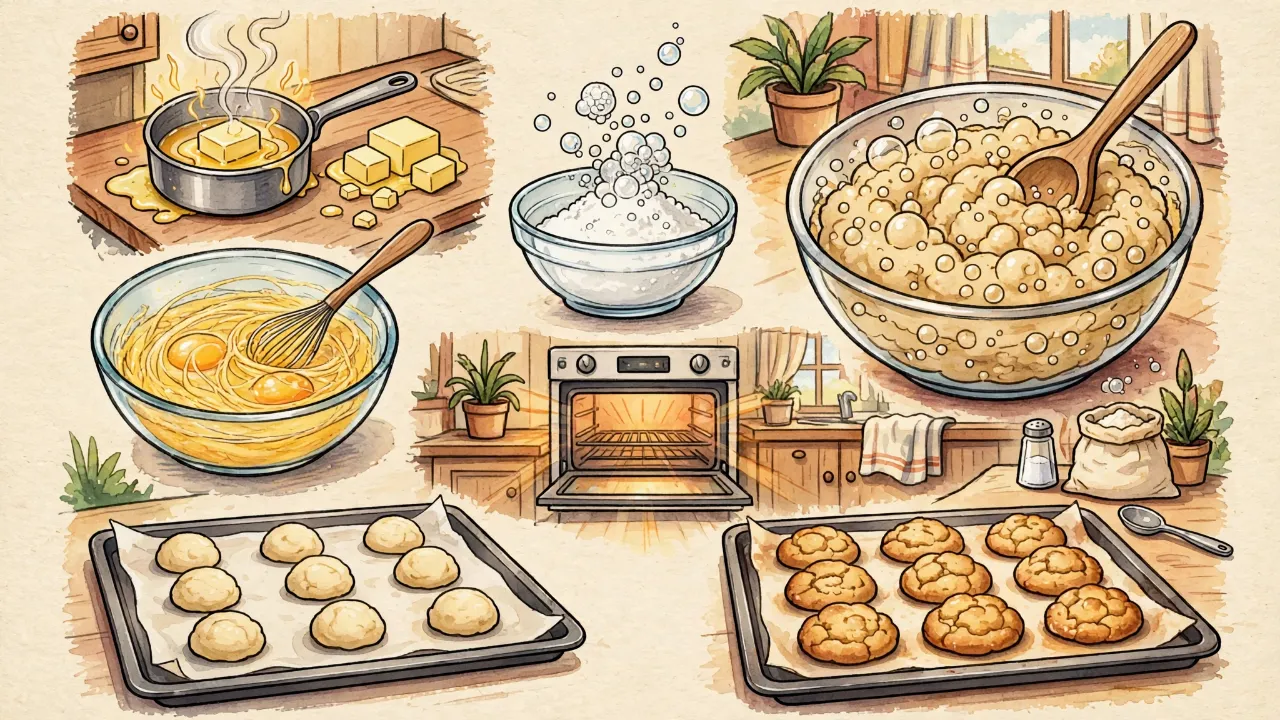
Mix the ingredients in a big bowl. Scoop little balls of dough onto a baking sheet. The oven heats them and they spread out flat. After about 10 minutes they turn golden brown, and your kitchen smells amazing!
Why Do Cookies Get Crunchy?
When cookies bake, the water in the dough turns into steam and floats away. Without that water, the cookie gets crispy! Take them out a little early and they stay soft and chewy.
Cookies Around the World
France has macarons, colorful sandwich cookies. Germany has gingerbread lebkuchen. Italy has biscotti, crunchy cookies you dip in milk. What is your favorite cookie? 🍪
A Sweet History
Cookies have been around for over a thousand years! The first cookies were made by accident. Bakers in ancient Persia (modern-day Iran) used small amounts of cake batter to test their oven temperature before putting in a whole cake. These little test cakes tasted so good that people started eating them on purpose.
The word "cookie" comes from the Dutch word koekje, which means "little cake." Dutch settlers brought cookie recipes to America in the 1600s.
The Chocolate Chip Cookie Accident
The most famous cookie in America was invented by accident! In 1938, Ruth Wakefield was baking at her Toll House Inn in Massachusetts. She broke a Nestlé chocolate bar into pieces and mixed them into her butter cookie dough, expecting the chocolate to melt completely. Instead, the pieces held their shape and created the first chocolate chip cookie.
The Science of Baking
Baking cookies is actually a science experiment in your kitchen! Here's what happens:
- Butter melts in the oven, making the dough spread out flat
- Sugar dissolves and makes the edges crispy
- Eggs act like glue, holding everything together
- Baking soda creates tiny gas bubbles that puff the cookie up
- Flour gives the cookie its structure so it doesn't fall apart
Cookies Around the World
Every culture has its own special cookie traditions:
- France: Macarons, delicate almond meringue sandwiches with filling
- Italy: Biscotti, twice-baked crunchy cookies perfect for dipping
- Mexico: Polvorones, crumbly cinnamon wedding cookies
- China: Fortune cookies (actually invented in San Francisco!)
- Scotland: Shortbread, rich buttery cookies with just three ingredients
Fun Cookie Facts
The world's largest cookie was baked in 2003 in Flat Rock, North Carolina. It was a chocolate chip cookie that measured 102 feet across and weighed over 40,000 pounds!
From Test Cakes to Global Obsession
The cookie's origin story is one of practical innovation. Seventh-century Persian bakers, among the first to refine sugar from sugarcane, used small dollops of cake batter as oven testers. These test cakes were expendable, but their taste was not. By the 10th century, cookies had spread across the Muslim world through trade routes, reaching medieval Europe during the Crusades.
The transformation from luxury to everyday food tracked with sugar's plummeting price. In 1300, sugar cost the equivalent of $100 per pound in today's money. By 1900, it was a few cents. Cheap sugar democratized cookies.
The Chemistry of the Perfect Cookie
Cookie baking is applied chemistry. Each ingredient plays a specific role, and small changes produce dramatically different results:
Why brown sugar makes chewier cookies: Brown sugar contains molasses, which is hygroscopic (it attracts and holds water). More moisture in the finished cookie means a softer, chewier texture. White sugar produces crispier cookies because it creates a drier final product.
Why chilling dough matters: Refrigerating cookie dough for 24-72 hours does two things. First, it solidifies the butter, so cookies spread less during baking. Second, it allows flour proteins to fully hydrate, and enzymes begin breaking down proteins and starches into amino acids and simple sugars, resulting in more complex Maillard reaction products (better flavor).
A typical chocolate chip cookie has a spread ratio of about 1.5:1.
If your dough ball starts at 3 cm diameter, the finished cookie will be about 4.5 cm across.
The Toll House Story: Invention and Litigation
Ruth Wakefield's 1938 invention of the chocolate chip cookie at the Toll House Inn became one of the most consequential moments in American food history. Nestlé struck a deal with Wakefield: she received a lifetime supply of chocolate in exchange for the right to print her recipe on every bag of Nestlé chocolate chips. That recipe, printed billions of times, essentially created the home-baking market for chocolate chips.
The economics are striking. Nestlé sells over $1 billion worth of chocolate chips annually, and approximately 50% of those purchases are specifically intended for making chocolate chip cookies using a variation of Wakefield's original recipe.
Industrial Cookie Science
Commercial cookie manufacturers operate in a different universe from home bakers. Factories like Nabisco's Fair Lawn, New Jersey facility produce 40 million Oreos per day. Key industrial differences include:
- Rotary molding: Dough is pressed into engraved rollers rather than dropped as balls
- Continuous ovens: Cookies travel through 300-foot tunnel ovens on steel mesh belts
- Water activity control: Target aw of 0.3-0.5 (too high and cookies go stale; too low and they shatter)
- Texture analysis: Industrial labs use texture analyzers to measure breaking force in Newtons, ensuring every cookie snaps consistently
The Global Cookie Map
Cookie traditions reveal cultural values:
- Japanese cookies emphasize aesthetics and seasonal ingredients (sakura in spring, matcha year-round)
- Scandinavian pepparkakor are spiced with cardamom, a legacy of the Viking spice trade
- Argentinian alfajores are sandwiched with dulce de leche, reflecting the country's dairy culture
- Indian nankhatai evolved from Portuguese-Mughal culinary exchange, blending ghee with European baking techniques
The Cookie as Cultural Object
The cookie occupies a unique position in food culture: simultaneously trivial (a snack, a child's treat) and consequential (a multi-billion-dollar industry, a vehicle for food science innovation, and a surprisingly effective lens on global trade history). Understanding the cookie means understanding sugar economics, protein chemistry, industrial food processing, and the psychology of comfort food.
Sugar, Empire, and the Accessible Cookie
The cookie's history is inseparable from the history of sugar. Sugarcane, domesticated in New Guinea around 8000 BCE, reached Persia by the 6th century CE, where it intersected with the flour-and-fat baking traditions of the Middle East. The earliest cookie analogues, including the lauzinaj (almond pastry) described in Muhammad ibn al-Hasan al-Baghdadi's 1226 cookbook Kitab al-Tabikh, required sugar that cost more per weight than most spices.
The sugar-slave-colony triangle drove cookie democratization. Caribbean plantations (17th-19th centuries) increased sugar production by orders of magnitude, dropping the price from a luxury spice to a bulk commodity. By the time the Industrial Revolution mechanized flour milling and butter production, all three core cookie ingredients were cheap enough for mass consumption. The cookie is, in this sense, a product of colonialism, though this framing is rarely applied to something so banal.
Protein Chemistry and the Chewy-Crispy Spectrum
The mechanical properties of a cookie are determined primarily by gluten network development, sugar glass formation, and moisture content.
1/Tg = (w₁/Tg1) + (w₂/Tg2)
where w = weight fraction, Tg1 = Tg of dry solids (~100°C), Tg2 = Tg of water (-135°C)
The glass transition explains cookie texture changes over time. Freshly baked cookies are above their glass transition temperature: the sugar matrix is rubbery and pliable (chewy). As cookies cool, they may drop below Tg, and the sugar matrix vitrifies into a glassy state (crispy). Staling occurs when cookies absorb ambient moisture, raising their Tg above room temperature, causing the matrix to transition from glassy to rubbery. This is why stale cookies become soft, not hard (the opposite of stale bread, where starch retrogradation causes hardening).
The Toll House Deal and IP in Food
Ruth Wakefield's arrangement with Nestlé raises enduring questions about intellectual property in food. Wakefield received a lifetime supply of chocolate (estimated value: a few thousand dollars total) for a recipe that has generated billions in revenue. Food recipes are generally not patentable (they lack the novelty and non-obviousness requirements of patent law), and copyright protects only the creative expression in a recipe's description, not the ingredient list or method.
The practical result: anyone can make chocolate chip cookies commercially using Wakefield's recipe. Nestlé's moat was never the recipe itself, but the distribution channel of printing it on the chip bag, creating a self-reinforcing demand loop.
Industrial Cookies and Ultra-Processed Food Debate
The Oreo, introduced by Nabisco in 1912 as an imitation of the Hydrox cookie (1908), is now the world's best-selling cookie, with annual revenue exceeding $3.1 billion across 100+ countries. Its ingredient list reveals the gulf between home-baked and industrial cookies:
- Home chocolate chip cookie: flour, butter, sugar, eggs, vanilla, baking soda, salt, chocolate chips (8 ingredients)
- Oreo: sugar, unbleached enriched flour, palm oil, cocoa, high fructose corn syrup, leavening, cornstarch, salt, soy lecithin, vanillin, chocolate (11+ ingredients, several processed)
The NOVA food classification system categorizes industrial cookies as "ultra-processed foods" (Group 4). Epidemiological studies, including the NutriNet-Santé cohort (n=105,159), have associated higher ultra-processed food consumption with increased cardiovascular disease incidence (Srour et al., BMJ, 2019). However, these are observational associations with significant confounders; the mechanistic pathway from ultra-processing to disease remains contested.
Cookie Diplomacy
Cookies play an outsized role in soft power. The annual White House Christmas Cookie is a minor diplomatic tradition. Girl Scout Cookies, a $800-million-per-year enterprise, are simultaneously a fundraising mechanism, a youth entrepreneurship program, and a cultural institution whose seasonal availability creates artificial scarcity. The thin-mint-freezer ritual is a distinctly American phenomenon with no real parallel in other countries' food cultures.
Sources
- Davidson, A. The Oxford Companion to Food. Oxford University Press (2014), entries on "biscuit" and "cookie."
- Figoni, P. How Baking Works: Exploring the Fundamentals of Baking Science. Wiley, 3rd ed. (2010).
- Corriher, S.O. BakeWise: The Hows and Whys of Successful Baking. Scribner (2008).
- Nestle, M. Food Politics: How the Food Industry Influences Nutrition and Health. University of California Press (2013).
- Srour, B. et al. "Ultra-processed food intake and risk of cardiovascular disease." BMJ 365, l1451 (2019).
- Mintz, S. Sweetness and Power: The Place of Sugar in Modern History. Penguin (1986).
Why Your Kid Asked About Cookies
Your child requested this article, which means you are, at minimum, co-reading a piece about cookies on a Saturday. That tracks. Cookies are the first baked good most children encounter, the first thing many learn to "bake" (stirring while an adult does the hard parts), and a remarkably effective gateway to basic chemistry. This article offers an excuse to bake together, which is always the right call.
The Accidental Genius of Ruth Wakefield
The standard Toll House origin story (Ruth Wakefield accidentally added chocolate chunks expecting them to melt fully) may be apocryphal. Wakefield held a master's degree in household arts and was an experienced recipe developer. Food historian Carolyn Wyman has argued that Wakefield likely understood that chocolate would not fully melt into butter cookie dough, and that the "accident" narrative was either a simplification or a marketing convenience that made the story more relatable.
Regardless, the business arrangement matters more than the chemistry. Wakefield traded the recipe to Nestlé for a lifetime supply of chocolate, estimated at a few thousand dollars in total value. Nestlé printed the recipe on chip bags, creating a closed consumption loop: the recipe on the bag drives purchase of the bag, which carries the recipe. This feedback mechanism has driven an estimated $30+ billion in cumulative chocolate chip sales since 1939.
What Baking Science Actually Teaches Kids
If you are looking for a practical STEM activity, cookie baking is surprisingly rigorous:
- Measurement and ratios: Baking is stoichiometry. Too much flour (high flour-to-fat ratio) produces dry, crumbly cookies. Too little produces greasy puddles. This is the baker's percentage system, where all ingredients are expressed as a percentage of flour weight.
- State transitions: Butter goes from solid (cold dough) to liquid (melting in oven) to re-solidified (cooling cookie). Sugar undergoes glass transition. Water goes from liquid to vapor. All three states of matter in one pan.
- Thermodynamics: Oven temperature matters because different reactions happen at different temperatures. The Maillard reaction accelerates above 140°C; caramelization above 170°C. An oven at 375°F (190°C) hits both; at 325°F (163°C), you get Maillard but not much caramelization (paler cookies with different flavor).
- Experimental design: Bake one batch with cold dough and one with room-temperature dough. Observe the difference in spread, thickness, and texture. This is a controlled experiment with a single variable and a delicious dependent variable.
The Health Conversation
A standard homemade chocolate chip cookie contains roughly 80 calories, 4g of fat, and 10g of sugar. For context, the American Heart Association recommends children ages 2-18 consume fewer than 25g of added sugar per day. Three cookies approach that limit.
The more nuanced point: homemade cookies and industrial cookies are not the same product. A homemade cookie contains 6-8 recognizable ingredients. An Oreo's ingredient list includes palm oil, high fructose corn syrup, soy lecithin, and artificial vanillin. The NOVA classification system places industrial cookies in the ultra-processed category (Group 4), which epidemiological evidence links to adverse health outcomes, though with important caveats about confounding.
The practical takeaway: bake with your kids, use real ingredients, eat cookies in moderation, and don't stress about it. The bonding value of baking together outweighs the nutritional cost of the cookies.
Recipes Worth Trying
If this article inspires a baking session, here are three starting points ranked by difficulty:
- Shortbread (easiest): 3 ingredients (flour, butter, sugar), no eggs, no leavening. Teaches ratio concepts. Hard to fail.
- Toll House chocolate chip (intermediate): The classic. Use the Nestlé bag recipe as a baseline, then experiment with brown-to-white sugar ratios and dough chilling time.
- French macarons (advanced): Requires precise meringue technique, macaronage (specific folding method), and temperature control. A genuine challenge for experienced home bakers.
Sources
- Wyman, C. The Great American Chocolate Chip Cookie Book. Countryman Press (2013).
- Figoni, P. How Baking Works. Wiley, 3rd ed. (2010).
- López-Alt, J.K. "The Science of the Best Chocolate Chip Cookies." Serious Eats (2015, updated 2023).
- Mintz, S. Sweetness and Power. Penguin (1986).
- Srour, B. et al. "Ultra-processed food intake and risk of cardiovascular disease." BMJ 365, l1451 (2019).
- American Heart Association. "Added Sugars and Cardiovascular Disease Risk in Children." Circulation 135, e1017-e1034 (2017).