
🦀🍽️
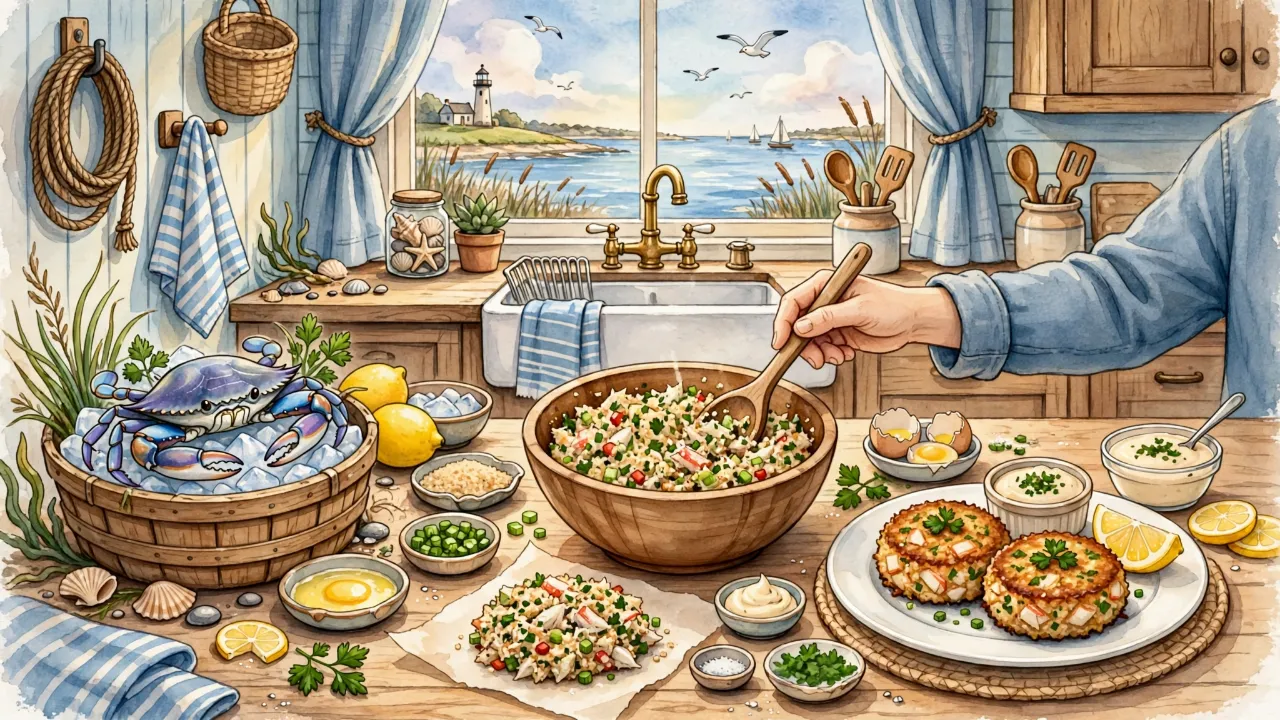
A crab cake is a yummy food made from crab! It is round and golden. 🥮
Crabs live in the ocean. People catch them and cook them into cakes! 🌊
Crab cakes are crispy outside and soft inside. Have you ever tried one? 😋
What Is a Crab Cake?
A crab cake is real crab meat mixed with a few other things to hold it together. It is a little round patty, like a hamburger made from crab!
Where Do Crabs Come From?
Blue crabs live in the ocean near Maryland, a state on the east coast of the United States. Fishermen catch them with special traps called crab pots.
How Do You Make One?
Take the meat out of the shell. Mix it with a little egg and breadcrumbs so it sticks together. Many people add a spice called Old Bay. Then cook it in a pan until it turns golden brown!
Did You Know?
People in Maryland love crab cakes so much that they call their state the "Crab Cake Capital of the World!" Some families have secret recipes passed down from grandparents. 🦀
What Exactly Is a Crab Cake?
A crab cake is a patty made from crab meat, mixed with just enough binding ingredients (like egg, mayonnaise, and breadcrumbs) to hold it together. The best crab cakes are mostly crab, with as little filler as possible. When you bite into a good one, you should taste the sweet, delicate flavor of the crab itself.
The Chesapeake Bay Connection
Crab cakes are most famous in Maryland, especially around the Chesapeake Bay, the largest estuary in the United States. The bay is home to the Atlantic blue crab (Callinectes sapidus), which has been caught there for hundreds of years. Native Americans were harvesting blue crabs from the Chesapeake long before European settlers arrived. The crab cake as we know it probably developed in the 1800s when Maryland cooks began shaping seasoned crab meat into patties and pan-frying them.
Lump vs. Claw: Not All Crab Meat Is the Same
Crab meat comes in different grades depending on which part of the crab it comes from:
- Jumbo lump: Big, beautiful chunks from the crab's swimming muscles. The most expensive and prized for crab cakes.
- Backfin: Smaller pieces from the body. Still flavorful and great for crab cakes.
- Claw meat: Darker, stronger-flavored meat from the claws. Often used in soups and dips.
The Secret Ingredient: Old Bay
Almost every Maryland crab cake includes Old Bay seasoning, a blend of celery salt, paprika, black pepper, and over a dozen other spices. It was invented in 1939 by a German immigrant named Gustav Brunn who settled in Baltimore. Today, Old Bay is practically the official spice of Maryland. People put it on french fries, popcorn, and even ice cream!
How to Cook Them
There are three main ways to cook a crab cake: pan-fried (in butter or oil for a crispy crust), broiled (cooked under high heat in the oven), or deep-fried (fully submerged in hot oil). Maryland purists usually prefer pan-fried or broiled, arguing that deep-frying overpowers the delicate crab flavor.
The Crab Cake: Maryland's Edible Identity
If you want to start an argument in Maryland, tell someone their crab cake has too much filler. The crab cake is not just food in the Chesapeake Bay region; it is a cultural institution, a point of fierce local pride, and an economic driver worth hundreds of millions of dollars annually. Understanding the crab cake means understanding the intersection of ecology, culinary tradition, and regional identity.
The Blue Crab: Biology of a Bay Icon
The Atlantic blue crab (Callinectes sapidus) is a decapod crustacean with 10 legs, including two large claws. Blue crabs are aggressive, fast swimmers, and remarkably adaptable. They tolerate a wide range of salinity, which is why the Chesapeake Bay's brackish waters (a mix of fresh river water and salty ocean water) suit them perfectly.
Blue crabs grow by molting, shedding their hard exoskeleton to reveal a soft, larger shell underneath. A crab caught right after molting is called a soft-shell crab, and the entire animal can be eaten, shell and all. Blue crabs molt about 25 times during their 3-4 year lifespan.
Anatomy of a Perfect Crab Cake
The debate over what belongs in a crab cake is surprisingly intense. The Maryland style prioritizes jumbo lump crab meat with minimal binder, typically just enough egg, mayonnaise, and Dijon mustard to hold the patty together. Breadcrumbs (or crushed saltine crackers) provide structure without overwhelming the crab. The key principle: the crab should be the star, and everything else is supporting cast.
Contrast this with other regional styles. In South Carolina, crab cakes often include more breadcrumbs and vegetables. New England versions may add cream. In the Gulf Coast, crab cakes sometimes use local blue crab or even crawfish blended in. Each region insists their version is best.
Old Bay: A Spice Blend That Became a Brand
Gustav Brunn arrived in Baltimore in 1938 after fleeing Nazi Germany. A trained spice merchant, he created Old Bay seasoning in 1939, originally selling it to local seafood houses. The blend contains at least 18 herbs and spices, including celery salt, red pepper, black pepper, and paprika. McCormick & Company acquired the brand in 1990, and today Old Bay generates an estimated $100+ million in annual revenue. It has become a regional identity marker: bumper stickers, clothing, and even Old Bay-flavored products (chips, vodka, chocolate) are popular throughout the Mid-Atlantic.
Sustainability Concerns
Blue crab populations in the Chesapeake Bay have fluctuated dramatically. The annual Winter Dredge Survey, conducted jointly by Maryland and Virginia since 1990, estimated the 2023-2024 population at approximately 323 million crabs, a healthy number compared to the historic low of 227 million in 2013. However, scientists caution that the bay faces ongoing threats from nutrient pollution (agricultural runoff feeds algal blooms that deplete oxygen), habitat loss (underwater grasses that juvenile crabs depend on), and climate change (warming waters shift crab distribution northward). Responsible crab cake consumption means paying attention to where and how crabs are harvested.
The Crab Cake: Ecology, Economy, and Cultural Politics
The crab cake sits at the intersection of American food culture, regional economics, and marine ecology. It is a dish simple enough to describe in a sentence, yet embedded in arguments about authenticity, sustainability, labor, and the future of the Chesapeake Bay. Treating it as "just food" misses what makes it genuinely interesting.
Historical Origins
The modern crab cake is a product of the late 19th century Chesapeake Bay economy. While Native Americans, particularly the Algonquin peoples, harvested blue crabs from the bay for centuries, the formed patty we call a "crab cake" emerged alongside commercial crabbing operations in the 1880s-1900s. Early recipes appear in Baltimore cookbooks from this period, typically calling for crab meat, breadcrumbs, egg, and mustard. The dish gained broader recognition through Chesapeake Bay seafood restaurants that catered to tourists and the growing railroad trade.
The crab cake's rise tracked the industrialization of the Chesapeake crabbing industry. By the early 1900s, crab-picking houses employed thousands of workers (predominantly Black women) to extract meat from cooked crabs by hand. This labor-intensive process remains largely unchanged: modern crab-picking is still done manually, and the industry relies heavily on H-2B visa workers from Mexico and Central America. A skilled picker can process about 3 pounds of meat per hour.
The Biology of Callinectes sapidus
Understanding the crab cake requires understanding the crab. Callinectes sapidus is a portunid (swimming crab) native to the western Atlantic from Nova Scotia to Argentina. Key biological features:
- Sexual dimorphism: Males ("jimmies") have a T-shaped abdominal apron; females ("sooks") have a rounded apron. Males grow larger; females are sometimes preferred for their roe.
- Molting cycle: Growth occurs through ecdysis (molting). Blue crabs undergo approximately 25 molts over 12-18 months to reach legal harvest size (5 inches point-to-point in Maryland). The soft-shell stage lasts only a few hours before the new exoskeleton hardens via mineral deposition (primarily calcium carbonate).
- Osmoregulation: Blue crabs are euryhaline, tolerating salinities from nearly fresh water to full ocean (0-35 ppt). This physiological flexibility explains their success in the Chesapeake's variable-salinity environment.
The Filler Wars: Culinary Authenticity and Economics
The primary axis of crab cake debate is the ratio of crab meat to binder. Maryland-style orthodoxy demands at least 80% crab by weight, with just enough egg, mayonnaise, and breadcrumbs to form a patty. This standard is partly culinary (letting the sweet, briny crab flavor dominate) and partly economic signaling (showing you can afford the good stuff).
The economics are real. Jumbo lump blue crab meat retails at $35-55 per pound depending on season and origin. A 4-ounce crab cake at 80% crab uses roughly $7-14 in raw crab. Lower-end crab cakes stretch this with breadcrumbs, crackers, vegetables, and cheaper crab grades (claw, special). Some establishments use imported crab from Southeast Asia (primarily Portunus pelagicus, the blue swimming crab), which costs 40-60% less. The use of imported crab sold as "Maryland-style" crab cake is a persistent controversy.
Cooking Chemistry
The three primary cooking methods each produce different results through distinct chemical processes:
- Pan-frying (170-190°C surface temperature): Maillard reaction between amino acids and reducing sugars in the breadcrumb coating produces the characteristic golden-brown crust and complex savory flavors. The butter or oil medium ensures even heat transfer.
- Broiling (260-290°C radiant heat): Top-down infrared radiation caramelizes the surface directly. Less fat is added, and the interior stays more delicate. Preferred by many Maryland purists.
- Deep-frying (175-190°C oil bath): Complete submersion produces uniform Maillard browning on all surfaces. Rapid moisture evaporation creates a crispy shell. Critics argue the frying oil flavor masks the crab.
Sustainability and Future
The Chesapeake Bay blue crab fishery faces interconnected pressures. Nutrient loading from agricultural runoff (primarily nitrogen and phosphorus from the Susquehanna River watershed) drives eutrophication, creating hypoxic "dead zones" in deep channel waters where crabs cannot survive. The Chesapeake Bay Total Maximum Daily Load (TMDL), established by the EPA in 2010, mandated nutrient reduction targets for all six watershed states, but compliance has been uneven. Meanwhile, warming bay temperatures (surface water temperatures have increased approximately 1.5°C since 1985) are shifting crab distribution patterns, potentially benefiting northern populations while stressing southern ones.
Aquaculture offers a partial solution but faces challenges. Blue crab farming has proven difficult because the larvae (called zoea) require specific salinity conditions and are highly cannibalistic. The University of Maryland's Institute of Marine and Environmental Technology has made progress on soft-shell crab aquaculture, but full-lifecycle farming at commercial scale remains elusive.
The Crab Cake: Identity, Labor, and Ecology in One Patty
Writing about the crab cake for a multi-level audience forces you to confront how much complexity hides inside apparently simple food. A crab cake is crab, binder, seasoning, heat. But it is also a story about the Chesapeake Bay's ecological fragility, the invisible labor of crab-picking houses, the cultural economics of "authenticity," and the quiet tension between tradition and sustainability. Every golden-brown patty on a restaurant plate carries more freight than most diners realize.
Origins: From the Bay to the Plate
The crab cake does not have a single inventor or a founding date. It evolved from the broader tradition of formed seafood patties common in 18th and 19th century American and European cooking (cod cakes, salmon croquettes, deviled crab). What distinguishes the Maryland crab cake is its relationship with a specific ecosystem: the Chesapeake Bay, the largest estuary in North America (11,600 km² surface area, 166,500 km² watershed spanning six states and the District of Columbia).
Blue crabs have been central to the bay's human ecology for millennia. Archaeological evidence from sites like the Turner Farm in Maine and various Chesapeake shell middens shows extensive pre-Columbian crab harvest. Colonial records from the 1600s describe abundant crab populations. However, the commercial crabbing industry and the crab cake as a distinct culinary product both emerged in the post-Civil War era, facilitated by improved transportation (railroads), ice-based refrigeration, and growing urban demand from Baltimore and Washington, D.C.
The Labor Question
Behind every pound of crab meat is a picker. Crab-picking is skilled manual labor that has resisted automation for over a century. The anatomy of the blue crab, with meat distributed through a complex internal structure of chambers, cartilage, and thin membranes, makes mechanical extraction impractical without destroying the prized lump pieces. A skilled picker working 8-hour shifts can extract approximately 2-3 pounds of meat per hour, requiring roughly 12-18 crabs per pound of finished meat.
The workforce demographics tell a social history. From the late 1800s through the mid-20th century, crab-picking houses in Maryland and Virginia employed predominantly African American women, often at piece rates that kept wages low. Beginning in the 1990s, as domestic workers became scarce (due to better employment alternatives), the industry shifted heavily to H-2B seasonal guest workers, primarily from Mexico. As of 2024, an estimated 40-50% of Maryland's crab-picking workforce holds H-2B visas. The industry has lobbied aggressively for increased H-2B allocations, arguing that without foreign labor, domestic crab meat production would collapse. Critics counter that the reliance on guest workers suppresses wages and perpetuates exploitative working conditions.
Authenticity and the Import Problem
Here is an uncomfortable fact: the majority of "crab cake" served in the United States does not contain Chesapeake Bay blue crab. The U.S. imports roughly 80-85% of its crab meat, primarily from Indonesia, the Philippines, Vietnam, Thailand, and India. The dominant species is Portunus pelagicus (blue swimming crab), supplemented by Scylla serrata (mud crab) and various Charybdis species.
Imported pasteurized crab meat costs $15-25/lb wholesale versus $35-55/lb for domestic fresh-picked. The flavor and texture differ perceptibly: domestic blue crab tends to be sweeter and more delicate, while imported crab (often pasteurized for shelf stability) has a firmer, slightly more uniform texture. Nevertheless, labeling is opaque. Restaurants are not required to disclose crab origin in most states, and "Maryland-style crab cake" refers to the recipe, not the crab's provenance. Maryland's Department of Agriculture has pushed for stronger origin labeling, but federal standards remain lax.
The Bay's Ecological Balance Sheet
The Chesapeake Bay's ability to produce blue crabs depends on a functioning ecosystem that is under serious, well-documented stress. The primary threats:
- Nutrient pollution: The bay receives approximately 300 million pounds of nitrogen and 19 million pounds of phosphorus annually from agricultural runoff, wastewater treatment plants, and atmospheric deposition (EPA Chesapeake Bay Program data). This nutrient loading drives algal blooms that block sunlight to underwater grasses and, when the algae die and decompose, create hypoxic zones (dissolved oxygen < 2 mg/L) in deep channel waters. The dead zone typically covers 15-30% of the bay's main channel during summer months.
- Habitat loss: Submerged aquatic vegetation (SAV), which provides critical nursery habitat for juvenile crabs, covered approximately 60,000 acres in 2023, down from an estimated 200,000+ acres before European colonization. SAV recovery has been a major management goal.
- Climate change: Chesapeake Bay surface temperatures have risen roughly 1.5°C since 1985 (NOAA data). Modeling by the Virginia Institute of Marine Science projects further 2-4°C increases by 2100 under moderate emission scenarios. Warmer winters may increase overwinter survival of crabs but also expand the range of parasites and competitors. Sea level rise (currently ~3.5 mm/year in the mid-bay) threatens tidal marshes that filter nutrients.
The Chesapeake Bay TMDL (established 2010, often called a "pollution diet") set target reductions of 25% for nitrogen and 24% for phosphorus across the watershed. A 2024 Chesapeake Bay Foundation report card gave the bay a D+ overall, noting that while some tributaries have improved significantly, others (notably in Pennsylvania's agricultural regions) remain far from compliance.
The Crab Cake as Economic Object
Maryland's blue crab industry generates approximately $80-100 million annually in dockside revenue and several times that in downstream economic activity (processing, restaurants, tourism). The crab cake specifically drives a tourism economy: visitors to Baltimore, Annapolis, and the Eastern Shore cite crab cakes as a primary culinary attraction. Faidley Seafood in Baltimore's Lexington Market, operating since 1886, sells hundreds of crab cakes daily during peak season and has been profiled by virtually every major food publication.
The premium market for crab cakes illustrates a broader pattern in American food culture: regionality as brand. "Maryland crab cake" functions similarly to "Maine lobster roll" or "Texas brisket," where the place name signals authenticity and quality. This branding creates economic value but also tension when the underlying supply chain globalizes. A Maryland restaurant selling crab cakes made with Indonesian crab is technically accurate ("Maryland-style") but arguably misleading.
Sources
- Wennersten, J.R. The Oyster Wars of Chesapeake Bay. Tidewater Publishers (1981). [Historical context of bay fisheries]
- Warner, W.W. Beautiful Swimmers: Watermen, Crabs and the Chesapeake Bay. Penguin (1976). [Pulitzer Prize-winning account of crab culture]
- Chesapeake Bay Program. "Blue Crab Population and Management." cbp.gov. [Winter Dredge Survey data and management framework]
- NOAA Chesapeake Bay Office. "Chesapeake Bay Fisheries: Blue Crab." noaa.gov. [Population trends, regulatory overview]
- Miller, T.J. et al. "Stock Assessment of Blue Crab in Chesapeake Bay." University of Maryland Center for Environmental Science (2024).
- McCormick & Company. "The History of Old Bay Seasoning." mccormick.com. [Brand history]
- Chesapeake Bay Foundation. "State of the Bay 2024." cbf.org. [Environmental health indicators]
- U.S. EPA. "Chesapeake Bay Total Maximum Daily Load." epa.gov (2010). [Nutrient reduction framework]
- Paolisso, M. "Blue Crabs and Controversy on the Chesapeake Bay: A Cultural Model for Understanding Watermen's Reasoning about Blue Crab Management." Human Organization 61(3):226-239 (2002).