
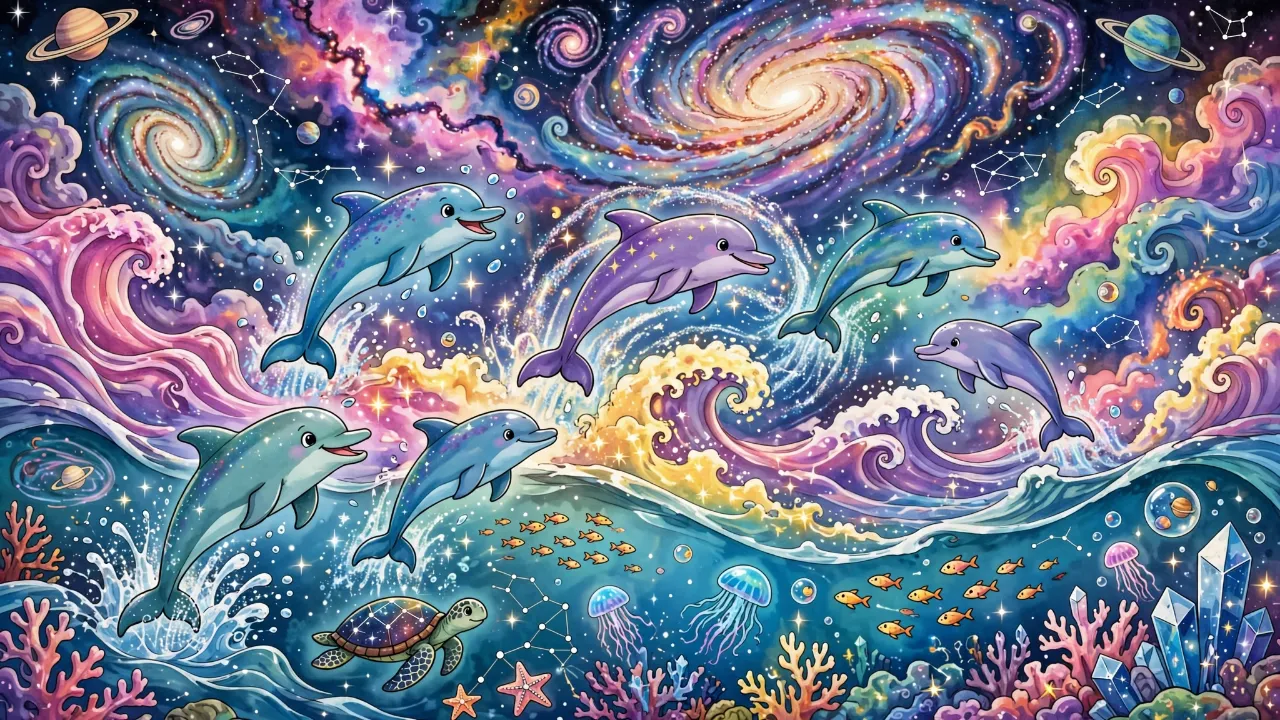
Dolphins in Space? 🐬
Dolphins live in the ocean. 🎵
Space is above the sky. There is no water or air. Everything floats!
A dolphin would float and spin like a toy in a bath! 🛁
But dolphins need water, so they need a space suit full of water! 💧
Why Are Dolphins Special? 🐬
Dolphins are mammals, like us. They breathe air through a hole on top of their head called a blowhole. Dolphins talk with clicks, whistles, and squeaks. Each dolphin has its own whistle, like a name. 🎶
What Is Space Like? 🌌
Space has no air to breathe and no water to swim in. There is no gravity, so everything floats.
Could Dolphins Really Go to Space? 🤔
A dolphin would need a spaceship full of warm, salty water, with a place to breathe at the top. In zero gravity, the water would float in big wobbly blobs, and the dolphin would spin and tumble. 😄
Dolphin Superpowers 💪
Dolphins can hold their breath a long time, dive deep, and use sound to see in the dark. Those skills might help in space.
The World's Smartest Swimmers 🐬
Bottlenose dolphins have bigger brains than humans (about 1,600 grams compared to our 1,400 grams). They can recognize themselves in mirrors, which is something only a few animals can do. They give each other unique whistle-names and remember friends they have not seen in 20 years!
Echolocation: Seeing With Sound 🔊
Dolphins make clicking sounds that bounce off objects and come back to them. This is called echolocation. It works like sonar on a submarine. Dolphins can "see" a golf ball from 100 meters away using nothing but sound!
The Challenges of Space 🚀
Space has three big problems for any Earth creature:
- No air to breathe (vacuum)
- No gravity to keep things in place (weightlessness)
- Radiation from the Sun with no atmosphere to block it
Dolphins would face all of these challenges plus one more: they need to be surrounded by water to support their body. On land, a dolphin's own weight can crush its organs. In space, at least the zero gravity would solve that problem!
Designing a Dolphin Spaceship 🛸
A real dolphin spaceship would need:
- A water tank with salt water at 22-26°C (72-79°F)
- An air pocket at the top so the dolphin can breathe
- Filters to keep the water clean
- Food (dolphins eat about 15 kg of fish per day!)
- Radiation shielding to protect the dolphin
The trickiest part? In zero gravity, water forms floating spheres instead of filling a tank normally. Engineers would need to use spinning or magnets to keep the water in the right place.
Would Echolocation Work in Space? 🤔
Sound cannot travel through the vacuum of space (there is no air for sound waves to move through). However, inside a water-filled spaceship, echolocation would work perfectly! Sound actually travels about 4 times faster in water than in air, so a dolphin could navigate its ship beautifully.
Dolphin Intelligence: More Than Tricks 🧠
Bottlenose dolphins (Tursiops truncatus) have an encephalization quotient (EQ) of approximately 4.14, second only to humans (EQ ~7.4) among mammals. Their neocortex, the brain region associated with higher-order thinking, is highly convoluted with more folds than the human brain. Research by Lori Marino at Emory University has demonstrated self-recognition, cultural transmission of foraging techniques, and the ability to understand abstract concepts like "none" and "different."
Echolocation: Biological Sonar 🔊
Dolphin echolocation operates at frequencies between 20 kHz and 130 kHz, well above human hearing range (20 Hz to 20 kHz). The melon, a fatty organ in the dolphin's forehead, focuses outgoing clicks into a directed beam. Returning echoes are received through the lower jawbone and transmitted to the inner ear.
This system can resolve objects as small as 2-3 mm at close range and detect targets over 100 meters away. The processing happens in a specialized region of the auditory cortex that creates what researchers call a "acoustic image," essentially a 3D model built from sound.
Zero Gravity and Marine Mammals 🌊➡️🚀
Dolphins face unique challenges in microgravity. On Earth, they rely on gravity to surface and breathe through their blowholes. Without gravity, a dolphin would need an entirely different breathing strategy. Furthermore, their circulatory system has evolved to handle pressure changes during deep dives (up to 300 meters), not the absence of external pressure.
Water behavior in microgravity is fascinating. Without gravity, surface tension dominates, causing water to form perfect spheres. NASA experiments on the ISS have shown that containing large volumes of water requires either centrifugal force (spinning the container) or specialized capillary systems.
Could Sound Replace Radio? 📡
Electromagnetic waves (radio, light) travel through vacuum at 299,792 km/s. Sound cannot travel through vacuum at all, requiring a medium like air or water. Inside a water-filled habitat, however, acoustic communication would be 4.4 times faster than in air. Theoretically, a network of water-filled habitats connected by tubes could allow dolphins to communicate acoustically across a space station, while electromagnetic systems handle external communications.
Animals in Space: A Real History 🐾
The idea is not entirely science fiction. Fruit flies were launched in 1947. Laika the dog orbited Earth in 1957. Medaka fish bred on the Space Shuttle in 1994. Tardigrades survived exposure to open space vacuum and radiation for 10 days in 2007. Each experiment taught us something about how life responds to the space environment.
Cetacean Cognition and the Great Brain Debate 🧠
The dolphin brain challenges our assumptions about intelligence. With approximately 37 billion neocortical neurons (Mortensen et al., 2014), dolphins possess more cortical neurons than any primate except humans. Their brains exhibit a unique paralimbic lobe structure absent in primates, suggesting convergent evolution of intelligence through different neural architectures.
The mirror self-recognition (MSR) test, originally designed by Gordon Gallup Jr. for primates, was adapted for dolphins by Diana Reiss and Marino (2001). Bottlenose dolphins passed convincingly, using mirrors to inspect marked body parts. This places them alongside great apes, elephants, and magpies in a small club of self-aware species.
Bioacoustics in Altered Environments 🔬
Dolphin biosonar operates as a matched-filter system. The transmitted click (broadband, ~40-130 kHz, duration ~50-70 microseconds) is modified by the melon's graded lipid density, which functions as an acoustic lens. The returning echo is processed by the auditory cortex at a rate that suggests parallel processing of spectral and temporal information.
In a hypothetical space habitat, the acoustic environment would differ substantially from the ocean. Reverberations from container walls, absent ambient noise from ocean currents and marine life, and the potential for unusual pressure regimes would all alter echolocation performance. The dolphin auditory system has demonstrated remarkable plasticity (Au, 1993), adjusting click frequency, intensity, and repetition rate based on environmental conditions.
Where SE = signal excess, SL = source level (~220 dB re 1 μPa), TL = transmission loss, TS = target strength, NL = noise level, DT = detection threshold
Physiological Barriers to Space 🚀
Marine mammals have evolved extraordinary adaptations for diving: the dive reflex (selective bradycardia and peripheral vasoconstriction), collapsible lungs to prevent nitrogen narcosis, elevated myoglobin concentrations (3-9x terrestrial mammals) for oxygen storage, and a rete mirabile for thermoregulation.
These adaptations, optimized for high-pressure environments, would encounter unprecedented conditions in space. The reduced external pressure environment could trigger barotrauma-like effects. The absence of hydrostatic pressure gradients would eliminate the gravitational cues dolphins use for orientation during surfacing behavior. And cosmic radiation exposure, shielded on Earth by the magnetosphere, would require substantial water or polymer shielding (approximately 5-10 g/cm² of water-equivalent material for deep space).
The Broader Question: Intelligence Beyond Earth 🌌
Dolphin intelligence raises profound questions about extraterrestrial life. If intelligence evolved independently in two radically different environments on Earth (terrestrial primates and aquatic cetaceans), it may not be as improbable as single-origin models suggest. The convergent evolution of echolocation in dolphins and bats, and of complex cognition in dolphins and primates, implies that certain cognitive solutions may be attractors in evolutionary space.
SETI researchers have studied dolphin communication precisely because it represents our best available model for decoding a non-human intelligent signal. John Lilly's controversial 1960s dolphin communication research, while methodologically flawed, catalyzed the Drake Equation discussions and inspired the inclusion of "communication with non-human intelligence" as a prerequisite for interstellar messaging protocols.
Why "Dolphins in Space" Is a Better Question Than It Sounds
The prompt sounds like a children's fantasy, and it is. But beneath the whimsy lies a genuinely interesting intersection of marine biology, aerospace engineering, and astrobiology. The thought experiment of placing Earth's second-most encephalized species into the space environment illuminates constraints we often take for granted.
The Neuroscience of Alien Intelligence
Dolphins represent the strongest evidence that high-order cognition is not an evolutionary fluke restricted to primates. Cetacean brains diverged from the primate lineage approximately 95 million years ago, yet convergently evolved large neocortices, self-awareness, cultural transmission, and syntactic communication. Marino's comparative neuroanatomy work (Marino et al., 2007, Brain, Behavior and Evolution) demonstrated that dolphin cortical surface area exceeds that of humans when corrected for body size, with a gyrification index (cortical folding complexity) among the highest in mammals.
The implication for astrobiology is significant: if intelligence arose independently twice on one planet through different neural architectures (a paralimbic-dominated cetacean system vs. a granular-cortex-dominated primate system), the probability of intelligence evolving elsewhere increases. This was precisely the reasoning that led to Project JANUS and NASA's funding of interspecies communication research in the 1960s-70s.
Engineering the Aquatic Spacecraft
The engineering challenge is non-trivial but not impossible. A dolphin-rated space habitat would require:
- Water containment in microgravity: Surface tension dominates at the scales relevant to ISS experiments (centimeter-range droplets). At habitat scale (minimum ~50 m³ for a single bottlenose dolphin), centrifugal containment via rotation is the only viable approach. A toroidal habitat rotating at ~2 RPM would provide adequate simulated gravity without exceeding the Coriolis threshold for vestibular discomfort.
- Life support: A single bottlenose dolphin consumes approximately 8-15 kg of fish daily, produces roughly 4-7 kg of waste, and requires water filtration capacity comparable to a mid-sized aquarium (~200 L/min recirculation). The closed-loop water recycling technology developed for ISS (Water Recovery System) could theoretically be scaled.
- Radiation shielding: Water itself is an effective radiation shield. 10 cm of water provides roughly equivalent shielding to 5 cm of aluminum. A water-filled habitat thus provides inherent radiation protection, a design advantage over air-filled human habitats.
The Real Animals-in-Space Program
Hundreds of animal species have flown in space since 1947. The scientific rationale evolved from simple survival testing (can a mammalian cardiovascular system function in microgravity?) to sophisticated developmental biology (Japanese medaka fish completed full reproductive cycles on the Space Shuttle in 1994, and zebrafish embryos developed normally on the ISS in 2012).
The most relevant precedent for dolphins may be the aquatic habitat experiments: the Aquatic Habitat (AQH) facility on the ISS maintained medaka fish for 90 days in 2012, demonstrating that closed-loop aquatic life support is feasible in orbit. Scaling from a 3-liter fish tank to a 50,000-liter dolphin habitat introduces engineering challenges of three orders of magnitude, but no fundamental physical barriers.
From Thought Experiment to Insight
The value of "dolphins in space" is not the literal proposal. It is the cascade of questions it triggers: What assumptions about intelligence are anthropocentric? What does "adapted for an environment" mean when we can engineer environments? If dolphins represent a proof-of-concept for aquatic intelligence, what does that predict about ocean worlds like Europa and Enceladus?
Carl Sagan reportedly said that dolphins were the reason he took the search for extraterrestrial intelligence seriously. Whether or not the attribution is accurate, the reasoning is sound. We share a planet with a non-primate intelligence that communicates in ways we still cannot fully decode. That fact alone should calibrate our expectations for what the universe might contain.
Sources
- Marino, L. et al. (2007). "Cetaceans Have Complex Brains for Complex Cognition." PLoS Biology, 5(5), e139.
- Reiss, D. & Marino, L. (2001). "Mirror self-recognition in the bottlenose dolphin." PNAS, 98(10), 5937-5942.
- Au, W. W. L. (1993). "The Sonar of Dolphins." Springer-Verlag.
- Mortensen, H. S. et al. (2014). "Quantitative relationships in delphinid neocortex." Frontiers in Neuroanatomy, 8, 132.
- NASA AQH Technical Report (2012). "Aquatic Habitat for the ISS." JAXA/NASA Joint Documentation.
- Dunbar, R. I. M. (1998). "The Social Brain Hypothesis." Evolutionary Anthropology, 6(5), 178-190.