
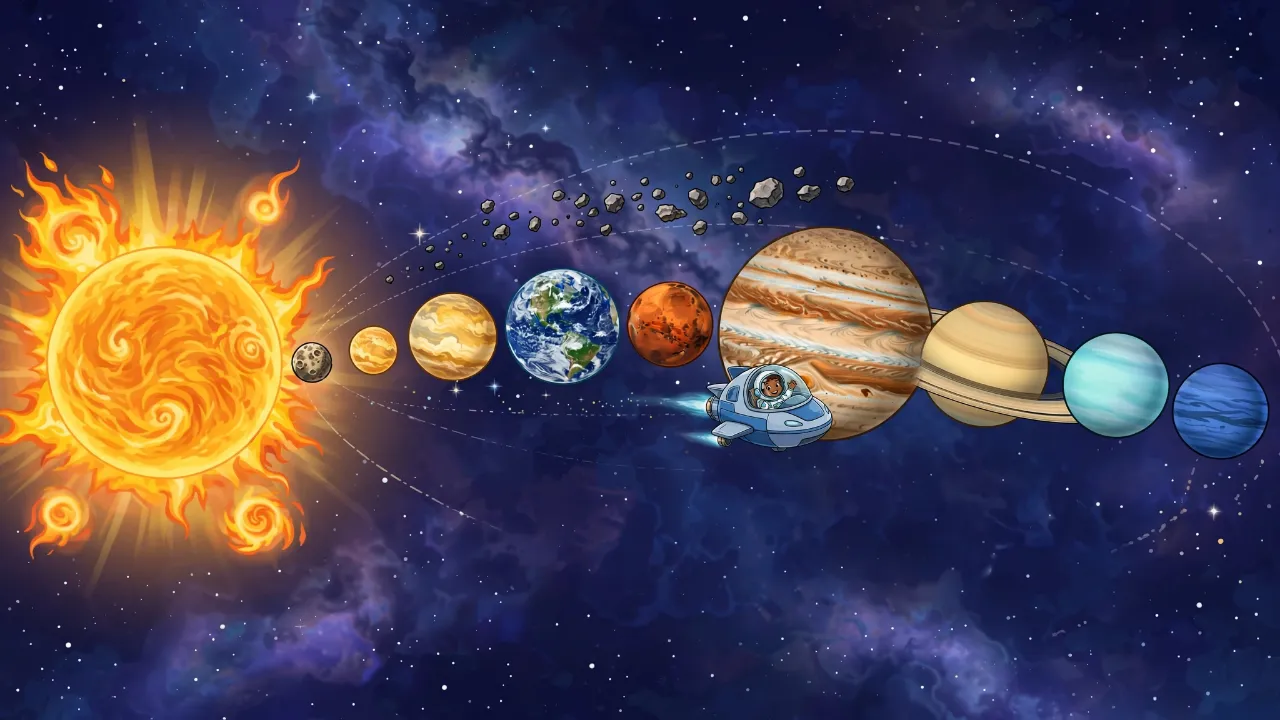
Space Is Big! 🚀
Look up at night. See the tiny sparkly lights? Those are stars. Our Sun is a star too. It keeps us warm.
🌍
Earth is our home. It goes round and round the Sun. Astronauts ride rockets into space! People have even walked on the Moon.
Space Is Huge 🌌
Space starts above the sky and goes on and on. If you could drive a car straight up, you would reach it in about an hour.
Stars and Planets
Stars are giant balls of hot gas that make their own light. Our Sun is a star. It looks big because it is close. Stars live in huge groups called galaxies, and ours is the Milky Way.
Planets are big round worlds that travel around stars. Our Sun has eight: Mercury, Venus, Earth, Mars, Jupiter, Saturn, Uranus and Neptune. Earth has one Moon. Jupiter has more than ninety.
Amazing Things
Black holes pull so hard that not even light can escape. Nebulae are colorful clouds where new stars are born. In 1969 astronauts walked on the Moon, and today robots called rovers explore Mars.
The Vast Expanse
Space is an immense, mysterious realm that stretches far beyond what the human eye can see. It begins just 100 kilometers above Earth's surface (called the Karman line) and extends into an almost infinite expanse filled with stars, planets, galaxies, and cosmic phenomena.
Space is mostly empty. If you shrunk the Sun to the size of a basketball, the nearest star (Proxima Centauri) would be another basketball about 6,500 kilometers away!
⭐ Stars and Galaxies
Stars are massive spheres of hot gas that produce light and heat through nuclear fusion. Deep inside a star, hydrogen atoms smash together to form helium, releasing enormous energy.
Stars come in different colors based on their temperature:
- 🔴 Red stars are the coolest (about 3,000°C)
- 🟡 Yellow stars like our Sun are medium (about 5,500°C)
- 🔵 Blue stars are the hottest (over 30,000°C!)
Stars gather in enormous collections called galaxies. Our Milky Way contains 100-400 billion stars. The observable universe has about 2 trillion galaxies!
🪐 Planets and Moons
Eight major planets circle our Sun:
- Mercury: Scorching days (430°C) and freezing nights (-180°C)
- Venus: The hottest planet (462°C!) with a thick heat-trapping atmosphere
- Earth: The only known planet with liquid water and life
- Mars: Has the tallest mountain in the solar system (Olympus Mons, 21 km high!)
- Jupiter: So big that 1,300 Earths could fit inside it
- Saturn: Its rings are made of billions of pieces of ice and rock
- Uranus: Rotates on its side, possibly from a giant collision
- Neptune: Has winds up to 2,100 km/h, the fastest in the solar system
🌀 Cosmic Phenomena
Black holes are regions where gravity is so strong nothing can escape. The black hole at the center of our Milky Way, Sagittarius A*, has the mass of 4 million Suns!
Nebulae are colorful clouds of gas and dust where stars are born. The Eagle Nebula's "Pillars of Creation" are columns of gas light-years tall where new stars are forming right now.
Supernovae are explosions so powerful a single one can briefly outshine an entire galaxy!
🚀 Human Exploration
- 1957: Sputnik, the first satellite
- 1961: Yuri Gagarin, first human in space
- 1969: Armstrong and Aldrin walked on the Moon
- 2021: James Webb Space Telescope launched
- Today: Mars rovers searching for ancient life!
🌟 Why Space Matters
Studying space helps us understand our origins and has given us GPS, weather forecasts, scratch-resistant lenses, and phone cameras! Space inspires innovation, fuels curiosity, and reminds us of our place in an awe-inspiring universe.
The Vast Expanse
Space begins at the Karman line (~100 km), where Earth's atmosphere becomes too thin for aerodynamic flight. The observable universe spans about 93 billion light-years in diameter. The farthest object ever observed, JADES-GS-z14-0, was detected by JWST at redshift z ≈ 14.2, meaning its light left when the universe was only 290 million years old.
⭐ Stars and Galaxies
Stars generate energy through nuclear fusion. In the Sun's core, 600 million tons of hydrogen become helium every second, with 4 million tons converted to energy via E = mc².
The Hertzsprung-Russell diagram classifies stars by luminosity vs. temperature. Galaxies come in spiral, elliptical, and irregular types. The Milky Way and Andromeda are approaching at 110 km/s and will merge in ~4.5 billion years.
🪐 Planets and Moons
Our solar system formed 4.6 billion years ago from a collapsing solar nebula. Beyond Neptune lies the Kuiper Belt and the Oort Cloud. The most exciting moons:
- Europa (Jupiter): Subsurface ocean, leading candidate for extraterrestrial life
- Enceladus (Saturn): Geysers of water vapor from its south pole
- Titan (Saturn): Thick atmosphere and lakes of liquid methane
🌀 Cosmic Phenomena
Black holes: In 2019, the Event Horizon Telescope captured the first image of a black hole's shadow in M87. Neutron stars pack solar masses into 20 km spheres. Gravitational waves, first detected by LIGO in 2015, let us "hear" black hole mergers.
🚀 Human Exploration
Artemis aims to return humans to the Moon. SpaceX's Starship targets Mars. JWST reveals the earliest galaxies. Europa Clipper investigates whether Jupiter's moon could harbor life. Every atom in your body heavier than hydrogen was forged inside a star that exploded. We are, literally, made of star stuff.
The Vast Expanse
The universe is ~13.8 billion years old (CMB measurements). The observable universe has a radius of ~46.5 Gly, larger than 13.8 Gly because space itself expands. The Hubble tension (67.4 vs 73.0 km/s/Mpc) is among cosmology's most significant open problems.
⭐ Stellar Evolution and Nucleosynthesis
The mass-luminosity relation (L ∝ M3.5) means massive stars burn fuel dramatically faster. Stellar nucleosynthesis builds elements through successive fusion stages ending at iron (highest binding energy per nucleon). Beyond iron, the r-process in supernovae creates gold, platinum, and uranium.
🪐 Exoplanets and Habitability
Over 5,700 confirmed exoplanets. JWST performs transmission spectroscopy on exoplanet atmospheres, detecting CO₂, H₂O, and potentially biosignature gases. The habitable zone concept now includes tidal locking, magnetic fields, and stellar activity.
🌀 Extreme Physics
The Schwarzschild radius rs = 2GM/c². Dark matter (~27% of mass-energy), dark energy (~68%), and ordinary matter (~5%). DESI 2024 BAO results hint at dynamical dark energy.
🚀 The Future
Artemis III targets the lunar south pole. Vera Rubin Observatory will catalog 20 billion galaxies. LISA will detect gravitational waves from supermassive black hole mergers. The Fermi Paradox and Drake Equation frame our deepest question: are we alone?
The Observable Universe and Its Limits
Comoving diameter: ~93.016 Gly. CMB surface of last scattering at z ≈ 1100. Planck 2018 ΛCDM parameters: H₀ = 67.36 ± 0.54 km/s/Mpc, Ωm = 0.3153, ΩΛ = 0.6847. The Hubble tension (4-6σ) between Planck and SH0ES (73.04 ± 1.04) may require new physics beyond ΛCDM.
Stellar Physics: pp-Chain to r-Process
Proton-proton chain (below ~1.3 M☉, ε ∝ T4) vs CNO cycle (above, ε ∝ T16). Post-main-sequence: Schonberg-Chandrasekhar limit triggers core contraction and red giant expansion. The GW170817 kilonova confirmed neutron star mergers as a dominant r-process site (~0.05 M☉ ejecta including lanthanides and actinides).
Exoplanet Characterization
JWST NIRSpec/MIRI transmission spectroscopy detected CO₂ in WASP-39b (Rustamkulov et al. 2023, Nature). Next frontier: temperate rocky planet biosignatures (O₂ + CH₄ disequilibrium, phosphine, dimethyl sulfide).
Black Holes, Dark Matter, Dark Energy
Hawking radiation T = ℏc³/8πGMkB implies evaporation but violates unitarity (information paradox). Island calculations in AdS/CFT suggest resolution. Dark matter candidates span 90 orders of magnitude. WIMP limits below 10-47 cm². DESI 2024 BAO hints at evolving w, challenging ΛCDM.
Multi-Messenger Astronomy
Gravitational waves + EM + neutrinos + cosmic rays. LISA (~2035) targets mHz GW from SMBH mergers. Breakthrough Listen surveys 10⁶ stars at 1-10 GHz. Drake Equation: fp ≈ 1, ηEarth ≈ 0.1-0.5. The unknowns (fl, fi, fc, L) are perhaps science's most consequential open questions.
Why It Matters
Every atom heavier than lithium in your body was synthesized inside a star. Calcium from a supernova. Iron from a silicon-burning shell. Whether the universe contains other minds is unknown. That it produced one species capable of asking is, by any measure, extraordinary.