
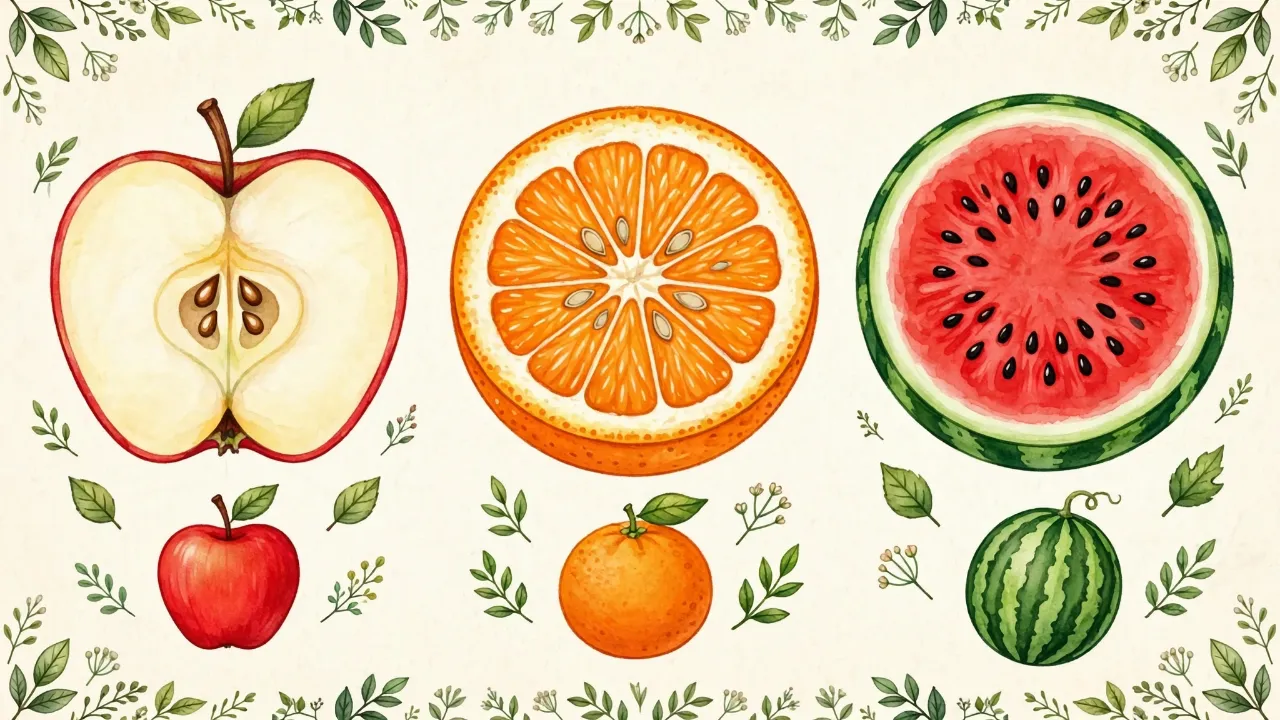
🍎 Fruit grows on plants!
Apples are red. Bananas are yellow. Grapes are purple!
Fruit is sweet and yummy. It has tiny seeds inside. 🌱
Seeds grow into NEW plants! 🌿
Fruit grows on plants and trees. Apples grow on apple trees. Blueberries grow on bushes. Watermelons grow on vines on the ground!
Why do plants make fruit? Here is the secret: fruit is a wrapper for seeds! 🎁 The plant makes the fruit sweet and tasty so animals will eat it. Then the animal carries the seeds to a new place. A new plant grows there!
Fruit is good for your body. It gives you vitamins that help you grow strong and stay healthy! 💪
Fruit is one of the most amazing tricks in the plant kingdom. A plant cannot walk around and plant its seeds somewhere new. So what does it do? It wraps its seeds in something delicious and lets animals do the work.
What IS Fruit, Really?
A fruit is the part of a plant that holds the seeds. It usually grows from a flower. After a flower is pollinated (which means pollen reaches it, often carried by bees 🐝), the flower's petals fall off and the base swells up into a fruit.
Here is the surprising part: by this definition, tomatoes are fruit. So are peppers, cucumbers, and even pumpkins! If it has seeds inside and grew from a flower, a scientist would call it a fruit.
Why Fruit Tastes Good
Plants want animals to eat their fruit! When a bird eats a cherry, the seed passes through the bird's body and lands somewhere far away, with a little pile of fertilizer around it. The plant gets its seeds spread without moving an inch. Sweet, bright-colored fruit is basically an advertisement: "Eat me!"
Not All Fruit Is Sweet
Some fruits use wind instead of animals. Maple "helicopter" seeds spin through the air. Dandelion puffs float on the breeze. These fruits do not need to taste good because no animal needs to eat them.
Fruit and Your Body
Fruit is packed with good stuff:
- Vitamin C (oranges, strawberries, kiwis): helps your body fight germs
- Potassium (bananas): keeps your muscles working
- Fiber (apples, pears): helps your digestion
- Water (watermelon is 92% water!): keeps you hydrated
In everyday language, "fruit" means something sweet you eat for a snack. In botany, "fruit" means something much more specific, and much more interesting. A fruit is a mature ovary of a flowering plant, typically containing seeds. By that definition, the world of fruit is far stranger than the produce aisle suggests.
The Botany: How Fruit Forms
It starts with a flower. Inside the flower is the ovary, which contains ovules (future seeds). When pollen lands on the stigma (the sticky top of the pistil), it grows a tube down through the style to reach the ovules. Fertilization occurs. The ovules develop into seeds. The ovary wall (called the pericarp) swells and ripens into the fruit.
Exocarp: the outer skin (apple peel, orange rind)
Mesocarp: the fleshy middle (the part you usually eat)
Endocarp: the inner layer around the seed (the hard pit of a peach, the papery core of an apple)
Types of Fruit
Botanists classify fruit into several categories:
- Simple fruits develop from a single ovary of a single flower (peach, tomato, grape)
- Aggregate fruits develop from multiple ovaries of a single flower (raspberry, strawberry: each little bump on a raspberry is actually a separate tiny fruit!)
- Multiple fruits develop from the ovaries of multiple flowers fused together (pineapple, fig)
- Accessory fruits include tissue that is not from the ovary: the fleshy part of a strawberry is actually the swollen receptacle of the flower, and the "seeds" on the outside are the real fruits
Seed Dispersal Strategies
The entire evolutionary point of fruit is seed dispersal. Different fruits use different strategies:
- Animal dispersal (zoochory): Sweet, colorful fruits attract animals. Many fruits turn bright red or orange when ripe because birds have excellent color vision. Interestingly, capsaicin (the chemical that makes chili peppers hot) deters mammals but not birds. Birds are the intended dispersers.
- Wind dispersal (anemochory): Maple samaras, dandelion achenes, and cottonwood capsules use wings, parachutes, and tufts to ride the wind.
- Water dispersal (hydrochory): Coconuts can float for months across oceans and still germinate when they wash ashore.
- Explosive dispersal: Some fruits literally explode. The sandbox tree (Hura crepitans) launches seeds at 160 mph (250 km/h).
Fruit Nutrition Science
Fruit provides sugars (fructose, glucose, sucrose), dietary fiber, vitamins (especially C, A, and various B vitamins), minerals (potassium, magnesium), and phytochemicals (flavonoids, carotenoids, anthocyanins). The fiber in whole fruit slows sugar absorption, which is why eating an orange is metabolically different from drinking orange juice: the juice delivers the same sugar without the fiber to moderate the blood sugar spike.
Strawberries: 4.9g sugar
Blueberries: 10g sugar
Banana: 12.2g sugar
Grapes: 16.3g sugar
Dates: 63.4g sugar
Despite the sugar, whole fruit consumption is consistently associated with lower (not higher) risk of type 2 diabetes in large cohort studies.
Fruit is one of evolution's most elegant solutions to a fundamental problem in plant biology: how does a stationary organism disperse its offspring? The answer: bribery. Wrap your seeds in sugar, color, and aroma, and let mobile organisms carry them away. This co-evolutionary relationship between plants and animals has shaped ecosystems, diets, and even human civilization.
The Evolution of Fruit
Fruit is an angiosperm innovation. Angiosperms (flowering plants) diverged from gymnosperms roughly 140 million years ago during the early Cretaceous period. Gymnosperms (conifers, cycads) disperse seeds via cones and wind. Angiosperms developed flowers to attract pollinators and fruit to attract seed dispersers, a two-stage system of animal co-option.
The rapid diversification of angiosperms in the mid-Cretaceous (the "abominable mystery" that puzzled Darwin) coincided with the diversification of pollinating insects and fruit-eating vertebrates, suggesting co-evolutionary feedback loops: more fruit-eaters meant better dispersal, which meant more plant species, which meant more food for fruit-eaters.
Non-climacteric fruits (grapes, citrus, strawberries) do not have this ethylene burst. They ripen gradually and do not continue to ripen after picking. This distinction is critical for agriculture: climacteric fruits can be picked green and ripened in transit, while non-climacteric fruits must be picked ripe.
Domestication and the Fruits We Know
Nearly every fruit in a modern grocery store is the product of thousands of years of selective breeding. Wild bananas are small, full of hard seeds, and barely edible. Wild watermelons were bitter and the size of a tennis ball. Wild peaches were 25mm in diameter with very little flesh.
Humans selected for larger size, higher sugar content, smaller or absent seeds, and longer shelf life. The Cavendish banana (the variety that accounts for 47% of global banana production) is a sterile triploid clone that cannot reproduce sexually. Every Cavendish banana is genetically identical, making the entire global crop vulnerable to a single pathogen (currently Fusarium oxysporum TR4, or Panama disease Tropical Race 4).
Co-evolution: Color, Chemistry, and Animal Partners
Fruit colors are not random. The "dispersal syndrome hypothesis" predicts that fruit traits evolve to attract specific dispersal partners:
- Bird-dispersed fruits tend to be red or black, small, with thin skin and no strong odor (birds have excellent color vision but poor olfaction)
- Mammal-dispersed fruits tend to be larger, green or brown when ripe, aromatic, and with thick rinds (mammals have good olfaction but many are red-green colorblind)
- Bat-dispersed fruits tend to be pale-colored, exposed on the branch, and strongly scented at night
The capsaicin defense in chili peppers is a textbook example. Capsaicin activates TRPV1 pain receptors in mammals but not birds. This selectively deters mammals (whose molars would crush the seeds) while permitting birds (whose digestive tracts pass seeds intact) to eat and disperse them. Tewksbury & Nabhan (2001) demonstrated this elegantly by comparing seed germination rates after passage through bird versus mammal digestive systems.
Fructose Metabolism and Human Health
Fructose is metabolized primarily by the liver via fructokinase, bypassing the regulatory step of phosphofructokinase that controls glucose metabolism. In excess, this pathway generates substrates for de novo lipogenesis (fat synthesis) and produces uric acid. This is the biochemical basis for concerns about high-fructose corn syrup (HFCS).
However, whole fruit consumption presents a paradox: despite containing fructose, it is consistently associated with reduced risk of metabolic disease. Muraki et al. (2013), in a meta-analysis of three large prospective cohorts (Nurses' Health Study I and II, Health Professionals Follow-Up Study; n = 187,382), found that greater whole fruit consumption was associated with a significantly lower risk of type 2 diabetes, while fruit juice consumption was associated with a higher risk. The fiber, water content, phytochemicals, and cell-wall matrix of whole fruit slow absorption and may alter the metabolic fate of the fructose.
- Tewksbury, J.J. & Nabhan, G.P., "Directed deterrence by capsaicin in chillies," Nature, 2001.
- Muraki, I. et al., "Fruit consumption and risk of type 2 diabetes," BMJ, 2013.
- Givnish, T.J., "Ecology of plant speciation," Taxon, 2010.
- Knapp, S. et al., "Fruit evolution in Solanaceae," Botanical Journal of the Linnean Society, 2004.
- Ploetz, R.C., "Panama disease: An old nemesis rears its ugly head," Plant Health Progress, 2015.
Fruit is one of those topics that seems simple until you actually dig into it, and then it becomes one of the most fascinating intersections of evolutionary biology, human history, chemistry, and nutrition. It is also a topic that kids encounter every single day, which makes it a perfect gateway into scientific thinking.
The Big Idea for Kids
The single most mind-blowing concept for kids is this: fruit exists because of a deal between plants and animals. Plants cannot move. They need their seeds carried somewhere else. So they evolved to bribe animals with sugar. The entire produce section of a grocery store is the result of millions of years of evolutionary negotiation between species that cannot move and species that can.
Once a kid grasps this, they start seeing biology everywhere. Why are flowers colorful? To attract pollinators. Why do some berries taste terrible? To warn off the wrong animals. Why do fruits turn red when they ripen? Because that is the color that catches the attention of the specific birds that disperse their seeds.
Is a Tomato a Fruit?
Botanically, yes. Culinarily, no, and that is fine. The distinction maps to two different questions: "What is this thing's role in the plant's reproduction?" (fruit = mature ovary with seeds) versus "How do we use it in cooking?" (fruit = sweet, eaten for dessert; vegetable = savory, eaten with dinner). Both answers are valid. The U.S. Supreme Court actually ruled on this in Nix v. Hedden (1893), declaring the tomato a vegetable for tariff purposes. Botany did not enter the deliberation.
The Banana Problem
The Cavendish banana is a cautionary tale about monoculture. Every Cavendish is a genetic clone. This makes large-scale farming efficient: every banana looks and tastes the same. But it also means a single disease can wipe out the entire crop. This already happened once: the Gros Michel ("Big Mike"), the dominant commercial banana before the 1950s, was effectively wiped out by Panama disease. The Cavendish was its replacement. Now Panama disease Tropical Race 4 threatens the Cavendish. There is no approved replacement variety that matches its yield, taste, and shipping durability.
Fruit Juice vs. Whole Fruit
This is one of the most important nutrition distinctions for parents. Whole fruit is excellent for health: the fiber slows sugar absorption, and the phytochemicals provide additional benefits. Fruit juice strips away the fiber and concentrates the sugar. A glass of apple juice contains roughly the same sugar as a glass of Coca-Cola (~24g per 8 oz). The American Academy of Pediatrics recommends no juice for children under 1, no more than 4 oz/day for ages 1–3, and no more than 6 oz/day for ages 4–6.
Getting Kids to Eat More Fruit
Research on children's food preferences (Birch, 1999) shows that familiarity drives preference: kids need 8–15 exposures to a new food before accepting it. Cutting fruit into accessible pieces, involving kids in selection at the store, and eating fruit yourself (modeling) are all more effective than verbal encouragement. Forcing or bribing tends to backfire.
💬 Talk About It
- For preschoolers: "What color is this fruit? Can you find the seeds?"
- For kindergartners: "If you were a plant and couldn't walk, how would you get your seeds to a new place?"
- For elementary: "Is a tomato a fruit or a vegetable? Trick question: it is both. Can you explain why?"
- For middle school: "If every banana in the world is genetically identical, what could go wrong? Has it happened before?"
- Muraki, I. et al., "Fruit consumption and risk of type 2 diabetes," BMJ, 2013.
- Birch, L.L., "Development of food preferences," Annual Review of Nutrition, 1999.
- American Academy of Pediatrics, "Fruit Juice in Infants, Children, and Adolescents: Current Recommendations," Pediatrics, 2017.
- Ploetz, R.C., "Panama disease: An old nemesis rears its ugly head," Plant Health Progress, 2015.