
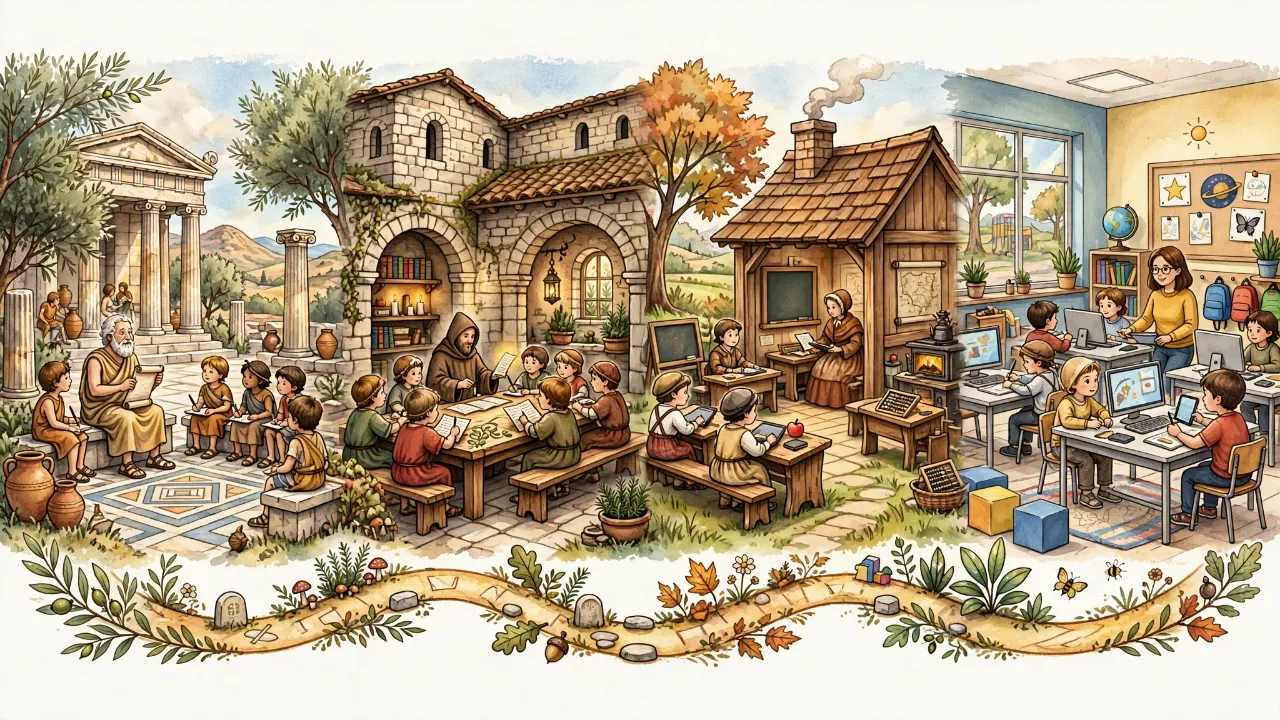
No Schools!
Long ago, kids did not go to school. They learned by watching grown-ups. A farmer's child learned to farm.
👀
Then people had an idea: teach the kids together. That was the first school. Now nearly every kid in the world goes to one.
Schools Were Not Always Like Today 🏛️
For most of history, kids learned at home or by helping their parents work.
Ancient Greece
Boys went to school to learn reading, music, and sports. A teacher named Socrates liked to ask questions instead of giving answers.
🏛️📜
Ancient China
A wise teacher named Confucius taught kids to respect their parents and work hard. Students wrote with brushes on bamboo strips.
Monks and Books
For hundreds of years, monks copied every book by hand. One book could take a whole year.
📖✍️
The Printing Press
About 575 years ago, Gutenberg invented the printing press. Books could be made fast, so more people learned to read.
Schools for Everyone
About 200 years ago, countries said all kids must go to school. Now school is for everyone.
🎒🌍
5,000 Years of School 📜
Schools seem like they have been around forever, but for most of human history, there were none. The first schools appeared about 5,000 years ago in ancient Sumer (modern-day Iraq). Students learned to write cuneiform on clay tablets. If you made a mistake, you just smoothed the clay and started over. No erasers needed!
Ancient Greece: Asking Questions
Greek schools taught reading, writing, math, music, and athletics. But what made Greek education special was HOW they taught. Socrates invented a method where the teacher asks question after question until the student figures out the answer themselves. Teachers still use this "Socratic method" today.
Only boys from wealthy families went to school. Girls learned at home. Sparta was different: both boys AND girls trained in physical fitness, because Spartans valued strong warriors above all.
Ancient China: The Imperial Exam
China created something revolutionary: government exams. If you passed the exam, you could get a government job even if your family was poor. This was one of the first "meritocracies" in history. Students studied Confucius's teachings for YEARS to prepare. Some took the exam dozens of times before passing.
Medieval Europe: Monks as Teachers
When the Roman Empire fell, most schools disappeared. For about 700 years, monks and nuns were the main teachers in Europe. They taught in Latin and preserved ancient Greek and Roman books by copying them by hand. One monk might spend 10 years copying a single large book.
The Printing Press: Game Changer (1440)
Gutenberg's printing press changed everything. Before it, a book cost as much as a house. After it, books became affordable. Within 50 years, over 20 million books had been printed. Literacy rates exploded. Schools followed.
The Factory Model (1800s)
During the Industrial Revolution, countries needed workers who could read and follow instructions. So they created public schools that looked a lot like factories: rows of desks, one teacher lecturing, everyone learning the same thing at the same time. Bells rang to change subjects, just like factory shift whistles. Sound familiar?
Today and Tomorrow
Modern schools still use a lot of that factory model. But things are changing. Some schools let kids learn at their own pace. Others use technology so students can learn from anywhere. The question for YOUR generation: what should school look like next?
Education's 5,000-Year Evolution 🏛️
The story of education is really the story of who gets to learn. For most of history, education was a privilege reserved for the elite. Making it universal took thousands of years of social, technological, and political change.
The Ancient World (3000 BCE - 500 CE)
Sumer (3000 BCE): The first schools, called "tablet houses" (edubbas), trained scribes in cuneiform writing. Students were almost exclusively boys from wealthy families. Education served the state: you learned to write so you could keep records and run the bureaucracy.
Greece (500-300 BCE): Athens invented two radical ideas that still shape education: the Socratic method (learning through questioning) and the concept of liberal arts (education for free citizens, not just job training). Plato's Academy (387 BCE) is sometimes called the first university. It lasted 900 years.
China (500 BCE - 1905 CE): Confucius argued that education should be based on merit, not birth. The Imperial Examination system (established 605 CE, abolished 1905) was the world's first standardized test. At its peak, over 2 million candidates sat for exams across China every three years.
Rome: Adapted Greek education but made it more practical. Rhetoric (public speaking) became the core subject because Roman citizens needed to argue law cases and debate in the Senate. Roman schools were the first to use a graded system: ludus (elementary), grammaticus (secondary), and rhetor (advanced).
The Medieval Period (500 - 1400 CE)
The fall of Rome wiped out most secular education in Europe. Monasteries became the last repositories of learning. Monks preserved classical texts through painstaking manual copying. One error per page was considered acceptable. Charlemagne's education reforms (789 CE) ordered every cathedral and monastery to establish a school, but progress was slow.
The first universities emerged around 1100 CE: Bologna (law), Paris (theology), Oxford (everything). Students were as young as 14. There were no campuses. Lectures happened in rented rooms or churches. Student riots were common enough that universities negotiated special legal protections.
The Printing Revolution (1440 - 1600)
Gutenberg's printing press (c. 1440) was the most disruptive technology in education history until the internet. Before printing, a single book cost roughly 6 months of a laborer's wages. By 1500, there were over 1,000 print shops across Europe producing 20+ million volumes. Literacy went from under 10% to over 30% in Protestant regions within a century. Martin Luther argued that every child, including girls, should learn to read so they could study the Bible themselves.
The Prussian Model (1763 - Present)
In 1763, Prussia (modern Germany) created the first modern compulsory education system. Frederick the Great mandated school attendance for all children ages 5-13. The system was designed to produce obedient citizens and capable soldiers. It featured: age-based grades, standardized curriculum, trained teachers, mandatory attendance, and government funding.
This model spread worldwide. Horace Mann brought it to Massachusetts in 1837. Japan adopted it during the Meiji Restoration (1868). By 1900, most industrialized nations had some form of compulsory schooling. The factory model worked because the economy needed factory workers.
Progressive Education (1900 - Present)
John Dewey challenged the factory model. He argued schools should teach children how to THINK, not just what to memorize. Maria Montessori developed child-centered education where kids choose their own activities. Both emphasized learning by doing over learning by listening.
Today the debate continues: standardized testing vs. project-based learning, traditional classrooms vs. personalized digital platforms, memorization vs. critical thinking. The factory model persists because it is efficient. But is efficient the same as effective?
The Philosophy and Politics of Education 🎓
Every educational system embeds a theory of what humans are for. Ancient Athens educated citizens for democratic participation. Medieval Europe educated monks for spiritual devotion. Prussia educated subjects for national obedience. Industrial America educated workers for factory productivity. What is today's education system optimizing for?
The Ancient Foundations
Plato's Republic (380 BCE) laid out the first comprehensive educational philosophy. He proposed tracking students by ability: gold (philosopher-kings), silver (warriors), and bronze (producers). This idea that education should sort people into social roles has persisted, controversially, for 2,400 years.
Confucius (551-479 BCE) took a radically different approach: education as moral cultivation. The Analects describe a teacher who adjusts instruction to each student's character. His idea that a farmer's son could, through study, become a minister of state was genuinely revolutionary in a world of hereditary caste systems.
The Trivium and Quadrivium: Medieval universities organized knowledge into seven liberal arts: grammar, logic, rhetoric (trivium), then arithmetic, geometry, music, astronomy (quadrivium). This structure influenced Western curricula for nearly a millennium. The SAT still fundamentally tests the trivium (reading, reasoning, writing).
The Printing Press as Platform Shift
Gutenberg did not just make books cheaper. He fundamentally changed the relationship between learner and authority. Before printing, knowledge was mediated by teachers and priests who controlled access to texts. After printing, individuals could read, interpret, and challenge ideas independently. The Protestant Reformation was essentially a dispute about who gets to interpret a printed text. Every "disruption" in education since then (radio, television, internet, AI) has replayed this same dynamic: new technology democratizes access, incumbents resist, the curriculum eventually adapts.
The Prussian System and Its Discontents
The system you attend daily descends from 18th-century Prussia. Frederick the Great's motivations were explicitly political: he needed citizens who could read military orders, follow regulations, and show up on time. Johann Gottlieb Fichte, in his "Addresses to the German Nation" (1808), argued that state-controlled education would create national unity. This is not conspiracy theory. It is the actual stated purpose of compulsory schooling.
Horace Mann imported the Prussian model to Massachusetts in 1837, explicitly praising its efficiency and uniformity. The one-room schoolhouse gave way to age-graded classrooms, standardized textbooks, and professional teacher training. The system worked brilliantly for industrialization.
Dewey, Montessori, and Freire
John Dewey (1859-1952) argued in "Democracy and Education" (1916) that schools should be microcosms of democratic society. Students learn by solving real problems, not by memorizing facts. His Laboratory School at the University of Chicago demonstrated that children learn more when they are actively engaged.
Maria Montessori (1870-1952) observed that children have natural developmental stages and learn best when given freedom within structured environments. Her method emphasizes self-directed activity, mixed-age classrooms, and hands-on materials. It is now used in over 60,000 schools worldwide.
Paulo Freire (1921-1997) wrote "Pedagogy of the Oppressed" (1968), arguing that traditional education treats students as empty vessels to be filled (the "banking model"). He proposed "problem-posing education" where students and teachers learn together through dialogue. His work influenced critical pedagogy and is particularly relevant to discussions about whose knowledge counts in the curriculum.
The Standardized Testing Debate
The SAT was created in 1926 to democratize college admissions. Its creator, Carl Brigham, was a eugenicist who later renounced his own test. The No Child Left Behind Act (2001) made standardized testing the primary measure of school quality. The result: schools that serve low-income students spend an estimated 20-25% of instructional time on test preparation. Whether testing improves education or merely measures socioeconomic status remains one of the most contested questions in education policy.
Finland consistently ranks among the top education systems globally. It has no standardized tests, no private schools, and no school inspections. Teachers are required to hold master's degrees and are given extraordinary autonomy. The Finnish model suggests that trust in professionals may produce better outcomes than testing and accountability.
Education as Social Technology: A Systems Analysis
Education systems are the largest social technology ever deployed. Over 1.5 billion students are currently enrolled in formal education worldwide. The infrastructure consumes 4-6% of GDP in most developed nations. Yet the fundamental architecture remains largely unchanged since Prussia's 1763 mandate. Understanding why requires examining education not as pedagogy but as institutional design.
The Pre-Institutional Era (Prehistory - 3000 BCE)
For roughly 95% of human existence, education was entirely informal. Hunter-gatherer societies transmitted knowledge through apprenticeship, storytelling, and play. Cross-cultural research by David Lancy ("The Anthropology of Childhood," 2008) shows that in traditional societies, children are expected to learn by observing and gradually participating in adult activities. The concept of "teaching" as a distinct activity is relatively rare in non-literate societies. Children learn; adults do not necessarily teach.
Institutional Origins: Literacy Creates Schools
Schools emerged specifically because writing cannot be learned by observation. The Sumerian edubba (c. 3000 BCE), Egyptian temple schools (c. 2500 BCE), and Chinese court schools (c. 2000 BCE) all share a common origin: bureaucratic states needed literate administrators. The technology (writing) created the institution (schools). This pattern repeats: printing created mass schooling; the internet is creating whatever comes next.
The Greek contribution was philosophical: Plato's Academy (387 BCE) proposed education as the formation of the whole person, not merely vocational training. The Chinese contribution was meritocratic: the keju (imperial examination, 605-1905 CE) established the principle that social mobility through demonstrated competence is a legitimate organizing principle for society. The tension between vocational and humanistic education, and between elite and democratic access, remains unresolved.
The University as Medieval Technology
The medieval university (Bologna 1088, Paris c. 1150, Oxford 1096) was a remarkable institutional innovation. It introduced: degree-granting authority, faculty governance, academic freedom (the right to teach controversial ideas), the lecture format, and the examination system. These features persist in virtually every modern university. The university survived because it solved a coordination problem: it credentialed knowledge workers in a way that was legible across political boundaries.
Print Capitalism and Mass Literacy
Benedict Anderson's "Imagined Communities" (1983) argues that print capitalism created the conditions for both mass literacy and nationalism. Standardized vernacular languages, made possible by printing, replaced Latin as the medium of instruction. This democratized access but also enabled state control of curriculum. The textbook replaced the teacher as the primary authority on content. Elizabeth Eisenstein's "The Printing Press as an Agent of Change" (1979) documents how print transformed not just access to knowledge but the structure of knowledge itself: standardization, indexing, cross-referencing, and cumulative revision.
The Prussian Model: Industrial Education Design
The Prussian Volksschule (1763) and its refinement under Wilhelm von Humboldt (1809-1810) created the template for modern mass education. Humboldt's model distinguished between Bildung (self-cultivation through humanistic education) and Ausbildung (vocational training). In practice, the Gymnasium provided Bildung for elites while the Volksschule provided Ausbildung for the masses. This bifurcation persists in tracking systems worldwide.
The American adoption via Horace Mann (1837) and the Committee of Ten (1893) standardized the high school curriculum around academic disciplines. The Cardinal Principles report (1918) shifted emphasis toward "life adjustment," creating the comprehensive high school. Both approaches reflect ongoing tension between preparing students for college and preparing them for work.
The Coleman Report and Its Legacy
James Coleman's "Equality of Educational Opportunity" (1966) was the largest social science study ever conducted at the time (600,000 students, 4,000 schools). Its findings were devastating: school resources (spending, facilities, curriculum) explained remarkably little of the variance in student achievement. Family background and socioeconomic status were far more predictive. The report's implications are still debated: does it mean schools cannot overcome inequality, or that we have not yet designed schools that do?
Eric Hanushek's subsequent meta-analyses confirmed that money alone does not predict outcomes, but teacher quality does. A student with a top-quartile teacher for three consecutive years can overcome the average achievement gap between low-income and high-income students. The policy implication: invest in teacher selection and development, not buildings and materials.
The Current Inflection
AI tutoring systems (Khan Academy's Khanmigo, Duolingo's GPT-4 integration) represent the first technology that can plausibly replicate the one-on-one tutoring that Benjamin Bloom's "2 Sigma Problem" (1984) identified as the gold standard. Bloom showed that students who received individual tutoring performed two standard deviations above conventionally taught students. No scalable intervention has ever replicated this effect. AI may change that.
The question is whether AI tutoring will democratize elite-quality education or further stratify it. If expensive AI tutoring outperforms free versions (as seems likely), the technology could widen rather than narrow the achievement gap. The history of education technology suggests both outcomes are possible: the printing press eventually democratized literacy, but it took centuries and required political will to create public schools.