
🌉 Look! A bridge over the water! Cars drive across it.
But HOW does it stay up?
Bridges use triangles! 📐 Triangles are strong. Make one with your fingers and push. It does not squish!
Some bridges hang from big ropes. Some curve like a rainbow! 🌈
Every bridge has the same job: hold things up over an empty space, like a river or a road.
Two Invisible Forces
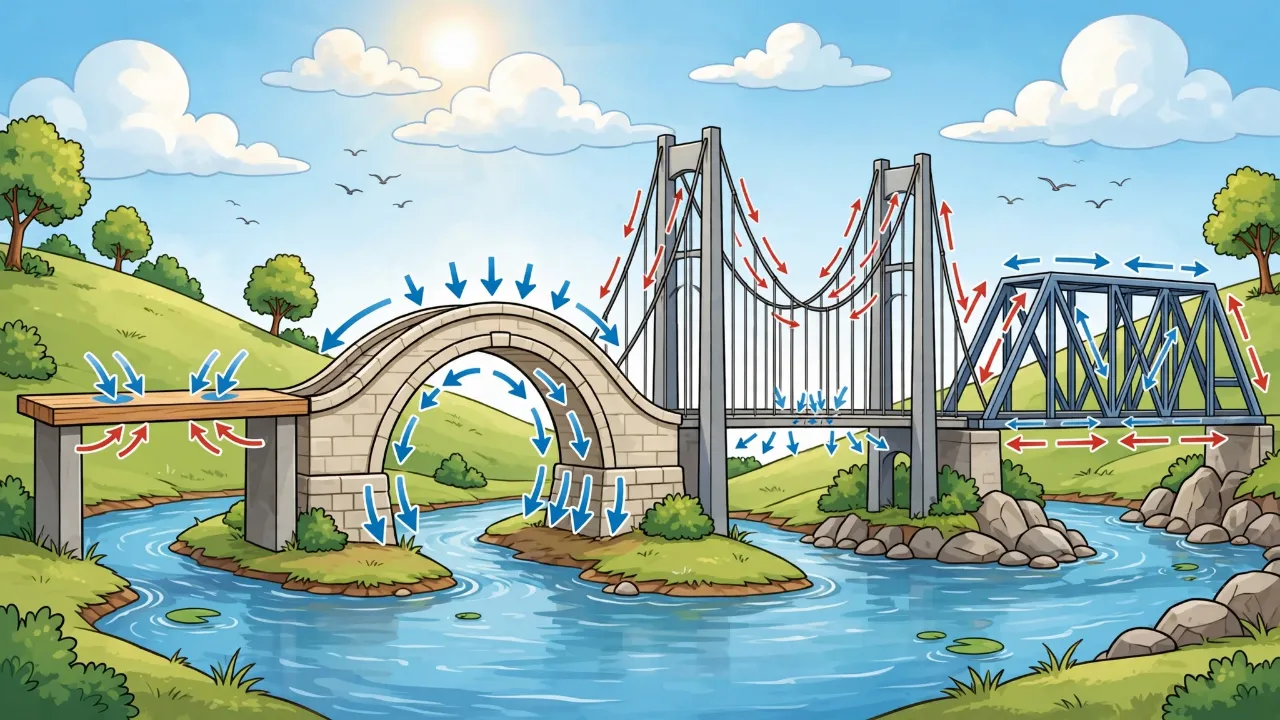
Compression is a pushing force. The weight of a bridge pushes down on its columns.
Tension is a pulling force. When you pull a rope, the rope is in tension. Bridge cables are pulled tight.
Three Main Types
A beam bridge is like a log across a stream. An arch bridge uses a curve to spread the weight. A suspension bridge hangs the road from cables on tall towers.
Why Shape Matters
A flat piece of paper bends easily. Fold it like a fan, and it gets much stronger. Triangles are the strongest shape of all, because a triangle cannot change its shape without breaking a side.
A bridge is a negotiation between forces. Weight pushes down. The structure pushes back. The path that force takes through the structure determines whether the bridge stands or falls.
Compression vs. Tension
Every structural element in a bridge is either being compressed (pushed together), pulled apart (tension), or both. Concrete is strong in compression but weak in tension (it cracks when pulled). Steel is strong in both. That is why modern bridges use reinforced concrete: steel rods inside handle the tension while concrete handles the compression.
Bridge Types
Beam Bridges are simplest: a horizontal surface supported at both ends. The bending force increases with the square of the span length. Double the length, quadruple the bending force. Most beam bridges are under 80 meters.
Arch Bridges redirect vertical loads into compressive forces along the curve. The Pont du Gard in France, built by the Romans around 19 BCE, still stands because every stone is in pure compression. No mortar. No steel. Just shapes and gravity.
Truss Bridges use triangulated frameworks. A triangle is the only polygon that cannot deform without changing the length of a side.
Suspension Bridges hang the deck from cables. The Akashi Kaikyo Bridge holds the record at 1,991 meters.
The Tacoma Narrows Lesson
On November 7, 1940, the Tacoma Narrows Bridge collapsed in 64 km/h winds. The wind matched the bridge's natural resonant frequency, causing it to twist until it failed. The entire collapse was captured on film. Modern bridges now include aerodynamic shapes and damping systems because of this failure.
Forces in Equilibrium
A bridge that is not falling down is in static equilibrium: the sum of all forces equals zero, and the sum of all torques (rotational forces) equals zero. Every force has a reaction force. Weight pushes down, supports push up. Cables pull, anchors resist. Understanding bridges means understanding how forces flow through a structure from the point of loading to the ground.
Compression and Tension: The Numbers
Materials have measurable strengths in compression and tension:
Concrete: 20-40 MPa (strong in compression)
Steel: 250-400 MPa
Granite: 130-280 MPa
Tensile strength (MPa):
Concrete: 2-5 MPa (weak in tension, about 10% of compressive)
Steel: 400-550 MPa (equally strong in both)
Granite: 7-25 MPa (also weak in tension)
This is why reinforced concrete works: steel handles the tension that concrete cannot.
Why Triangles Work: Geometric Rigidity
A triangle is the simplest rigid polygon. If you build a square frame from four sticks and push on one corner, the square deforms into a diamond without breaking any sticks. The joints rotate. A triangle frame cannot do this. To change a triangle's shape, you must change the length of at least one side, which means bending or breaking a member.
Trusses exploit this by building entire structures from triangles. A Pratt truss, Warren truss, and Howe truss are all arrangements of triangles optimized for different load patterns. The Pratt truss (diagonal members slope toward center) is efficient for railroad bridges because the diagonals are in tension (steel is efficient in tension). The Howe truss (diagonals slope outward) puts diagonals in compression, which was better when bridges used timber (wood handles compression well).
Resonance: The Tacoma Narrows Failure
Every structure has natural frequencies at which it vibrates. If an external force (wind, footsteps, earthquakes) matches a natural frequency, the vibration amplitude increases dramatically. This is resonance.
Stress, Strain, and Material Behavior
Stress (σ) is force per unit area, measured in Pascals (Pa) or megapascals (MPa). Strain (ε) is the fractional change in length. For most engineering materials under small loads, stress and strain are linearly related:
Where E is Young's modulus (also called the modulus of elasticity). Steel has E ≈ 200 GPa. Concrete has E ≈ 30 GPa. This means steel is about 6.7 times stiffer than concrete: for the same stress, steel deforms less.
Beyond the elastic limit, materials behave differently. Steel yields plastically (deforms permanently but does not break immediately), giving warning before failure. Concrete and cast iron are brittle: they crack suddenly with little warning. This is why ductile materials like steel are preferred for structures where safety is critical.
Cable Mechanics in Suspension Bridges
The main cables of a suspension bridge form a catenary curve under their own weight, but with the deck load distributed along the span, the shape approximates a parabola. The horizontal tension H in the cable is constant along its length and relates to the cable geometry by:
Where w is the distributed load per unit length, L is the span, and d is the cable sag. Reducing sag increases cable tension dramatically: halving the sag doubles the required cable strength. The Golden Gate Bridge cables have a sag-to-span ratio of about 1:9, balancing tension forces against the desire for vehicle clearance below.
Fatigue and the S-N Curve
Bridges do not just support static loads. Traffic creates millions of stress cycles over a bridge's lifetime. Metal fatigue causes cracks to initiate and propagate even at stresses well below the yield strength. The S-N curve (stress vs. number of cycles to failure) characterizes this behavior. Steel has an endurance limit (about 40% of ultimate tensile strength) below which fatigue failure theoretically never occurs. Aluminum does not have an endurance limit, which is why aluminum aircraft structures require periodic inspection.
- Gordon, J.E., Structures: Or Why Things Don't Fall Down, Penguin Books, 1978.
- Salvadori, M., Why Buildings Stand Up: The Strength of Architecture, Norton, 1980.
- Federal Highway Administration, National Bridge Inventory Statistics, 2023.
- NTSB, Highway Accident Report: Collapse of I-35W Highway Bridge, NTSB/HAR-08/03, 2008.
Bridge engineering is one of the most intuitive entry points to structural mechanics for children because the forces involved can be felt with hands and household objects.
Why Shape Beats Material
A flat sheet of paper spans a few centimeters before sagging. The same sheet folded into a corrugated profile can support hundreds of times more weight. The material has not changed. The moment of inertia has.
The Eiffel Tower uses 7,300 tonnes of iron but is so structurally efficient that if melted down, the iron would fill the tower's base footprint to a depth of only 6 centimeters.
US Bridge Infrastructure: The Numbers
The Federal Highway Administration's National Bridge Inventory as of 2023 counts 617,084 bridges in the United States. 42% are 50+ years old. 7.5% (46,154) are structurally deficient. The total backlog of deferred maintenance is approximately $125 billion. The Bipartisan Infrastructure Law allocated $40 billion over 5 years, roughly one-third of the backlog.
The Failure Cascade Problem
Bridge failures are disproportionately instructive because they are visible. The 1940 Tacoma Narrows collapse was filmed and became the most-watched structural failure in history, permanently changing how engineers think about wind loading. The 2007 I-35W collapse killed 13 people because of gusset plates that were under-designed in 1967 and never caught in 40 years of inspections. The 2018 Morandi Bridge collapse in Genoa killed 43 people when corroded stay cables on a non-redundant design failed. Each failure exposed a systemic blind spot, not just a local defect.
What makes these cases powerful for teaching is that the physics is accessible. Resonance (Tacoma), cumulative load addition (I-35W), and corrosion of a single critical element (Morandi) are all concepts a motivated middle-schooler can grasp.
Building Bridges at Home
Bridges are one of the few engineering topics where the kitchen table IS the lab. A sheet of paper, two books, and a handful of coins demonstrate beam deflection, corrugation, and the moment of inertia. Popsicle stick bridges (held together with wood glue) can be tested to failure with a bucket of sand, turning abstract stress-strain curves into a satisfying crunch.
💬 Talk About It
- For preschoolers: Build bridges with blocks, books, and paper. "Can you make a bridge strong enough to hold this toy car?"
- For kindergartners: Next time you drive over a bridge, look at the shape. Is it flat? Curved? Are there triangles?
- For elementary: The Romans built bridges 2,000 years ago that still work. Ours last 75 years. Is faster and cheaper always better?
- For middle school: Look up the closest structurally deficient bridge in your area using the National Bridge Inventory database. What would it take to fix it?
- Gordon, J.E., Structures: Or Why Things Don't Fall Down, Penguin Books, 1978.
- Salvadori, M., Why Buildings Stand Up: The Strength of Architecture, Norton, 1980.
- Federal Highway Administration, National Bridge Inventory Statistics, 2023.
- Petroski, H., To Engineer Is Human: The Role of Failure in Successful Design, Vintage, 1992.
- NTSB, Highway Accident Report: Collapse of I-35W Highway Bridge, NTSB/HAR-08/03, 2008.