
Ice Cream vs. Gelato: What's the Real Difference?
September 9, 2026
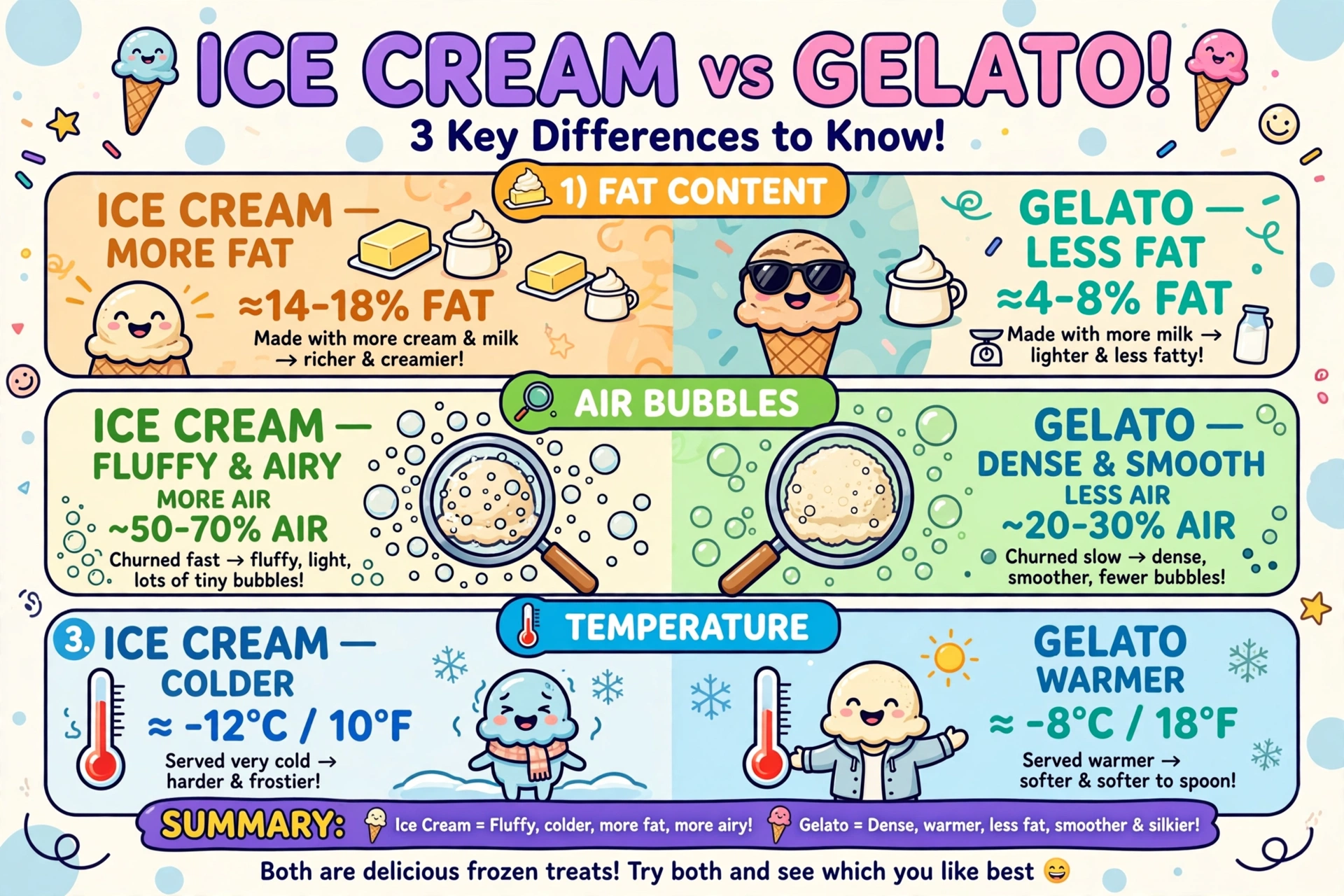
🍨 Ice cream is cold and sweet!
🍦 Gelato is cold and sweet too!
Gelato feels thick and creamy on your tongue. Ice cream feels light and fluffy. Both are yummy frozen treats!
What makes them different?
Ice cream and gelato are both frozen treats made from milk and sugar. But they feel different on your tongue! Gelato feels thick and smooth. Ice cream feels light and fluffy.
What does churn mean?
To churn means to stir something very fast while it freezes. Ice cream is churned fast. Fast churning whips lots of air into it, like blowing bubbles into milk. That air makes ice cream fluffy.
Why is gelato churned slow?
Gelato is churned slow. Slow churning adds less air. Less air means gelato feels dense and creamy instead of fluffy.
Why does gelato taste stronger?
Gelato has less fat than ice cream. Fat can coat your tongue like a blanket. With less fat in the way, the flavor hits your tongue faster. That is why lemon gelato tastes super lemony!
Three Differences You Can Taste
Ice cream and gelato look like cousins, but three big differences separate them: fat, air, and temperature. Each one changes how the treat feels and tastes.
Fat: Less Is More (Flavor)
American ice cream must contain at least 10% milkfat, and premium brands go up to 16%. Gelato usually has only 4% to 8% fat. That sounds backwards. Shouldn't more fat mean more flavor?
Nope! Fat coats your tongue like a cozy blanket. A thick blanket of fat actually blocks flavor from reaching your taste buds quickly. Gelato's lower fat means flavors like pistachio or strawberry hit your tongue directly. That is why gelato often tastes more intense even though it has less fat.
Air: The Invisible Ingredient
Ice cream makers whip air into their product while churning. The industry calls this overrun: how much bigger the finished product is compared to the liquid mix. Cheap ice cream can be 100% overrun, meaning half of every scoop is air!
Gelato is churned slowly, so it picks up much less air, usually 20% to 35% overrun. Less air means a denser, silkier scoop that melts more slowly on your tongue.
Temperature: Warmer Means Tastier
Ice cream is stored and served at about 0°F, which is very cold. Gelato is served warmer, around 10°F to 15°F. Cold numbs your taste buds a little, the same way your fingers go numb in snow. Because gelato is served warmer, your taste buds stay awake and catch more flavor.
Try This!
Do a taste test at home. Get a small cup of vanilla ice cream and a small cup of vanilla gelato. Taste the ice cream first, then the gelato. Which one tastes more like vanilla? Which one feels heavier on your spoon? Write down what you notice!
The Physics Hidden in Your Scoop
Ice cream and gelato are both frozen foams. Sounds simple. It is not. Not even close.
Each scoop contains four things mixed together: ice crystals, air bubbles, fat droplets, and a sugary syrup that never fully freezes no matter how cold it gets, a liquid that persists inside the solid like a secret. The difference between ice cream and gelato comes down to how those four parts are balanced. Change the ratios. Change everything.
Overrun: Doing the Math on Air
Overrun measures how much air gets whipped in during churning. Simple formula. Big implications.
Economy ice cream: 100% overrun. Premium: 50%. Traditional gelato: 20-35%. See the pattern?
Pick up a pint of gelato. Heavy. Dense. Substantial. Now pick up a pint of cheap ice cream. Light. Fluffy. Suspiciously light. That is because you are literally holding more food and less air, and your hand can tell the difference even before your tongue gets a vote, even before you read the label, even before you pay.
Why Fat Mutes Flavor
Fat molecules are large. They coat the tongue like paint. Thick paint.
Flavor molecules must dissolve through that fatty layer before taste buds can detect them, which delays and dulls perception in a way you can actually measure with timing experiments, the delay quantifiable in milliseconds. Gelato's 4-8% fat versus ice cream's 10-16% means flavor compounds reach your receptors faster and in higher concentration. The result? That intense hit. The eye-close. The first-spoonful moment. Sensory scientists have confirmed this in blind taste tests: lower-fat frozen desserts score higher on flavor intensity even when the recipe is identical.
Temperature and Your Taste Buds
Taste buds peak around 68-86°F. Room temperature. Comfort zone.
At 0°F, the serving temperature of ice cream, their sensitivity drops sharply. Numb. Muted. Asleep. Gelato served at 10-15°F keeps receptors more responsive, more awake, more ready. There is a second effect too: warmer temperatures release more volatile aroma molecules into the air, and since most of what you experience as "flavor" is actually smell traveling up the back of your throat to your nose, gelato delivers a bigger aromatic punch with every single bite, every single time, no exceptions.
A 500-Year-Old Invention
Frozen desserts go back to ancient Persia. Ancient China. Millennia old.
But gelato as we know it? Renaissance Florence. 1565. Bernardo Buontalenti, architect and inventor for the powerful Medici family, created a frozen cream dessert for a royal banquet so spectacular it became legend, the kind of dish guests talked about for years, the kind that changes what people think is possible. Guests had never tasted anything like it. Nothing close. Catherine de' Medici brought the concept to France. France brought it to the world.
Think About It
Less fat means more flavor. So why does premium ice cream keep adding fat?
Texture versus flavor. Richness versus intensity. Mouthfeel versus taste. Fat makes things feel luxurious even as it mutes flavor slightly, and that contradiction sits at the heart of every premium pint. Which matters more to you? The creamiest mouthfeel or the strongest flavor? No wrong answer. But now you know the trade.
Four Phases, One Scoop
Ice cream is complicated, absurdly so.
From a materials science perspective, each scoop contains four distinct phases coexisting in delicate balance: ice crystals (typically 30-50 micrometers in premium products), air cells (20-50 micrometers), partially coalesced fat globules forming a network around the air cells, and an unfrozen serum phase containing dissolved sugars, proteins, and stabilizers. The size distribution of the ice crystals largely determines perceived smoothness. Crystals above roughly 50 micrometers register as grainy or icy on the tongue, which is why industrial producers obsess over freezing speed.
Churning Speed and Crystal Nucleation
The dasher speed inside the churn controls two competing processes. Faster churning whips in more air but also scrapes forming ice crystals off the barrel wall more aggressively, promoting many small crystals rather than fewer large ones.
Gelato's slow churn is a deliberate tradeoff, and understanding it requires thinking about what each variable costs, how every choice in the recipe ripples through the final texture, and why the traditional method survived centuries of industrial pressure to change it. It accepts slightly larger ice crystals in exchange for dramatically lower overrun. The denser matrix compensates texturally. The warmer serving temperature keeps the product scoopable despite the lower air content. Every parameter is a negotiation. No exceptions.
The Regulatory Divide
In the United States, the FDA defines ice cream precisely under 21 CFR 135.110: minimum 10% milkfat, maximum limits on overrun, and specific allowances for sweeteners, stabilizers, and flavorings. Anything below 10% fat must be labeled "ice milk" or "low-fat ice cream." Clear rules, enforced.
Italy has no equivalent legal standard for gelato. The term is unregulated. Quality varies enormously: artisanal gelaterie follow tradition (low fat, low overrun, fresh daily), while industrial producers can sell high-overrun, high-stabilizer product under the same romantic name, and the customer has no legal recourse. Culture protects what law does not.
Emulsifiers, Stabilizers, and the Freshness Window
Commercial ice cream relies on stabilizers (guar gum, locust bean gum, carrageenan) and emulsifiers (mono- and diglycerides, polysorbate 80) to survive months in a supply chain. These ingredients control ice recrystallization during temperature fluctuations in transport and home freezers.
Artisanal gelato, made fresh daily and served within 72 hours, needs far fewer of them. This is not a health claim so much as a logistics observation: the shorter the distance from churn to spoon, the simpler the ingredient list can be, and the closer the product stays to what the maker intended.
The Flavor-Fat Paradox, Quantified
Sensory research consistently finds an inverse relationship between fat content and flavor intensity in frozen systems, up to a point.
Fat-soluble flavor compounds (vanillin, many fruit esters) partition preferentially into fat globules, releasing slowly while water-soluble compounds hit immediately, creating a temporal flavor profile that unfolds over seconds rather than arriving all at once. Gelato's lower fat shifts this partition toward faster release. However, below about 3% fat, the product loses the creamy mouthfeel that makes frozen dessert pleasurable at all, and iciness dominates completely, turning what should be indulgence into a chore. The 4-8% gelato range sits near the optimum of the flavor-texture tradeoff curve, a sweet spot discovered through centuries of trial and error by artisans who had no instruments, no chemistry, only their tongues and their customers' reactions. The tradition converged there centuries before anyone measured it. The science just caught up.
Why Your Kid Asked About Gelato
Somewhere between the third gelateria on your last vacation and the "gelato" label now appearing on supermarket pints, your child noticed that not all frozen desserts are the same thing.
Good eye: the distinction is real, measurable, and rooted in five centuries of food technology. This article gives you the full picture so you can answer the follow-up questions. They will absolutely come.
What the Labels Actually Mean
In the US, "ice cream" is a legally defined term (21 CFR 135.110): at least 10% milkfat, with overrun effectively capped near 100% by the 4.5-pounds-per-gallon minimum weight rule. "Gelato" has no US legal definition whatsoever.
When major brands sell "gelato" in American supermarkets, the product inside is typically just ice cream formulated at slightly lower overrun, trading on Italian romance rather than regulatory meaning. True artisanal gelato, the kind served from a pozzetto in Bologna, differs in fat content (4-8%), overrun (20-35%), serving temperature (−12 to −9°C versus −18°C for ice cream), and above all freshness: it is made to be eaten within days, not warehoused for months.
Italy itself never codified gelato the way the US codified ice cream, a regulatory gap that creates a genuine quality-control problem with no easy fix, since the artisanal tradition is protected more by culture and guild pride than by law, and industrial producers free-ride on the romantic term while selling a fundamentally different product. If you want the real thing, look for gelaterie that make it on-site daily, display it in covered pozzetti (the traditional stainless steel tubs) rather than mounded high in a display case (mounding requires stabilizers to hold the shape), and offer flavors that follow the seasons, changing with what is fresh, what is ripe, what the maker found at the market that morning.
A Brief History Worth Knowing
Frozen desserts predate both names by millennia. Persian nobles ate faloodeh, a frozen vermicelli dessert, as early as 400 BCE, cooled with ice hauled from mountain glaciers and stored in yakhchals, ancient evaporative-cooling structures that still stand in the Iranian desert today. Chinese records describe frozen milk and rice mixtures under the Tang dynasty.
What Buontalenti created in Florence in 1565 was not the first frozen dessert but the first recognizably modern one: a churned, sweetened, flavored cream served as a luxury dish rather than a novelty ice, the template every gelateria still follows. The American ice cream industry, by contrast, is a story of mechanization, scale, and air. Nancy Johnson's 1843 hand-crank freezer patent made churning a household task. Jacob Fussell's 1851 Baltimore factory made it an industry. The continuous-process freezer (Clarence Vogt, 1926) made high-overrun mass production possible. Each innovation pushed American ice cream toward higher air content and longer shelf life, away from the dense, fresh ideal the Italians preserved.
The Home Experiment
You can demonstrate every principle in this article with a single kitchen experiment.
Make a simple vanilla base, split it in two, and churn one batch fast (or buy premium ice cream) and leave the other to freeze with minimal stirring. Taste them side by side at different temperatures: straight from the freezer versus after five minutes on the counter. Your kids will taste the flavor intensify as it warms, feel the textural difference air makes, and understand freezing point depression when the high-sugar batch stays scoopable. It is a thermodynamics lesson that ends with dessert. The best kind.
On Sugar and Moderation
Both products are desserts, and neither is health food.
Gelato's lower fat does not make it low-calorie: it typically compensates with slightly higher sugar content, landing around 150-200 calories per half cup versus 200-300 for premium ice cream, a difference that shrinks further when you account for the fact that gelato's density means you're eating more actual food per spoonful. The denser serving also means a "small" cup of gelato contains more actual food than the same volume of ice cream, which surprises people who assume the smaller-looking portion is automatically lighter. Portion awareness matters more than the choice between them, more than the fat percentage on the label, more than the romantic Italian name on the sign. The honest nutritional advice is the boring kind: enjoy it, keep portions small, and treat the superior flavor of good gelato as nature's portion control, the intensity itself discouraging the mindless overconsumption that fluffy, airy, easy-to-inhale ice cream practically invites.
Sources
- U.S. Food and Drug Administration. 21 CFR 135.110, Ice cream and frozen custard.
- Goff, H.D. and Hartel, R.W. Ice Cream. Springer, 7th ed. (2013). The standard food-science reference on frozen dessert microstructure.
- Clarke, C. The Science of Ice Cream. Royal Society of Chemistry (2012).
- Marshall, R.T., Goff, H.D. and Hartel, R.W. Ice Cream. Kluwer Academic/Plenum (2003).
- Weir, C. "The physics of ice cream." Physics World 17(7) (2004).
- Davidson, A. The Oxford Companion to Food. Oxford University Press, 3rd ed. (2014). Entry on gelato and Buontalenti.