
🍦
Ice cream is cold and sweet! It comes in SO many colors and flavors.
Vanilla is white. Chocolate is brown. Strawberry is pink! 🍓🍫🤍
You can eat it in a cone, in a bowl, or on a stick! What flavor do YOU like best? 😋
What Is Ice Cream Made Of? 🥛
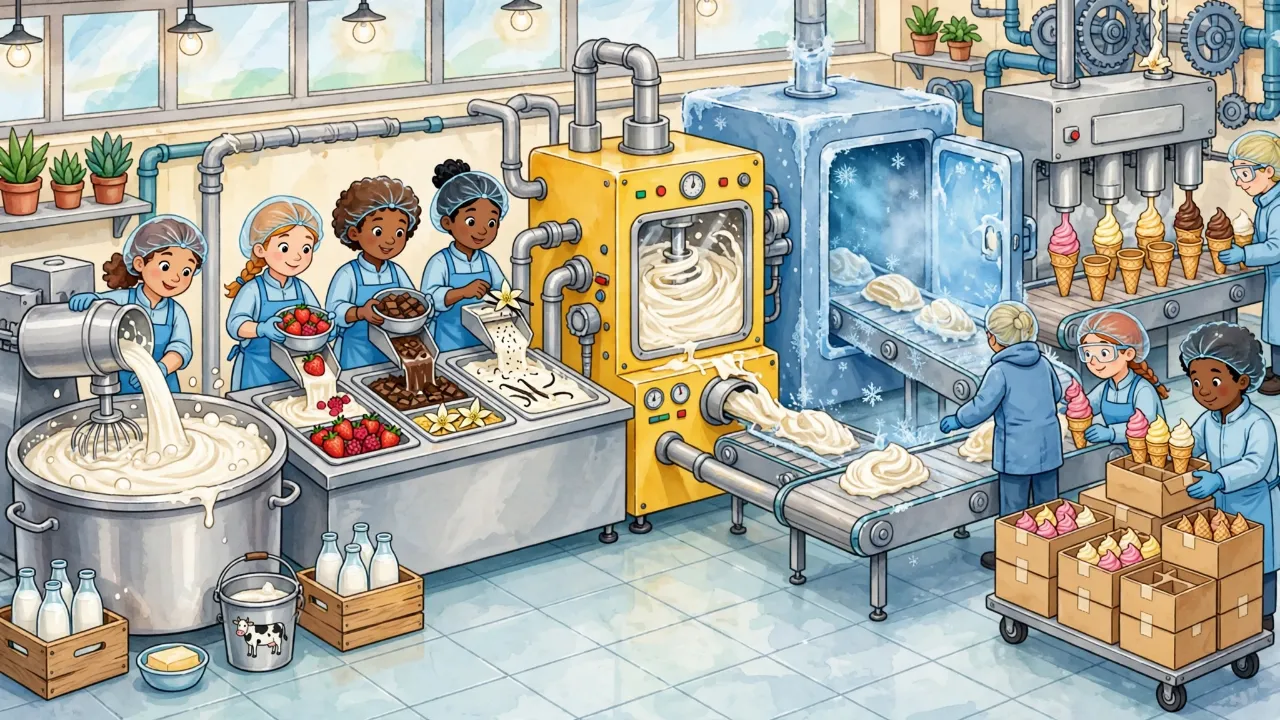
Ice cream is made from milk, cream, sugar, and flavoring. You mix them together and make them really, really cold!
Why Is It So Cold? 🥶
Ice cream is frozen, like ice. But it is softer than ice because of the cream and sugar. Tiny air bubbles get mixed in too. That is what makes ice cream fluffy instead of hard.
How Old Is Ice Cream? 🕰️
People have loved cold treats for thousands of years. Long ago, kings ate snow mixed with fruit juice. That was the very first snow cone!
A LOT of Ice Cream! 🌍
Americans eat about 1.5 billion gallons of ice cream every year. That would fill a swimming pool as big as a football field!
Try This! 🧪
Press ice cream against the roof of your mouth. It melts because your body is warm!
The Coolest Invention Ever 🍦
Ice cream might seem simple, but it is actually one of the trickiest foods to make. Getting it just right took hundreds of years of experimenting!
How Does It Work?
Ice cream is a frozen mixture of milk, cream, sugar, and flavoring. But the real secret is air. When ice cream is churned (stirred while freezing), tiny air bubbles get trapped inside. Without those bubbles, you would just have a solid block of frozen milk. The air makes ice cream smooth and scoopable.
Sugar does more than add sweetness. It actually lowers the freezing point of the mixture, which keeps ice cream from freezing into a rock-hard block. That is why ice cream stays soft enough to scoop even when it is well below freezing.
A Very Old Treat 🏛️
Ancient Romans sent runners into the mountains to bring back snow, then flavored it with honey and fruit juice. Chinese emperors mixed buffalo milk with flour and camphor (a minty plant) and packed it in snow. But modern ice cream, the creamy kind we know, was probably invented in Italy or France in the 1600s.
Vanilla Is Not Boring! 🌺
Vanilla is the most popular ice cream flavor in the world, and for good reason. Real vanilla comes from orchid flowers that only grow in tropical places. Each flower blooms for just one day and must be pollinated by hand! A single vanilla bean takes 9 months to grow. That makes real vanilla one of the most expensive spices on Earth, second only to saffron.
Brain Freeze! 🧊
When you eat ice cream too fast, the cold hits the roof of your mouth. Blood vessels there shrink quickly, then expand. This sends a pain signal to your brain, and you get that sharp headache called "brain freeze." The scientific name for it is sphenopalatine ganglioneuralgia (try saying that five times fast!).
More Than Just Frozen Milk 🔬
Ice cream looks simple, but it is one of the most complex food systems in your kitchen. It is simultaneously a foam (air bubbles), an emulsion (fat droplets in water), a sol (ice crystals in liquid), and a solution (dissolved sugar). Understanding how all four of these phases interact is the key to understanding why some ice cream is silky and delicious while other ice cream is icy and grainy.
The Four-Phase System
A typical premium ice cream is about 60% air by volume (measured as "overrun"), 15% milk fat, 10% non-fat milk solids, and 15% sweetener. Each component plays a specific role:
- Fat globules (from cream) coat air bubbles and prevent them from collapsing, creating a stable foam.
- Ice crystals provide the cold sensation. Smaller crystals (under 50 micrometers) feel smooth; larger ones feel gritty.
- Sugar lowers the freezing point by 1.86°C per mole of solute per kilogram of water (a colligative property), keeping some liquid water unfrozen even at -18°C so the ice cream remains scoopable.
- Air makes up 30-50% of the total volume in most commercial ice cream. Without it, the product would be dense and hard.
The Churning Problem 🔄
The entire challenge of ice cream making comes down to one variable: crystal size. If ice crystals grow too large (over 50 micrometers), the ice cream feels sandy and rough on your tongue. The churning process during freezing serves two purposes: it incorporates air and it breaks up forming ice crystals, keeping them small.
Commercial ice cream machines freeze and churn simultaneously at very low temperatures (-30°C or colder) in continuous-flow scraped-surface heat exchangers. The mixture spends only 30-60 seconds in the freezer before being extruded at about -6°C, then hardened further in blast freezers. This rapid process keeps crystals tiny.
A Brief History of Getting Cold 🧊
Before mechanical refrigeration (invented in the 1840s), making ice cream required either natural ice or an endothermic salt-ice mixture. Mixing salt with ice lowers the temperature to about -21°C, cold enough to freeze cream. This technique, likely learned from Arab traders who used saltpeter (potassium nitrate), made European ice cream possible in the 1600s.
The first known recipe appears in a 1692 cookbook by Antonio Latini in Naples. By the 1700s, ice cream was a luxury served at European courts. Thomas Jefferson brought a recipe back from France and served it at the White House. But it remained expensive until the 1840s, when Nancy Johnson patented the hand-crank ice cream freezer, putting production within reach of ordinary households.
Why Vanilla Dominates 🌺
Vanilla accounts for about 29% of all ice cream sold globally. This is not just cultural habit. Vanillin (the primary flavor compound in vanilla) is one of the most universally pleasant aroma molecules across cultures. Research suggests this may be because vanillin appears naturally in breast milk, creating a positive association from infancy.
Real vanilla extract contains over 200 flavor compounds beyond vanillin, which is why it tastes more complex than synthetic vanillin (derived from wood pulp lignin or petrochemical guaiacol). A kilogram of cured vanilla beans costs $300-600, making it the second most expensive spice after saffron.
Thermodynamics on a Spoon 🧊
Ice cream is arguably the most complex food system humans consume regularly. It is a partially frozen, aerated emulsion: a colloidal system containing four simultaneous phases (solid ice crystals, liquid sugar solution, gaseous air cells, and partially coalesced fat globules) that exists in thermodynamic metastability. Understanding ice cream is an exercise in physical chemistry, materials science, and food engineering.
Colligative Properties and Freezing Point Depression
The scoopability of ice cream at serving temperature (-12 to -15°C) depends entirely on freezing point depression. Pure water freezes at 0°C, but the dissolved sugars, salts, and proteins in ice cream mix depress the freezing point according to Raoult's Law:
where K_f = 1.86°C·kg/mol for water, m = molality, i = van 't Hoff factor
At -15°C, approximately 72% of the water in a standard mix is frozen, while the remaining 28% exists as a concentrated sugar solution (called the "cryo-concentrated phase"). This unfrozen fraction is what allows ice cream to remain pliable rather than becoming a solid ice block. Different sugars contribute differently: sucrose (MW 342) provides less freezing point depression per gram than dextrose (MW 180), which is why formulations often blend multiple sugars to optimize texture independently of sweetness.
Fat Destabilization and Foam Stability
In liquid ice cream mix, fat exists as discrete globules stabilized by milk proteins and added emulsifiers (typically mono- and diglycerides or polysorbate 80). During churning, these globules undergo partial coalescence: the emulsifier weakens the protein coating, allowing fat globules to clump together around air cells. This partially coalesced fat network is what stabilizes the foam structure and prevents air cells from collapsing during storage.
Ostwald Ripening and Recrystallization
Ice cream quality degrades during storage through two primary mechanisms. Ostwald ripening drives the growth of large ice crystals at the expense of small ones, because larger crystals have lower surface energy per unit volume (the Gibbs-Thomson effect). Temperature fluctuations accelerate this: each warm-cool cycle partially melts small crystals and adds that water to larger ones during refreezing.
Stabilizers like locust bean gum and carrageenan slow recrystallization by increasing the viscosity of the unfrozen phase, physically impeding water molecule migration. They do not prevent crystal growth thermodynamically; they merely slow the kinetics. This is why stabilizer-free artisan ice cream must be consumed within days, while commercial ice cream with stabilizers maintains acceptable texture for months.
The Historical Chemistry of Cold
The history of ice cream parallels the history of refrigeration technology. Pre-mechanical ice cream relied on endothermic dissolution: NaCl dissolving in ice absorbs approximately 6 kJ/mol, reaching temperatures of -21°C. Earlier Arab sources describe using potassium nitrate (saltpeter), which produces even colder temperatures. The 1692 Antonio Latini recipes from Naples mark the first documented ice cream formulations, though Chinese frozen dairy desserts predate them by centuries.
The pivotal technological shift came with Jacob Fussell's Baltimore dairy in 1851, which applied industrial-scale continuous freezing to ice cream production. By 1900, electric refrigeration was replacing ice-salt systems, and Clarence Vogt's 1926 continuous freezer patent established the scraped-surface heat exchanger design still used in modern production. The Green Revolution's impact on dairy farming (1950s-60s) made cream cheap enough for ice cream to become a daily staple rather than a luxury.
Gelato vs. Ice Cream: A Material Science Comparison
Italian gelato differs from American ice cream in three measurable ways: lower fat content (4-8% vs. 10-16%), lower overrun (25-30% vs. 50-100%), and warmer serving temperature (-10 to -12°C vs. -15 to -18°C). These differences are not merely stylistic. Lower fat means less coating of taste receptors, allowing flavor compounds to reach olfactory receptors more quickly. Lower overrun means denser product with more flavor molecules per unit volume. Warmer serving temperature means more molecules are volatile enough to reach the nose. The combined effect is that gelato delivers flavor more intensely per serving, which is why gelato portions are traditionally smaller than ice cream portions.
The Unlikely Physics of a Scoop
Ice cream is a textbook case of emergent complexity: simple ingredients (milk, cream, sugar, air) assembled into a four-phase colloidal system whose behavior cannot be predicted from any single component. It is simultaneously a foam, an emulsion, a sol, and a solution. Its entire appeal depends on existing in a thermodynamically metastable state that the second law of thermodynamics is constantly trying to destroy. Every scoop you eat is a small victory against entropy, held together by careful engineering.
The Economics of Cold
The global ice cream market is worth approximately $90 billion annually (2025 estimate), dominated by Unilever (Wall's, Ben & Jerry's, Magnum), Nestlé (Häagen-Dazs, Dreyer's), and Mars (Dove, Snickers Ice Cream). But the economics of ice cream production reveal a fascinating cost structure.
Air is the most profitable ingredient. Commercial ice cream can legally contain up to 100% overrun in the US (meaning half the carton's volume is air). Premium brands like Häagen-Dazs use 20-25% overrun; value brands push 90-100%. When you buy a pint of cheap ice cream, you are paying largely for flavored air. The FDA's Standard of Identity for ice cream (21 CFR 135.110) requires only 10% milk fat and a minimum weight of 4.5 pounds per gallon, the latter being the only real constraint on air incorporation.
The vanilla supply chain adds another layer of economic complexity. Over 80% of the world's vanilla is grown in Madagascar by approximately 80,000 smallholder farmers. Vanilla prices have swung wildly: $20/kg in 2013, $600/kg in 2018 (driven by Cyclone Enawo and speculative buying), back to $100/kg in 2020, then surging again. This volatility means that most "vanilla" ice cream uses synthetic vanillin (about 99% of the vanillin consumed globally is synthetic, derived from guaiacol or lignin). The distinction matters: natural vanilla contains 200+ aromatic compounds; synthetic vanillin is a single molecule.
The Cold Chain Revolution
Ice cream's transformation from aristocratic luxury to daily commodity tracks precisely with refrigeration technology. Before Clarence Vogt's 1926 continuous freezer patent, ice cream was batch-produced and consumed almost immediately. The post-WWII suburban expansion, combined with home freezers becoming standard (rising from 12% of US households in 1950 to 92% by 1975), created the infrastructure for take-home ice cream to become a staple.
The cold chain's environmental cost is significant. Refrigeration accounts for approximately 17% of global electricity consumption, and frozen dessert storage (maintaining -18°C or colder) is among the most energy-intensive food preservation methods. Some estimates attribute 1% of global greenhouse gas emissions to the cold chain. The industry is slowly transitioning to hydrocarbon-based refrigerants (propane R-290, isobutane R-600a) from hydrofluorocarbons (HFCs), driven by the Kigali Amendment to the Montreal Protocol.
The Neuroscience of the Brain Freeze
Sphenopalatine ganglioneuralgia (brain freeze) is one of the few reliably reproducible pain models in neuroscience, which makes it valuable for headache research. The mechanism involves rapid cooling of the palate triggering vasodilation of the anterior cerebral artery via the trigeminal nerve. Jorge Serrador's 2012 study using transcranial Doppler ultrasound showed that the anterior cerebral artery dilates significantly during a brain freeze episode, and the headache resolves precisely when the artery constricts back to normal diameter.
The evolutionary purpose (if any) is debated. One hypothesis: the rapid vasodilation serves as a thermoregulatory reflex protecting the brain from sudden temperature drops in the blood supply. The pain is a side effect of a protective mechanism. This aligns with the observation that brain freeze is more common in people who experience migraines, suggesting shared neurovascular pathways.
What Gelato Teaches Us About Flavor Perception
The gelato vs. ice cream comparison is instructive for understanding flavor science more broadly. Italian gelato uses less fat, less air, and is served warmer than American ice cream. Each of these differences enhances flavor delivery:
- Less fat means less coating of the oral mucosa, so taste receptors are more exposed to dissolved flavor compounds.
- Less air means higher density of flavor molecules per spoonful.
- Warmer temperature increases the vapor pressure of volatile aroma compounds (per the Clausius-Clapeyron relation), meaning more molecules reach the olfactory epithelium retronasally during consumption.
The net result: gelato delivers a more intense flavor experience with less fat per serving. This is not a matter of Italian superiority; it is thermodynamics. Any ice cream served warmer with less air would taste more intense. The tradeoff is shelf stability: gelato's lower fat and lower overrun make it more susceptible to recrystallization and texture degradation, which is why true gelaterias produce small batches daily.
Sources
- Goff, H. D. & Hartel, R. W. (2013). "Ice Cream." 7th ed. Springer.
- Clarke, C. (2004). "The Science of Ice Cream." Royal Society of Chemistry.
- Serrador, J. M. et al. (2012). "Cerebral hemodynamics during ice cream headache." The FASEB Journal, 26(S1).
- FDA 21 CFR 135.110: Ice cream and frozen custard. US Code of Federal Regulations.
- International Dairy Foods Association (2025). "Ice Cream Sales and Trends."
- Mintz, S. (1985). "Sweetness and Power: The Place of Sugar in Modern History." Viking.
- Gage, F. & Gage, R. (2019). "Vanilla: Travels in Search of the Ice Cream Orchid." Grove Press.