
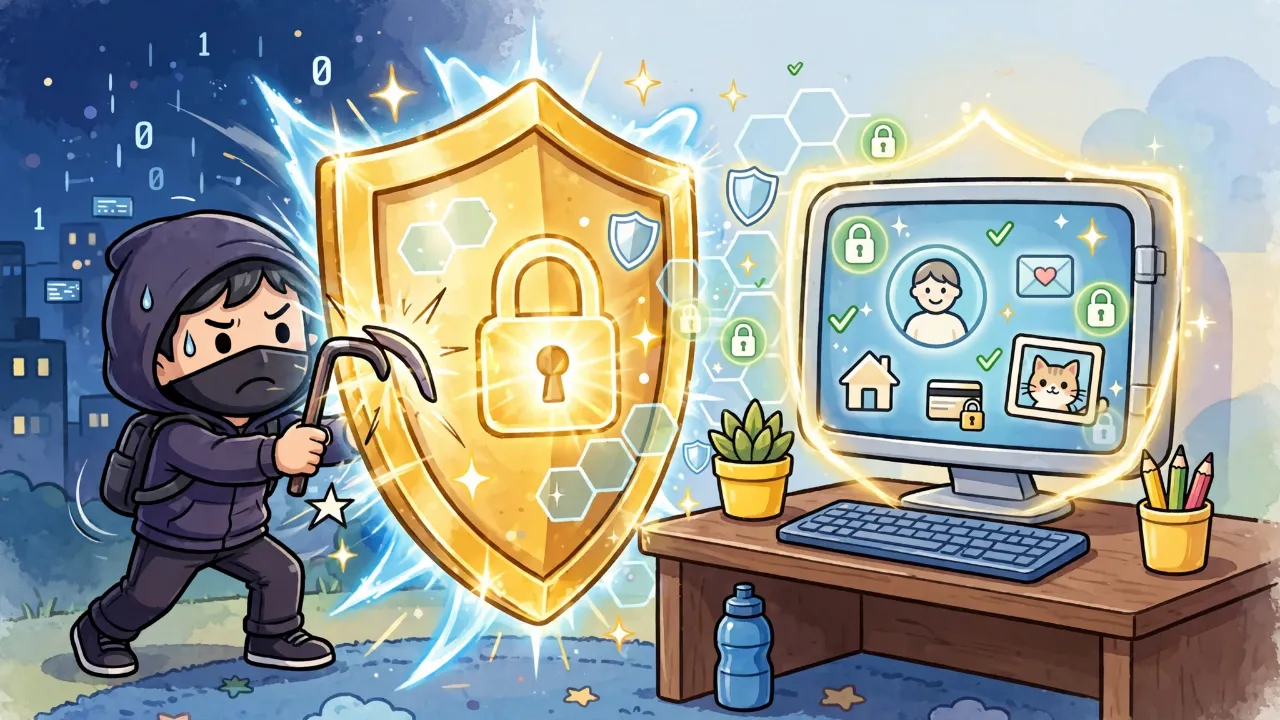
🔒 You have a name and a birthday. That is YOUR information!
Some sneaky people try to steal names. That is NOT okay! 🚫
Keep it safe, like your toys. Never tell strangers your full name, address, or birthday!
If a stranger asks, tell a grown-up right away! 💎
What Is Identity Theft?
Identity theft is when a sneaky person steals your personal information and pretends to be you. That information includes your full name, your birthday, and where you live. It is like someone wearing a mask of your face.
How Does It Happen?
Bad guys send tricky emails that look real. They dig through trash for letters. They pretend to be someone else to get people to tell secrets.
How Can You Stay Safe?
Never share your full name, birthday, or address with strangers online. If a website or game asks for your information, ask a grown-up first. Your information is a treasure chest. Keep it locked up tight. 🔐
What If It Happens?
Do not worry. Grown-ups can fix it. The most important thing is to tell a grown-up right away if something seems wrong.
What Is Identity Theft?
Identity theft happens when someone steals your personal information and uses it to pretend to be you. They might use your name to buy things, open bank accounts, or even get medical care. In 2024, the Federal Trade Commission (FTC) received over 1.1 million identity theft reports from people across the United States.
Your Personal Information Is Like a Key
Think of your personal information as a set of keys that unlock different doors. Your name, birthday, Social Security number, and address can all be used to "unlock" important things like bank accounts and credit cards. If someone gets hold of your keys, they can open doors that should only be open to you.
How Do Thieves Steal Information?
There are several ways identity thieves get your information:
- Phishing: Fake emails or messages that look like they come from real companies, trying to trick you into typing in your password or personal details.
- Data breaches: When hackers break into a company's computers and steal information about millions of customers at once.
- Mail theft: Stealing letters from mailboxes that contain personal information like bank statements.
- Shoulder surfing: Peeking over someone's shoulder to see their password or PIN number.
How to Protect Yourself
- Never share passwords with anyone except your parents.
- Do not click on links in emails from people you do not know.
- Use different passwords for different websites (and make them hard to guess!).
- Ask a grown-up before entering personal information on any website.
- Look for the lock icon 🔒 in your browser before entering information on a website.
What to Do If It Happens
If you or your family become victims of identity theft, here is what to do: Tell a parent or guardian immediately. They can report it to the FTC at IdentityTheft.gov, place a freeze on credit reports so nobody can open new accounts, and file a police report. It can be stressful, but it IS fixable!
Identity Theft by the Numbers
In 2024, the Federal Trade Commission received over 1.1 million identity theft reports through its Consumer Sentinel Network. Total fraud losses reported to the FTC exceeded $12.5 billion in 2023 and jumped to $16.6 billion in 2024, according to the FBI's Internet Crime Report. Credit card fraud was the most common type, making up 43.9% of all identity theft reports, followed by miscellaneous identity theft (online shopping fraud, social media fraud, and email fraud) at 32.4%.
Florida, Georgia, and Nevada had the highest identity theft rates per capita. The states with the lowest rates were South Dakota, Montana, and Vermont.
Types of Identity Theft
Identity theft is not just one crime. It comes in several forms:
- Financial identity theft: Using someone's information to open credit cards, take out loans, or make purchases. This is the most common type.
- Medical identity theft: Using someone's health insurance to get medical care, prescription drugs, or file fake insurance claims. This can be dangerous because it can mix up your medical records with someone else's.
- Criminal identity theft: Giving someone else's name and information to police during an arrest. The victim might end up with a criminal record they know nothing about.
- Child identity theft: Using a child's Social Security number to open accounts. Children are attractive targets because their credit is "clean" and the theft often goes undetected for years.
- Synthetic identity theft: Combining real and fake information to create an entirely new identity. A thief might pair a real Social Security number with a made-up name and date of birth.
How Identity Thieves Operate
Phishing remains the most common attack method. Criminals send emails, text messages, or social media messages that mimic real companies, banks, or government agencies. The messages create urgency ("Your account has been suspended!") to pressure you into clicking a link and entering your credentials. More sophisticated versions, called "spear phishing," target specific individuals using personal details gathered from social media profiles.
Data breaches are the industrial-scale version. In 2024, there were over 3,100 data compromises reported in the United States, with 1.35 trillion victim notifications issued, according to the Identity Theft Resource Center. Five "mega-breaches" each exposed between 100 million and 560 million records. When a company you have an account with gets breached, your email, password, and sometimes your Social Security number end up in databases that criminals buy and sell on the dark web.
Social engineering is the art of manipulating people rather than hacking computers. A thief might call a bank, pretend to be you, and talk a customer service representative into revealing account details. They gather enough personal information from public records, social media, and previous breaches to answer security questions convincingly.
Average time to detect identity theft: 5 to 6 months
Average time to resolve it: 100 to 200 hours of the victim's time
Average financial loss per victim (2024): approximately $500 for median loss, but some cases reach tens of thousands
That means a thief can have months of free spending before anyone notices.
Warning Signs
- Bills or collection calls for accounts you never opened
- Unfamiliar charges on your bank or credit card statements
- Being denied credit when you expected to be approved
- Getting tax documents for jobs you never worked
- Medical bills for treatments you never received
- Missing mail, especially bills and financial statements
Protection Strategies
For yourself: Use strong, unique passwords for every account. Enable two-factor authentication (2FA) wherever available, which requires both your password and a code sent to your phone. Monitor your bank statements regularly. Shred documents that contain personal information before throwing them away.
For your family: Parents can freeze their children's credit with all three credit bureaus (Equifax, Experian, TransUnion) for free. Since most children should not have credit reports at all, the existence of one is itself a red flag that their information may have been compromised.
What to Do If It Happens
- Report it to the FTC at IdentityTheft.gov, which creates a personalized recovery plan.
- Place a fraud alert or credit freeze with all three credit bureaus.
- File a police report (many fraud investigations require one).
- Contact any companies where fraudulent accounts were opened and dispute the charges.
- Check your credit reports at AnnualCreditReport.com for any accounts you do not recognize.
A Brief History of Identity Theft
Identity theft is not a modern invention. Impersonation fraud has existed as long as recorded history: ancient Romans forged seals on documents, and medieval con artists assumed false identities to claim inheritances. But the crime accelerated dramatically in the 20th century as bureaucratic systems created standardized identity documents. The U.S. Social Security number, introduced in 1936 as a retirement benefits tracking number, gradually became the de facto national identifier even though it was never designed for that purpose. By the 1960s, banks, employers, hospitals, and universities all used SSNs as primary identifiers, creating a single point of failure for identity verification.
The most famous identity thief of the pre-digital era was Frank Abagnale Jr., who between 1964 and 1969 impersonated an airline pilot, a doctor, and a lawyer while cashing $2.5 million in forged checks across 26 countries. His story became the basis for the 2002 film Catch Me If You Can. Abagnale later became an FBI consultant on fraud prevention, though some historians have questioned the accuracy of his more dramatic claims.
The term "identity theft" itself did not enter common usage until the 1990s. The Identity Theft and Assumption Deterrence Act of 1998 made it a federal crime for the first time, establishing penalties of up to 15 years in prison. The Fair and Accurate Credit Transactions Act (FACTA) of 2003 gave consumers the right to free annual credit reports and required merchants to truncate credit card numbers on receipts.
The Digital Explosion
The internet transformed identity theft from a labor-intensive, person-to-person crime into an industrial-scale operation. Before the internet, a thief had to physically steal mail, forge documents, or impersonate someone in person. Today, a single data breach can expose hundreds of millions of records simultaneously. The 2017 Equifax breach compromised the personal information of 147 million Americans, including names, SSNs, birth dates, and addresses. The 2013 Yahoo breach affected all 3 billion user accounts.
The dark web created a marketplace for stolen data. A stolen credit card number sells for $5 to $30. A complete identity package (name, SSN, date of birth, address, bank account details) goes for $30 to $100. Medical records are worth $250 to $1,000 each because they contain enough information to commit both financial and medical identity theft. These prices are low precisely because supply is so abundant.
Synthetic Identity Fraud: The Fastest-Growing Threat
Traditional identity theft steals an existing person's identity. Synthetic identity fraud creates a new one. A criminal takes a real Social Security number (often belonging to a child under 5, an elderly person in a care facility, or a recent immigrant) and combines it with a fabricated name, date of birth, and address. The resulting "person" does not exist, which means there is no individual victim to notice and report the fraud.
The synthetic identity is then used to apply for credit. Initial applications are rejected, but the rejection itself creates a credit file with the credit bureaus. The criminal then adds the synthetic identity as an authorized user on existing accounts to build credit history, a technique called "piggybacking." Over 12 to 24 months, the synthetic identity develops a legitimate-looking credit profile. The criminal then "busts out," maxing out all available credit lines and disappearing. The Federal Reserve has estimated that synthetic identity fraud costs U.S. lenders $6 billion annually and is the fastest-growing type of financial crime.
Child Identity Theft
Children are particularly vulnerable because they have valid Social Security numbers but no credit history, no bank accounts, and no reason to check their credit reports. A 2021 report by Javelin Strategy and Research found that 1.25 million children were victims of identity fraud in a single year, with an average fraudulent amount of $1,128 per child. In 40% of cases, the perpetrator was someone who personally knew the child, including family members.
The damage often goes undetected until the child turns 18 and applies for their first student loan, credit card, or apartment lease, only to discover that "they" already have a credit history full of unpaid debts and defaulted loans. The Children's Online Privacy Protection Act (COPPA) of 1998 restricts the collection of personal information from children under 13 online, but it does not prevent offline theft or breaches of data already collected.
The AI Factor
Artificial intelligence has made identity theft both easier to commit and harder to detect. AI-generated deepfake videos and voice clones can defeat biometric verification systems. In 2024, a finance worker in Hong Kong was tricked into transferring $25 million after a video call with what appeared to be the company's CFO but was actually a deepfake. AI-powered phishing emails are grammatically perfect and personalized using data scraped from social media, making them far more convincing than the obvious scam emails of the past.
On the defensive side, AI is also being used to detect fraud patterns, flag suspicious transactions, and verify identities through behavioral biometrics (analyzing typing patterns, mouse movements, and device usage patterns). The arms race between AI-powered fraud and AI-powered detection is likely to define cybersecurity for the next decade.
Legal Framework and Consumer Rights
- Fair Credit Reporting Act (1970): Establishes the right to access and dispute information in your credit reports.
- Identity Theft and Assumption Deterrence Act (1998): Made identity theft a federal crime with penalties up to 15 years.
- FACTA (2003): Free annual credit reports, truncated card numbers on receipts, fraud alert rights.
- Red Flags Rule (2007): Requires financial institutions and creditors to implement identity theft prevention programs.
- Credit freeze laws (2018): Free credit freezes and unfreezes for all consumers, including minors.
Protection Protocol
- Freeze your credit with all three bureaus. This is the single most effective protection measure. It prevents new accounts from being opened in your name.
- Use a password manager with unique, complex passwords for every account. Never reuse passwords.
- Enable two-factor authentication on all accounts that support it, preferably using an authenticator app rather than SMS (which can be intercepted via SIM-swapping attacks).
- Monitor your accounts by setting up transaction alerts on bank accounts and credit cards.
- Check your credit reports regularly at AnnualCreditReport.com (free weekly reports from all three bureaus).
- Be skeptical of urgency. Legitimate companies do not pressure you to act immediately. If an email or call creates panic, that is a sign it is a scam.
Recovery Steps
- Visit IdentityTheft.gov (the FTC's dedicated recovery portal) and follow the guided recovery plan.
- Place fraud alerts with all three credit bureaus (one call triggers all three).
- File a police report in your local jurisdiction.
- Contact each company where fraud occurred and file formal disputes.
- Consider an IRS Identity Protection PIN if tax fraud is involved.
- Document everything: dates, names, reference numbers, copies of correspondence.
Scale and Trajectory
Identity theft is the most reported consumer complaint in the United States and has held that position for over two decades. In 2024, the FTC's Consumer Sentinel Network received over 6.47 million reports, of which 18% (approximately 1.1 million) were identity theft complaints. The FBI's Internet Crime Complaint Center (IC3) recorded $16.6 billion in total cybercrime losses for 2024, up 33% from $12.5 billion in 2023. Credit card fraud dominated identity theft categories at 43.9% of reports, followed by miscellaneous identity theft (online shopping, social media, and email fraud) at 32.4%, personal and business loan fraud at 10.4%, new bank account fraud at 6.8%, and auto loan fraud at 6.5%.
The Identity Theft Resource Center (ITRC) reported 3,158 data compromises in the United States in 2024, the second-highest year on record behind 2023. Five mega-breaches each exposed between 100 million and 560 million records, collectively accounting for 1.35 trillion victim notifications. The sheer volume of compromised data means that for most American adults, some combination of their personal information is already circulating in criminal databases. The question is no longer whether your data has been compromised but how recently and how completely.
The Anatomy of Modern Identity Theft
Identity theft operates along a supply chain that mirrors legitimate business operations. At the top are the data acquisition specialists: hackers who breach corporate databases, phishing operators who harvest credentials at scale, and insiders who sell customer records from their employers. The stolen data flows to aggregators who compile, verify, and package it for resale. "Fullz" (complete identity packages containing name, SSN, date of birth, address, mother's maiden name, and sometimes bank account and credit card details) sell for $30 to $100 on dark web marketplaces. Medical records command $250 to $1,000 because they enable both financial and medical identity fraud.
Downstream purchasers specialize in monetization. Some open new credit accounts ("new account fraud"), while others take over existing accounts by changing passwords, contact information, and security questions. SIM-swapping attacks, where a criminal convinces a mobile carrier to transfer a victim's phone number to a new SIM card, have become a critical enabler because they defeat SMS-based two-factor authentication and give the attacker control of the victim's phone number for password resets.
The fraud lifecycle is remarkably fast. In many cases, stolen credit card numbers are used within minutes of a breach, before the victim or the issuing bank can react. Account takeovers often begin with credential stuffing, automated tools that test stolen username-password pairs (from one breach) against hundreds of other services, exploiting the widespread practice of password reuse. Research by the Ponemon Institute found that the average time to identify a data breach was 194 days in 2024, meaning criminals had more than six months of access before detection.
Synthetic Identity Fraud
Synthetic identity fraud represents a fundamental challenge to the identity verification systems that financial institutions rely on. By combining a real Social Security number with fabricated personal details, criminals create identities that do not correspond to any existing person, which means no individual victim files a complaint, no credit monitoring service flags the activity, and no fraud alert is triggered. The Federal Reserve's 2024 assessment estimated annual losses from synthetic identity fraud at $6 billion, though the true figure is likely higher because many cases are misclassified as credit losses rather than fraud.
The technique exploits a design flaw in the credit reporting system. When a credit application is submitted with a valid SSN but no matching credit file, the credit bureau creates a new file rather than rejecting the application. This file creation is the entry point for synthetic identities. The criminal then builds the synthetic identity's credit profile over 12 to 24 months through "piggybacking" (being added as an authorized user on established accounts) and small, consistently paid credit lines. When the credit profile is sufficiently developed, the criminal executes a "bust-out" scheme: simultaneously maxing out all available credit and vanishing.
Children under 5, elderly individuals in care facilities, homeless individuals, recent immigrants, and incarcerated people are disproportionately targeted for their SSNs because they are least likely to monitor their credit or apply for credit in the near term. The Javelin Strategy and Research 2021 Child Identity Fraud Study found that 1.25 million children were victims of identity fraud annually, with an average loss of $1,128 per incident and 40% of perpetrators known personally to the child.
The AI Acceleration
Generative AI has compressed the skill requirements for identity fraud. Phishing emails that once required native fluency and knowledge of corporate communication norms can now be produced at scale by language models. Deepfake technology has reached the point where it can defeat video-based identity verification ("liveness checks") used by financial institutions. In early 2024, a Hong Kong finance worker transferred $25 million after a video conference call in which every participant except the victim was an AI-generated deepfake, including a convincing replica of the company's chief financial officer.
Voice cloning presents an equally serious threat. With as little as three seconds of audio, modern voice synthesis tools can produce convincing replicas of a person's voice. The implications for telephone-based authentication (used by banks, insurance companies, and government agencies) and for social engineering attacks ("Hi Mom, I am in trouble and need money") are severe. The World Economic Forum's 2025 report on identity fraud noted that while overall fraud volumes were declining, the complexity and sophistication of attacks were increasing sharply, driven primarily by AI tool accessibility.
Defensive AI has responded with behavioral biometrics, systems that authenticate users not by what they know (passwords) or what they have (tokens) but by how they interact with devices. Keystroke dynamics, mouse movement patterns, touchscreen pressure, scrolling speed, and device tilt angles create a behavioral signature that is difficult for criminals to replicate even if they possess all of a victim's credentials. These systems operate continuously rather than at a single authentication checkpoint, flagging anomalies mid-session.
Legal and Regulatory Architecture
The legal framework for identity theft in the United States has evolved through several landmark statutes. The Fair Credit Reporting Act (FCRA, 1970) established consumer rights to access and dispute credit reports but predated identity theft as a recognized crime category. The Identity Theft and Assumption Deterrence Act (1998) made it a federal offense to knowingly use another person's identification with the intent to commit unlawful activity, with penalties of up to 15 years imprisonment. The Identity Theft Penalty Enhancement Act (2004) added mandatory consecutive sentences for identity theft committed in connection with other felonies, including terrorism.
The Fair and Accurate Credit Transactions Act (FACTA, 2003) provided the most practical consumer protections: free annual credit reports, fraud alert rights, credit card number truncation on receipts, and the requirement that credit reporting agencies block fraudulent information within four business days of receiving a police report. The Economic Growth, Regulatory Relief, and Consumer Protection Act (2018) required all three credit bureaus to provide free credit freezes and unfreezes, including for minors under 16, eliminating the fees that had previously discouraged widespread adoption.
State-level regulation varies significantly. California's Consumer Privacy Act (CCPA, 2020) and its successor, the California Privacy Rights Act (CPRA, 2023), give residents the right to know what data companies collect, to delete it, and to opt out of its sale. As of 2025, 14 states have enacted comprehensive consumer privacy laws, though no federal privacy law exists. The absence of a unified federal standard creates regulatory fragmentation that both consumers and companies find difficult to navigate.
Optimal Protection Strategy
The evidence supports a layered defense approach, prioritized by effectiveness:
- Credit freezes with all three bureaus (Equifax, Experian, TransUnion) and the lesser-known Innovis and NCTUE (National Consumer Telecom and Utilities Exchange). Freezes are free, require no renewal, and prevent virtually all new-account fraud. They are the single most effective preventive measure available to consumers.
- Password managers generating unique, random passwords for every account, combined with two-factor authentication via hardware security keys (FIDO2/WebAuthn) or authenticator apps. SMS-based 2FA is better than nothing but vulnerable to SIM-swapping.
- Transaction monitoring through real-time alerts on all bank accounts and credit cards. Most banks offer free push notifications for transactions above a user-defined threshold.
- IRS Identity Protection PIN to prevent tax refund fraud. Available to all taxpayers since 2021 and recommended for anyone whose SSN has been compromised in a breach.
- Mail security: informed delivery through USPS (email previews of incoming mail to detect missing items), locked mailbox, and prompt retrieval.
- Minimize data exposure: opt out of data broker databases (a tedious but valuable exercise), limit social media disclosure of identifying details, and use masked email addresses for non-essential accounts.
Recovery Protocol
If identity theft occurs, the FTC's IdentityTheft.gov portal generates a customized recovery plan based on the specific types of fraud reported. The standard recovery workflow involves filing an FTC Identity Theft Report (which creates an Identity Theft Affidavit with legal standing), placing fraud alerts and credit freezes with all three credit bureaus, filing a local police report, disputing fraudulent accounts individually with each creditor, reviewing all three credit reports in detail, and documenting every step with dates, names, and reference numbers. For tax-related identity theft, IRS Form 14039 initiates a case with the Identity Protection Specialized Unit. For medical identity theft, request an "accounting of disclosures" from each healthcare provider under HIPAA to identify unauthorized use of your medical identity.
The median resolution time for identity theft is 100 to 200 hours of the victim's time over a period of 6 to 12 months, though complex cases involving multiple types of fraud can take years. The emotional toll is well-documented: a 2023 ITRC study found that 16% of identity theft victims reported suicidal ideation, and 83% reported significant stress or anxiety. Identity theft is not merely a financial crime. It is a violation of personal autonomy that can disrupt every system, financial, medical, legal, and social, that relies on the integrity of personal identity.
Sources
1. Federal Trade Commission, Consumer Sentinel Network Data Book 2024.
2. FBI Internet Crime Complaint Center (IC3), 2024 Internet Crime Report.
3. Identity Theft Resource Center (ITRC), 2024 Annual Data Breach Report.
4. Federal Reserve Bank of Boston, "Synthetic Identity Fraud in the U.S. Payment System" (2024 update).
5. Javelin Strategy and Research, "2021 Child Identity Fraud Study."
6. Ponemon Institute, "Cost of a Data Breach Report 2024."
7. World Economic Forum, "How Identity Fraud Is Changing in the Age of AI" (December 2025).
8. U.S. Government Accountability Office, "Data Protection: Federal Agencies Need to Strengthen Online Identity Verification Processes" (2023).
9. Identity Theft and Assumption Deterrence Act of 1998, 18 U.S.C. § 1028.
10. Fair and Accurate Credit Transactions Act of 2003, Pub. L. 108-159.