
The Guessing Game That Gets Smarter: Newton's Method
September 9, 2026
🤔🔢
Guessing is fun! But the smartest game ever is this: guess, check, then guess BETTER. 🎯
You take a guess, you check how close you were, and your next guess gets closer.
Guess, check, guess better! That is the smartest guessing game in the world. 🌟
What Is the Smartest Guessing Game?
You need a number you cannot calculate. Isaac Newton found a trick: guess, then use that guess to make a better one, and repeat. Every guess gets closer, like a detective following clues!
How Do You Guess Better?
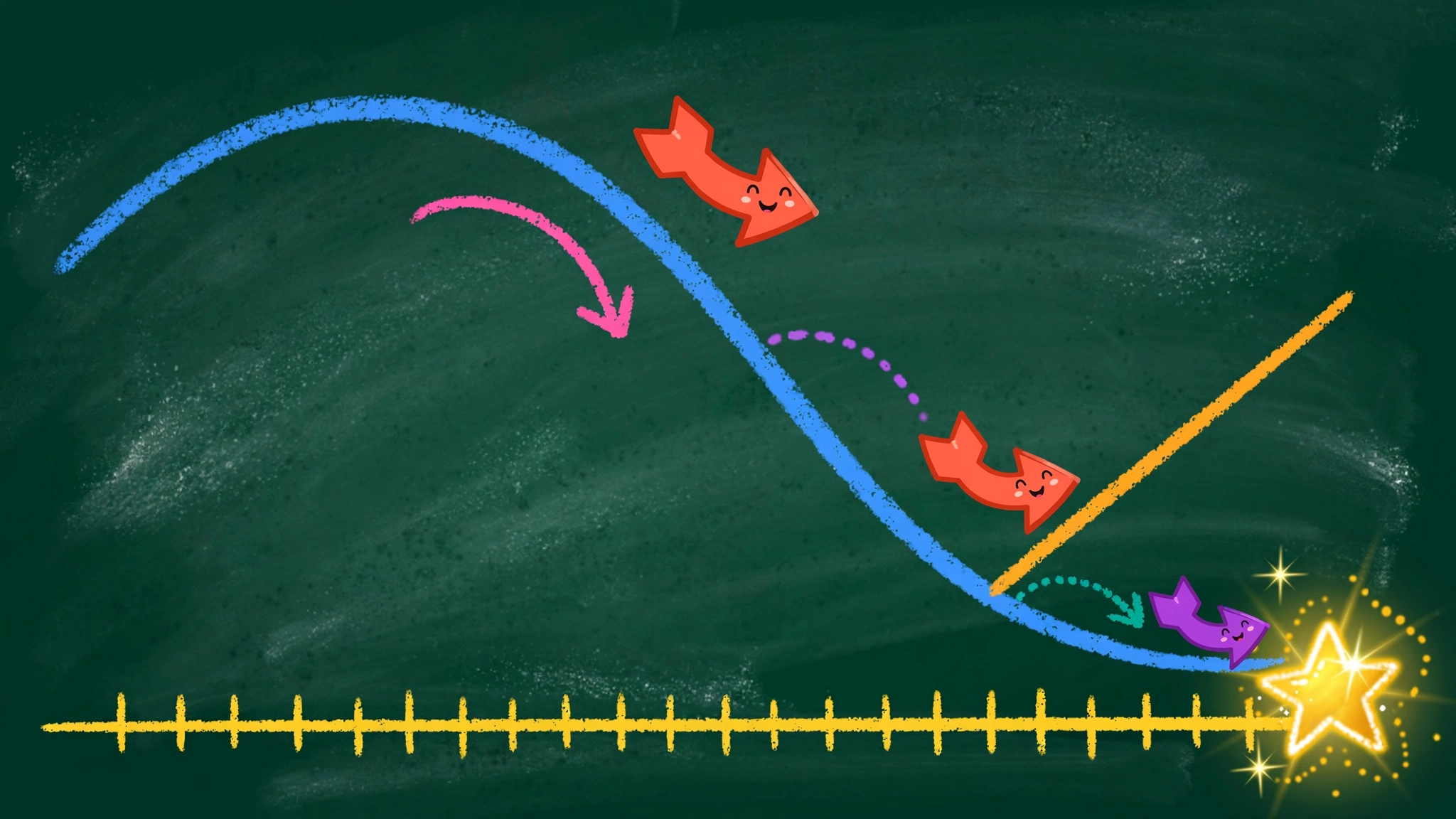
Picture a curvy hill and find the spot where it touches the ground. Mark your guess on the hill, then draw a straight line touching it there. That touch-line is called a tangent, and you slide down it to the ground for your next guess!
Can You Try It?
What number times itself makes 2? Try 1.5. But 1.5 times 1.5 is 2.25, too big, so guess a tiny bit smaller: guess, check, guess better!
Why Is It Smart?
Normal guessing stays random, but this guessing learns! Each new guess uses what the last one taught you. Scientists still use Newton's trick today.
The Number Nobody Can Write Down
Here is a number no human has ever written down completely. It starts 1.41421356 and never ends or repeats: the square root of 2. How does your calculator find it in a split second? It plays a guessing game, a very smart one.
Guess, Check, Guess Better
Isaac Newton found this trick more than 350 years ago. When a problem is too hard to solve directly, start with a reasonable guess, then use a clever rule to turn it into a better guess, and repeat. Repeating a step over and over is called iterating. The moment your guesses settle on the answer is called convergence: a fancy word for "we arrived."
Finding the Square Root of 2
Let us hunt √2, the number that times itself equals 2. Start with guess 1 and use this simple rule: new guess = (old guess + 2 / old guess) / 2. Just average your guess with 2 divided by it.
Round 1: (1 + 2/1) / 2 = 1.5. Round 2: (1.5 + 2/1.5) / 2 = 1.4167. Round 3: (1.4167 + 2/1.4167) / 2 = 1.41422. The answer is 1.41421356..., so after three rounds we are right to four decimals! Each round roughly doubles the correct digits, a super-speed called quadratic convergence.
The Sliding Line Trick
Here is the geometry behind the guessing. Draw a curve crossing the number line exactly at √2. Pick a guess and find the point on the curve above it. Draw the straight line touching the curve at that spot, called a tangent. Follow the tangent down to the number line. That crossing is your next guess, and every new tangent aims closer to the truth.
Where Is It Used?
Calculators and phones use tricks like this for square roots. Engineers use it for bridges and airplanes, and GPS and spacecraft use it for navigation. When a problem is too tangled to untangle directly, smart guessing saves the day.
Try This!
Grab a calculator and find √3: start at 2 and repeat new guess = (old guess + 3 / old guess) / 2. How many rounds until the answer stops changing? Beat three?
Most Equations Have No Formula
Here is a secret textbooks hide: most equations have no formula for the answer, although you know the quadratic formula, which cracks x² + 5x + 6 = 0 in one step, and a cubic formula exists too. But in 1824, Niels Henrik Abel proved something shocking: for x⁵ and higher, no general formula can exist. Not undiscovered. Impossible.
So what do scientists do with x⁵ − x − 1 = 0, which has a real answer but no formula? They cheat, beautifully: they guess and let each guess teach them a better one, which is Newton's method, one of the most useful tricks in all of mathematics.
The Geometry: Follow the Tangent
Suppose you want to solve f(x) = 0, the spot where the curve y = f(x) crosses the horizontal axis. Start with a guess, x₀, then go up to the curve and draw the tangent line, the straight line that just kisses the curve there. Follow it down to where it crosses the axis, and that crossing is your next guess, x₁. Then repeat.
Why does it work? Because near your guess the curve looks straight, the tangent is its best straight-line approximation, and where the approximation hits zero is close to where the real curve hits zero, with each round replacing your guess by the zero of the local approximation while the approximations improve as you close in.
The Formula
The tangent at xₙ has slope f′(xₙ), the derivative, so y = f(xₙ) + f′(xₙ)(x − xₙ), and setting y = 0 and solving for x gives the next guess:
xₙ₊₁ = xₙ − f(xₙ) / f′(xₙ)
In plain words: take your guess and subtract the function's value divided by its slope, so far from zero you take a big step while on a steep slope you take a small, careful one. The formula adjusts its own stride, which is part of why it converges so fast.
Watch It Work: √2 to Six Digits
Finding √2 means solving x² − 2 = 0, so with f(x) = x² − 2 and f′(x) = 2x the formula simplifies to the averaging rule xₙ₊₁ = (xₙ + 2/xₙ) / 2, and starting from the guess x₀ = 1 the magic happens fast:
x₁ = (1 + 2/1) / 2 = 1.5
x₂ = (1.5 + 2/1.5) / 2 = 1.4166667
x₃ = (1.4166667 + 2/1.4166667) / 2 = 1.4142157
x₄ = 1.4142136
The true value: √2 = 1.41421356...
After 4 iterations, all 7 displayed digits are correct, and the correct digits per round, 0, 1, 3, 5, 7, roughly double every step.
Quadratic Convergence: The Digits Double
That doubling is called quadratic convergence, and it is why Newton's method feels like magic: each iteration roughly squares the error, so the correct digits double, turning 3 into 6 in one step and 6 into 12 in the next. A few iterations give more digits than any calculator display can show, which is why the method feels less like arithmetic and more like a conjuring trick.
When It Goes Wrong
Newton's method has one honest weakness: a bad starting guess can ruin everything, because where the curve is nearly flat the tangent is almost horizontal, and following it down can fling your next guess far away. Sometimes guesses bounce back and forth forever without settling, because the method is a brilliant follower but a terrible explorer, so choose the first guess wisely.
Real-World Uses
Your phone's calculator uses Newton-style iteration for square roots and other functions, while GPS receivers solve nonlinear equations to turn satellite signals into your location, iterating until the answer settles, and spacecraft navigators refine trajectories the same way. Engineers designing bridges, circuits, and chemical plants rely on it daily, because when the equation is too tangled for a formula, the guess-and-improve loop does the job.
Try This!
Use a calculator to find √3: start with x₀ = 2 and iterate xₙ₊₁ = (xₙ + 3/xₙ) / 2. How many rounds until the digits stop changing? Now start from x₀ = 100: does it still converge, and how many extra rounds does the bad start cost?
The 26-Year-Old Who Didn't Publish
In 1669, a 26-year-old Isaac Newton wrote down one of the most practical algorithms in the history of mathematics, circulated it privately among a few friends, and left it sitting in manuscript for decades. Twenty-one years later, Joseph Raphson published his own version and got his name permanently attached to it. Every time a textbook says "Newton-Raphson method," it is quietly telling the story of a genius who did not bother to claim credit and a contemporary who did. The history is messier than the hyphen suggests, and the mathematics is deeper than the recipe.
Deriving the Iteration
We want to solve f(x) = 0, assuming f is differentiable and starting from an approximation xₙ, whose first-order Taylor expansion f(x) ≈ f(xₙ) + f′(xₙ)(x − xₙ) is exactly the tangent line at that point. Instead of solving the hard equation, solve the easy linear one:
This is the whole method in one line. The derivation asks for nothing beyond first-semester calculus, yet it produces an algorithm that solves equations which defeated every closed-form technique mathematicians spent centuries inventing. Geometrically you slide down the tangent to the axis, while algebraically you replace the function with its linearization and solve that, and the two viewpoints are the same idea wearing different clothes, so fluency in both is what separates using the method from understanding it.
Why the Error Squares
Let r be the true root and eₙ = xₙ − r the error at step n, then expand f around the root with Taylor's theorem and use f(r) = 0 to get f(xₙ) ≈ f′(r)eₙ + ½f′′(r)eₙ², and substitute this into the iteration formula and simplify. The linear terms cancel, leaving:
The next error is proportional to the square of the current error, so if eₙ is 0.001, then eₙ₊₁ is on the order of 0.000001, which is why the correct digits roughly double with each step, a property called quadratic convergence. But notice the fine print quietly hiding in the derivation: it only holds once you are already close enough for the Taylor approximation to be trustworthy, which makes the method's blistering speed a local phenomenon rather than a global guarantee, and it requires f′(r) ≠ 0. Far from the root, all bets are off. Speed with strings attached.
Newton vs. Raphson: Who Gets the Credit?
Newton described his tangent method in De analysi, written in 1669 and circulated in manuscript but not printed until 1711, while the first published account appeared in John Wallis's Treatise of Algebra in 1685. Then in 1690, Joseph Raphson published Analysis Aequationum Universalis, presenting an iterative method for polynomials that avoided Newton's fluxional language entirely and was arguably simpler to use, though his version was genuinely independent only in presentation while the core idea remained Newton's. Thomas Simpson later recast the method in terms of derivatives in 1740 and extended it to systems of equations.
And the square-root version is older than all of them, with the averaging rule xₙ₊₁ = (xₙ + a/xₙ)/2 was known to the Babylonians, appears on the clay tablet YBC 7289 (which computes √2 to six sexagesimal digits, around 1800 BCE), and was described by Heron of Alexandria around 60 CE. What is remarkable is not that the Babylonians could compute square roots, but that the same averaging idea, once Newton freed it from the specific equation x² = a, became a universal engine for differentiable functions of every kind, turning an ancient trick into a universal machine.
Failure Modes
The method's speed comes with fragility. If f′(xₙ) = 0, the tangent is horizontal and the formula divides by zero; geometrically, you are sliding along a line that never reaches the axis, and near-flat regions can catapult guesses far away. Worse, the iteration can fall into a cycle. For f(x) = x³ − 2x + 2, starting at x₀ = 0 gives x₁ = 1, and then x₂ = 0 again, bouncing between the two forever without ever approaching the real root near −1.77.
For polynomials in the complex plane, the set of starting points that converge to each root forms intricate fractal boundaries called Newton fractals. Zoom into the boundary between two basins of attraction and you find infinite filigree: starting guesses that differ by a hair can converge to entirely different roots, a humbling picture of a method this powerful turning chaotic at its edges.
Beyond One Dimension
Real problems rarely have one variable, since GPS receivers solve for four unknowns (latitude, longitude, altitude, and clock error) from satellite signals, which means solving a system of nonlinear equations. The generalization replaces the derivative with the Jacobian matrix of partial derivatives: xₙ₊₁ = xₙ − J⁻¹F(xₙ). Each iteration solves a linear system instead of a linear equation, but the spirit is identical: approximate the hard problem with an easy linear one, solve it, repeat, and let the sequence of easy problems drag you toward the answer of the hard one. Spacecraft trajectory correction, circuit simulation, and chemical equilibrium calculations all run on this idea.
Try This!
Derive the Newton iteration for the cube root of 5 by applying the formula to f(x) = x³ − 5, for which you should get xₙ₊₁ = (2xₙ + 5/xₙ²) / 3. Start at x₀ = 2 and iterate on a calculator: how many steps to reach 1.70998? Then try the failure case: apply Newton's method to g(x) = x³ − 2x + 2 starting at x₀ = 0, computing x₁ and x₂ by hand. What do you notice, and why will you never reach the real root near −1.77?
The Method Newton Barely Published
Newton described his tangent method in De analysi per aequationes numero terminorum infinitas, composed in 1669 and circulated privately in manuscript among figures like John Collins and Isaac Barrow, though it was not printed until 1711, more than four decades later. In the meantime, John Wallis included an account of Newton's approach in his Treatise of Algebra (1685), the first publication of the method. Then Joseph Raphson, in Analysis Aequationum Universalis (1690), presented an iterative root-finding scheme for polynomials that avoided Newton's fluxional machinery and was, for working algebraists, easier to apply. The hyphen in "Newton-Raphson" thus encodes a genuine priority tangle: Newton had the geometric idea first, Wallis printed it first, and Raphson independently packaged it in the form most people actually used.
Thomas Simpson's Essays (1740) recast the iteration in terms of derivatives and extended it to systems of equations, completing the transformation from a geometric construction into the algebraic formula we teach today. It is worth remembering that for over a century, "Newton's method" was not quite Newton's as published, not quite Raphson's as used, but a composite artifact of a community working out what the idea really was.
Heron Got There First (for Square Roots)
The special case for square roots, xₙ₊₁ = (xₙ + a/xₙ)/2, predates Newton by nearly two millennia. The Babylonian clay tablet YBC 7289, dating to roughly 1800-1600 BCE, records √2 to six sexagesimal places (1;24,51,10, accurate to about one part in two million), almost certainly computed by exactly this averaging iteration. Heron of Alexandria described the procedure explicitly in the Metrica around 60 CE, and what Newton contributed was not the square-root trick but the generalization: any differentiable function, attacked through its tangent lines, yields to the same loop, so the ancient algorithm was a tool while Newton's became a machine for making tools.
Why It Conquered Computing
The method's dominance rests on two properties that compound each other: first, quadratic convergence, which means that once iterates enter the neighborhood of a simple root, the error roughly squares each step, so the count of correct digits doubles. Four iterations can deliver seven correct digits. Let that sink in. Second, each iteration needs only function and derivative evaluations, operations a computer performs natively. The combination made Newton's method the default inner loop of scientific computing long before electronic computers existed; human "computers" of the 19th century used it for astronomical tables, and most pocket calculators since the 1970s have used Newton-family iterations for roots and division.
Modern hardware sometimes prefers division-free variants (division is relatively expensive in silicon), but the Newton lineage is unmistakable in software libraries, and quasi-Newton methods like BFGS, which approximate the derivative information instead of computing it, dominate large-scale optimization including machine learning training. The irony is delicious: an algorithm invented before the steam engine now sits inside the training loops of neural networks, quietly minimizing loss functions with billions of parameters, because the core idea, replacing each hard problem with a sequence of easy linear ones, scales to dimensions Newton never imagined.
Where the Modern World Quietly Depends on It
A GPS receiver must solve for four unknowns, three position coordinates plus its own clock bias, from the measured travel times of satellite signals. The resulting pseudorange equations are nonlinear and have no closed-form solution, so receivers linearize them around a current estimate and solve the linear system, then re-linearize: the Gauss-Newton iteration, Newton's method adapted for overdetermined systems via least squares. Spacecraft navigation refines trajectories the same way, solving for the small correction burn that will put a probe on target millions of kilometers away. Power-grid load flow, chemical equilibrium, circuit simulation, and structural analysis in finite-element software all reduce, at their core, to Newton iterations. It is arguably the most economically valuable algorithm of the pre-digital age that the digital age kept.
The Honest Fine Print
Nothing this powerful is unconditional. Convergence is guaranteed only locally, and the classical sufficient conditions were not nailed down until Kantorovich's theorem (1948), which remains the gold standard because it tells you, before computing a single iterate, whether your starting guess and your function satisfy conditions strong enough to guarantee convergence. That is precisely the kind of advance knowledge engineers will pay for. Outside those conditions, the iteration can diverge, oscillate, or cycle, and for complex polynomials the basins of attraction form fractals of notorious intricacy. Practitioners therefore almost never run "pure" Newton: damped steps, trust regions, and line searches that verify each step actually reduces the residual are standard. The method Newton sketched in 1669 works; the method engineers trust in 2026 is Newton plus three centuries of seatbelts. Beautiful. Fragile. Worth it.
Sources
- Ypma, "Historical Development of the Newton-Raphson Method," SIAM Review, 37(4), 531-551 (1995).
- Isaac Newton, De analysi per aequationes numero terminorum infinitas, written 1669 and published 1711.
- John Wallis, A Treatise of Algebra, Both Historical and Practical, London (1685).
- Joseph Raphson, Analysis Aequationum Universalis, London (1690).
- Thomas Simpson, Essays on Several Curious and Useful Subjects in Speculative and Mix'd Mathematicks, London (1740).
- David Fowler and Eleanor Robson, "Square Root Approximations in Old Babylonian Mathematics: YBC 7289 in Context," Historia Mathematica, 25(4), 366-378 (1998).
- Leonid Kantorovich, "On Newton's Method for Functional Equations," Doklady Akademii Nauk SSSR, 59, 1237-1240 (1948).
- Elliott Kaplan and Christopher Hegarty (eds.), Understanding GPS/GNSS: Principles and Applications, 3rd edition, Artech House (2017).