
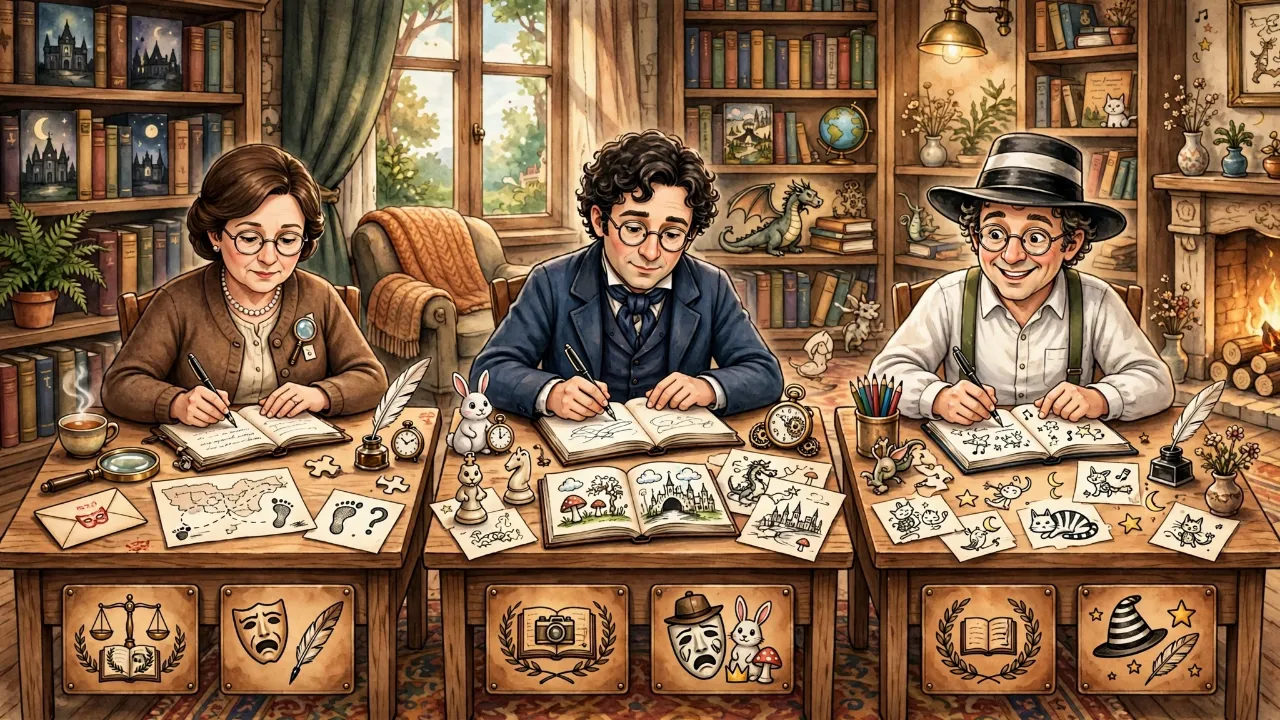
✍️🎭
Some people who write books use a pretend name! It's like a costume for their name. 🦸
Dr. Seuss was really named Ted! He picked a fun name for his stories. 📚
Would YOU pick a special writing name? 🌟
What Is a Pen Name?
A pen name is a pretend name that a writer uses instead of their real name. It is like wearing a mask at a costume party. The same person is underneath, but nobody knows who.
Why Use a Fake Name?
Some writers want to keep their writing a secret. Maybe they are shy, or they want people to think about the story instead of who wrote it.
Famous Fake Names
Dr. Seuss was really Theodor Seuss Geisel. He used his middle name and added "Dr." because it sounded fun.
Mark Twain wrote Tom Sawyer. His real name was Samuel Clemens. "Mark twain" is a riverboat call that means the water is deep enough.
Could You Have a Pen Name?
If you wrote a book, what would your pen name be? 🤔✨
What Is a Pen Name?
A pen name (also called a pseudonym) is a fake name that a writer uses on their books instead of their real name. The term comes from the French phrase nom de plume, which literally means "name of the pen." Writers have been using pen names for hundreds of years, and some of the most famous books ever written were published under made-up names.
Why Do Writers Use Pen Names?
There are many reasons a writer might choose a pen name:
- Privacy: They want to keep their writing life separate from their personal life
- Safety: They're writing something controversial and could get in trouble
- Gender bias: Women writers sometimes used male names because people wouldn't buy books by women
- Starting fresh: A famous author might use a new name to see if people like their writing without knowing who they are
- Fun: Sometimes a made-up name just sounds cooler!
Famous Pen Names You Might Know
- Dr. Seuss → Real name: Theodor Seuss Geisel
- Mark Twain → Real name: Samuel Langhorne Clemens
- Lewis Carroll (Alice in Wonderland) → Real name: Charles Lutwidge Dodgson
- Lemony Snicket (A Series of Unfortunate Events) → Real name: Daniel Handler
- Dav Pilkey (Captain Underpants) → Uses a shortened version of his name David
The Sisters Who Pretended to Be Brothers
In the 1840s, three sisters named Charlotte, Emily, and Anne Brontë wanted to publish their poems and novels. But in those days, people didn't take women writers seriously. So they picked male pen names: Currer, Ellis, and Acton Bell. Emily wrote Wuthering Heights and Charlotte wrote Jane Eyre, two of the most famous novels in history, all while pretending to be men.
Pen Names Today
Pen names are still common today. Many online writers use screen names or handles. Even on social media, people create usernames that aren't their real names. In a way, everyone who uses a username online is using a kind of pen name!
The Secret Lives of Authors
A pseudonym (from Greek pseudos "false" + onyma "name") is more than a quirky tradition. It's a tool that has shaped the history of literature. Writers have used fake names to dodge censorship, challenge prejudice, conduct literary experiments, and protect themselves from political persecution. The practice reveals as much about society as it does about the writers themselves.
Gender and the Pen Name
For centuries, women who wanted to publish faced a brutal reality: their work was dismissed simply because of their gender. The solution for many was to adopt male pen names.
- George Eliot (Mary Ann Evans) wrote Middlemarch, considered one of the greatest novels in English. She chose a male name to ensure her work "would be taken seriously."
- George Sand (Amantine Lucile Aurore Dupin) was one of the most prolific writers of 19th-century France, publishing over 70 novels under her male pseudonym.
- The Brontë sisters published as Currer, Ellis, and Acton Bell. Even after Jane Eyre became a bestseller, there was public debate about whether "Currer Bell" was really a man or a woman.
- James Tiptree Jr. (Alice Bradley Sheldon) dominated science fiction in the 1960s-70s. Fellow author Robert Silverberg once wrote that Tiptree's writing had an "ineluctably masculine" quality, a statement that became deeply embarrassing when Sheldon's identity was revealed in 1977.
Political Pseudonyms
Some of the most important political documents in history were published under pen names:
- Publius: Alexander Hamilton, James Madison, and John Jay used this shared pseudonym to write The Federalist Papers (1787-1788), the essays that argued for ratifying the U.S. Constitution
- Voltaire (François-Marie Arouet) chose his pen name partly to distance himself from his family and partly because his real name had been associated with his imprisonment in the Bastille
- Pablo Neruda (Ricardo Eliécer Neftalí Reyes Basoalto) adopted his pen name at age 16 to hide his poetry from his disapproving father, then kept it for life
The Galbraith Experiment
In 2013, J.K. Rowling published The Cuckoo's Calling, a crime novel, under the name Robert Galbraith. Without Rowling's fame attached, the book sold about 1,500 copies in its first three months, respectable for a debut novel but nothing extraordinary. When a Twitter leak revealed the true author, sales increased by 4,000% overnight. The book shot to #1 on bestseller lists.
This incident became a natural experiment in how much an author's name (brand) matters versus the quality of the writing itself. The writing was identical; only the name changed. The answer was clear: in modern publishing, the author's brand often matters more than the text.
Digital Age Pseudonyms
The internet has made pseudonyms more common than ever. Online, people routinely operate under screen names, handles, and avatars. The question of whether online anonymity is a right or a privilege is one of the defining debates of the digital age. Writers on platforms like Wattpad, Archive of Our Own, and Substack frequently use pen names, continuing a tradition that's centuries old, just on new platforms.
Pen Names: Identity, Power, and the Politics of Authorship
The pen name is not merely a literary convention: it's a lens through which to examine power structures in publishing, the construction of literary identity, and the relationship between an author's biography and the reception of their work. The history of pseudonymous writing is, in many ways, a shadow history of who was allowed to have a public voice and who was not.
The Gendered History
The most striking pattern in pen name usage is gender-based. From the Brontës through George Eliot to James Tiptree Jr., women have adopted male pseudonyms with a frequency that constitutes a systemic response to systemic bias. The underlying logic was articulated bluntly by Charlotte Brontë in 1850: "We had a vague impression that authoresses are liable to be looked on with prejudice."
The Tiptree case is particularly instructive. Alice Sheldon published science fiction as James Tiptree Jr. from 1967 to 1977, winning Hugo and Nebula Awards. Her prose was praised for its "masculine" qualities. When her identity was revealed, the critical reassessment was immediate and uncomfortable. Robert Silverberg's 1975 introduction to Tiptree's collection (arguing that the writing was self-evidently male) became a canonical example of how gender assumptions distort literary judgment. The James Tiptree Jr. Award (now the Otherwise Award) was established in 1991 to honor science fiction that explores gender.
Pseudonyms as Literary Experiment
Some writers use pen names not to hide but to liberate. Fernando Pessoa (1888-1935), the Portuguese poet, created over 70 heteronyms: not just fake names but fully developed alternate literary personalities, each with distinct biographies, writing styles, and philosophical worldviews. Alberto Caeiro wrote pastoral poetry; Ricardo Reis wrote formal odes; Álvaro de Campos wrote futurist manifestos. Pessoa considered these not pseudonyms but autonomous creative entities. This raises genuine philosophical questions about authorial identity that anticipate modern discussions of AI-generated writing.
Søren Kierkegaard used pseudonyms differently: as philosophical tools. Works like Either/Or (1843) were published under names like "Victor Eremita" and "Johannes de Silentio," each representing a distinct philosophical position. Kierkegaard used pseudonyms to present ideas he could then critique from another pseudonymous perspective, creating a dialectical conversation with himself.
The Legal and Ethical Framework
Publishing under a pseudonym is legal in virtually every jurisdiction. In the United States, the First Amendment protects anonymous and pseudonymous speech, as established in McIntyre v. Ohio Elections Commission (1995). Copyright law protects pseudonymous works for 95 years from publication or 120 years from creation (vs. life + 70 years for identified authors), per 17 U.S.C. § 302(c).
However, pseudonymous publishing raises ethical questions in non-fiction. When a white author publishes under an ethnically coded pen name to write about racial experiences (as in the case of Michael Derrick Hudson, who submitted a poem under the name "Yi-Fen Chou" and was selected for Best American Poetry 2015), the pseudonym becomes a tool of appropriation rather than protection. The incident sparked intense debate about when pseudonyms cross from legitimate privacy into deception.
The Rowling Natural Experiment
The Robert Galbraith episode (2013) is valuable because it approximates a controlled experiment in author branding. The Cuckoo's Calling received warm but modest reviews under an unknown name, selling approximately 1,500 copies in three months. Post-reveal, it sold 1.1 million copies within weeks. This suggests that in contemporary publishing, the author's name functions less as an identifier and more as a quality signal, a brand that reduces search costs for readers navigating an oversaturated market.
The economic implications are significant. If even writing as accomplished as Rowling's cannot break through without brand recognition, the barrier to entry for genuinely new authors is immense. This partly explains the rise of self-publishing platforms and serialized web fiction, where pseudonymous authors can build audiences incrementally without the gatekeeping function of traditional publishing.
Digital Pseudonymity
The internet has democratized pseudonymous expression to an unprecedented degree. Platform policies vary: Facebook historically required "real names" (a policy criticized for disproportionately affecting drag performers, indigenous people, and political dissidents), while Twitter/X, Reddit, and most literary platforms allow pseudonyms by default. The debate over online anonymity (privacy versus accountability) is the direct descendant of centuries of arguments about pen names, now scaled to billions of participants.
Pen Names: What a Fake Name Reveals About Real Power
Pen names seem like a simple topic: writers pick fake names, sometimes for fun, sometimes for privacy. But scratch the surface and you find a remarkably clear window into who gets to speak, who gets heard, and how identity shapes the reception of ideas. It's a topic that connects 19th-century feminism to modern internet culture in a straight line.
The Gender Pattern
The most historically significant use of pen names is gender-based concealment, and the pattern is both well-documented and depressing in its persistence. The Brontë sisters (Currer, Ellis, Acton Bell) in the 1840s. George Eliot (Mary Ann Evans) in the 1850s. George Sand (Amantine Lucile Aurore Dupin) across mid-19th century France. Isak Dinesen (Karen Blixen) in the early 20th century. James Tiptree Jr. (Alice Sheldon) in the 1960s-70s. J.K. Rowling using initials in 1997 on her publisher's advice.
The Tiptree revelation in 1977 remains the most scientifically useful data point. Sheldon wrote acclaimed science fiction for a decade. Critics specifically praised the writing's "masculine" qualities. Robert Silverberg wrote, with confidence, that "there is to me something ineluctably masculine about Tiptree's writing." When Sheldon was revealed to be a 61-year-old woman, the literary community was forced to confront the degree to which gender assumptions shaped critical judgment. The entire episode functions as a blind taste test for literary criticism, and the critics failed.
The contemporary data suggests the problem persists in subtler forms. Novelist Catherine Nichols conducted an informal experiment in 2015, sending the same query letter and manuscript pages to literary agents under both her real name and a male pseudonym ("George Leyer"). The male name received 17 times more manuscript requests. This is one data point from one person, not a rigorous study, but it aligns with the VIDA Count's systematic findings of gender disparity in book reviews and literary attention.
Pessoa and the Limits of Authorial Identity
Fernando Pessoa's heteronyms deserve extended attention because they push the concept of the pen name to its philosophical limit. Pessoa didn't just use fake names: he created fully autonomous literary personalities. Alberto Caeiro (1889-1915, per Pessoa's fiction) was a self-taught pastoral poet; Ricardo Reis was a classicist educated by Jesuits; Álvaro de Campos was an engineer who wrote futurist verse; Bernardo Soares kept a philosophical diary (The Book of Disquiet). Pessoa described the heteronyms not as masks but as independent consciousnesses that happened to share his body.
This anticipates contemporary questions about AI authorship with uncomfortable precision. If an author can create a fictional personality whose writing is genuinely distinct from their own, what is the meaningful difference between a heteronym and an AI trained on a specific style? Pessoa would likely argue: the heteronym has a biography, a philosophical position, a death. The AI has parameters. Whether that distinction holds under scrutiny is an open question that literary theory has not yet resolved.
The Economics of the Galbraith Experiment
The Robert Galbraith affair (Rowling publishing crime fiction pseudonymously in 2013) generated real data about author branding. Pre-reveal: ~1,500 copies in three months, positive but modest reviews (the Sunday Times called it a "scintillating debut"). Post-reveal: #1 bestseller within hours, eventually selling over 1.5 million copies. Same text. Same publisher (albeit different imprint). Different name.
The standard interpretation is that Rowling's fame explains the difference, and that's obviously true. But the more interesting question is what this implies about the discoverability problem in publishing. Approximately 4 million books are published annually worldwide. A good book by an unknown author is not merely competing against other good books: it's competing against the entire attention economy. The pen name, paradoxically, strips the author of their most powerful marketing tool: brand recognition. Rowling could afford the experiment because she had Harry Potter money. For most authors, pseudonymity is a luxury or a necessity, not a choice.
Digital Pseudonymity and the Real-Name Debate
The pen name tradition maps directly onto the internet's foundational tension between anonymity and accountability. Facebook's "real name policy" (implemented 2014, softened after criticism) was, in effect, an argument that authentic identity produces better discourse. The counterfactual is extensive: real-name platforms have not demonstrably produced less harassment or misinformation than pseudonymous ones. Meanwhile, pseudonymous platforms (Reddit, early Twitter, Substack) have produced substantive investigative journalism, whistleblowing, and literary work that would not exist under real-name requirements.
The strongest argument for pseudonymity comes from the pen name tradition itself: some of the most important writing in history was published under fake names because the authors' real identities would have prevented publication, invited persecution, or biased reception. The Federalist Papers. Voltaire's philosophical works. The Brontës' novels. Kierkegaard's philosophical treatises. The question is not whether pseudonymity enables bad actors (it does) but whether the cost of eliminating it exceeds the cost of permitting it. History's answer, consistently, is that the world is better off when writers can choose whether to attach their names to their words.
Sources
- Mullan, J. Anonymity: A Secret History of English Literature. Faber & Faber (2007).
- Carmela Ciuraru. Nom de Plume: A (Secret) History of Pseudonyms. Harper (2011).
- Griffin, R.J. "Anonymity and Authorship." New Literary History, 30(4), 877-895 (1999).
- Phillips, J. "The Mem Sahib's Identity: James Tiptree Jr. and the Problem of Gender in Science Fiction." Science Fiction Studies, 17(2) (1990).
- Nichols, C. "Homme de Plume: What I Learned Sending My Novel Out Under a Male Name." Jezebel (August 4, 2015).
- VIDA: Women in Literary Arts. "The Count" annual surveys (2010-2024). vidaweb.org.
- Zenith, R. Pessoa: A Biography. Liveright (2021).
- McIntyre v. Ohio Elections Commission, 514 U.S. 334 (1995).
- 17 U.S.C. § 302(c): Duration of Copyright: Anonymous and Pseudonymous Works.