
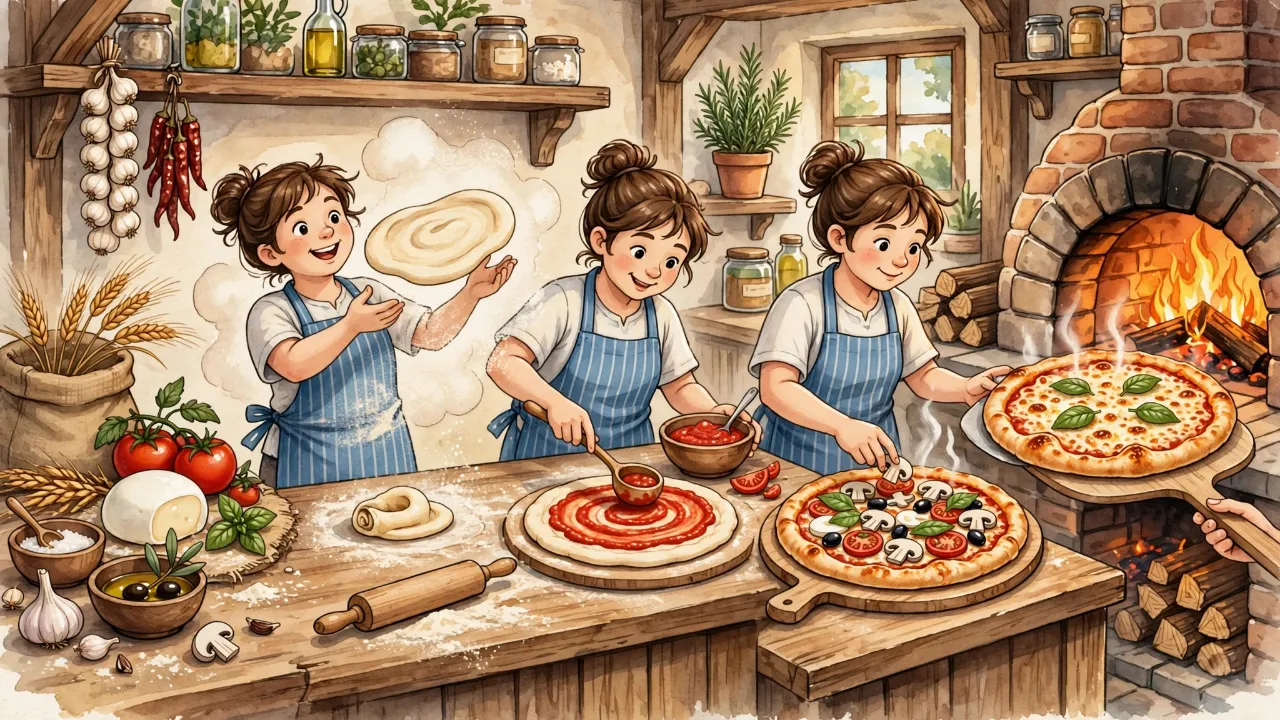
Pizza Is Yummy! 🍕
Pizza has bread on the bottom, red sauce, and gooey cheese on top!
Make It!
Squish the dough flat, add sauce and cheese, then bake it in a HOT oven! 🔥
You can put pepperoni, mushrooms, or pineapple on top! What is YOUR favorite? 😋
Where Did Pizza Come From? 🇮🇹
Pizza comes from Italy. Long ago, people in a city called Naples made flat bread with tomatoes and cheese on top. It was quick, cheap, and delicious.
The Three Pizza Ingredients 🧀
- Dough (flour, water, yeast, and salt)
- Sauce (usually tomatoes)
- Cheese (mozzarella is the classic)
The dough has tiny living things called yeast in it. Yeast eat sugar and make little bubbles of gas. Those bubbles make the dough puffy and soft. 🫧
Pizza Around the World 🌍
In Japan, people put squid on pizza. In Brazil, green peas. In Australia, shrimp. There is no wrong topping. If it tastes good to you, it is a good pizza. 😊
Fun Pizza Fact 🎉
Americans eat about 3 billion pizzas every year. Stacked up, they would reach the Moon. 🌙
A Brief History of Pizza 📜
People have been eating flatbread with toppings for thousands of years. Ancient Egyptians, Greeks, and Romans all made versions of flat bread baked with olive oil and local herbs. But modern pizza, with tomato sauce and cheese, was born in Naples, Italy in the 1700s.
Here is the cool part: tomatoes originally came from the Americas! When Spanish explorers brought them to Europe, many Europeans thought tomatoes were poisonous. The poor people of Naples were the first to start putting them on flatbread, and pizza was born.
The Famous Margherita 🇮🇹
In 1889, a pizza maker named Raffaele Esposito made a special pizza for Queen Margherita of Italy. He used three ingredients that matched the colors of the Italian flag:
- 🔴 Red tomato sauce
- ⚪ White mozzarella cheese
- 🟢 Green basil leaves
He named it "Pizza Margherita" after the Queen, and it is still the most famous pizza in the world!
The Science of Dough 🔬
Pizza dough is alive! It contains yeast, a tiny single-celled fungus. When yeast eats the sugars in flour, it produces carbon dioxide gas and alcohol. The gas gets trapped in the stretchy gluten network (formed when flour proteins mix with water), creating bubbles that make the dough rise.
The best pizza dough is fermented slowly, sometimes for 24 to 72 hours. Longer fermentation creates more flavor compounds and makes the crust easier to digest.
Why Does Pizza Taste So Good? 😋
Pizza hits almost every taste your tongue can detect:
- Sweet: caramelized sugars in the crust and sauce
- Salty: cheese and added salt
- Sour: fermented dough and tomato acid
- Umami: aged cheese, tomatoes, and cured meats
- Savory fat: melted cheese and olive oil
Very few foods hit all five taste categories at once. That is why pizza is almost universally loved!
From Naples to the World: Pizza's Journey 🌍
Pizza's transformation from Neapolitan street food to global phenomenon tracks with some of the most significant migration and economic patterns of the 19th and 20th centuries. Between 1880 and 1920, approximately 4 million Italians emigrated to the United States, bringing their food traditions with them. Pizza remained an ethnic food largely confined to Italian-American communities until after World War II, when American GIs who had been stationed in Italy returned home craving the dish.
The post-war suburban boom and the rise of franchising transformed pizza from artisan craft to industrial product. Pizza Hut (1958), Domino's (1960), and Little Caesars (1959) created supply chains that standardized ingredients and processes across thousands of locations.
The Chemistry of Great Crust 🧪
Pizza dough is a study in biochemistry. Wheat flour contains two proteins, glutenin and gliadin, that form gluten when hydrated. Glutenin provides elasticity (stretch and spring-back), while gliadin provides extensibility (the ability to stretch without breaking). The ratio of these proteins determines whether dough is suitable for pizza, bread, or cake.
Professional pizza flour (Tipo 00 in Italy) is milled to an extremely fine particle size (less than ~150 micrometers) with a protein content of 11-13%. The fine grind increases water absorption and creates a smoother, more extensible dough.
The Maillard Reaction and Caramelization 🔥
Two separate chemical processes create pizza's distinctive flavors and colors. The Maillard reaction (named for French chemist Louis-Camille Maillard, 1912) occurs when amino acids react with reducing sugars above approximately 140°C. This non-enzymatic browning creates hundreds of flavor compounds, including pyrazines (nutty, roasted notes) and furanones (caramel, butterscotch).
Caramelization is the thermal decomposition of sugars above 160°C, producing diacetyl (buttery flavor) and maltol (toasty sweetness). A Neapolitan pizza oven at 485°C achieves both reactions in 60-90 seconds. A home oven at 250°C requires 8-12 minutes, producing a different balance of reaction products and thus a different flavor profile.
Pizza Economics 💰
The global pizza market was valued at approximately $150 billion in 2023 and is projected to reach $230 billion by 2030. In the United States alone, there are approximately 75,000 pizzerias generating $46 billion in annual revenue. The average American consumes about 23 pounds of pizza per year.
Pizza's economic efficiency is remarkable: the core ingredients (flour, water, yeast, tomatoes, mozzarella) are among the cheapest foods per calorie. A basic Margherita's raw ingredient cost is approximately $1.50-2.00, while selling for $8-18, representing a food cost percentage of 15-25%, among the best margins in food service.
Fermentation Science: Dough as Living System 🧬
Pizza dough fermentation involves multiple microbial communities producing a cascade of metabolic products. Saccharomyces cerevisiae (baker's yeast) performs alcoholic fermentation, converting glucose to ethanol and CO₂. In long-fermented doughs (24-72 hours at 2-4°C), lactic acid bacteria (primarily Lactobacillus sanfranciscensis and L. plantarum) produce organic acids that contribute flavor complexity.
The interplay between yeast and LAB populations is competitive: as pH drops below 4.5 from acid production, yeast activity declines. This dynamic equilibrium determines the final flavor profile. Research by Corsetti and Settanni (2007) demonstrated that sourdough-style pizza fermentation produces up to 300% more volatile aromatic compounds than direct-method (rapid-rise) doughs.
Heat Transfer and Oven Physics 🔥
The traditional Neapolitan pizza oven operates at 430-485°C, cooking a pizza in 60-90 seconds. Three modes of heat transfer occur simultaneously:
- Conduction from the oven floor (refractory brick or stone, thermal conductivity ~1.0 W/m·K) to the dough base
- Convection from the superheated air and combustion gases circulating within the dome
- Radiation from the dome and walls (Stefan-Boltzmann law: q = εσT⁴, where emissivity ε ≈ 0.9 for firebrick)
q = εσT⁴ = 0.9 × 5.67×10⁻⁸ × 758⁴ ≈ 16,800 W/m²
At 250°C (523 K, home oven):
q = 0.9 × 5.67×10⁻⁸ × 523⁴ ≈ 3,820 W/m²
The Neapolitan oven delivers 4.4x more radiative energy.
This differential explains why home ovens cannot replicate the "leopard spotting" (localized char pattern) characteristic of Neapolitan pizza. The rapid surface desiccation at high temperatures creates steam-leavened bubbles (cornicione) before the interior overcooks, a thermodynamic balance impossible at lower temperatures.
Food Geography: Pizza as Cultural Mirror 🗺️
Regional pizza variations encode local agricultural, economic, and cultural information. New York-style pizza (high-gluten flour, low-moisture mozzarella, gas-deck oven) reflects the city's coal-then-gas infrastructure and immigrant labor economics. Detroit-style pizza (blue-steel automotive parts trays, brick cheese, twice-baked) literally repurposes auto industry materials. Brazilian pizza (catupiry cream cheese, green corn, hearts of palm) incorporates Indigenous and Portuguese ingredient traditions.
Japan's pizza market is particularly instructive. Domino's Japan generates more revenue per store than any other Domino's market globally, but Japanese artisan pizzerias also dominate international Neapolitan pizza competitions. This dual success reflects Japan's broader pattern of mastering foreign culinary traditions while simultaneously transforming them (cf. Japanese whisky, ramen, curry).
The Associazione Verace Pizza Napoletana: Culinary Standardization 📋
The AVPN, founded in 1984 and receiving EU Traditional Speciality Guaranteed (TSG) certification in 2010, specifies every parameter of "true" Neapolitan pizza: Tipo 00 flour, San Marzano tomatoes (DOP), fresh mozzarella di bufala campana or fior di latte, wood-fired at 485°C for 60-90 seconds, diameter not exceeding 35 cm. This standardization raises questions about authenticity, innovation, and who has the authority to define a living culinary tradition.
The tension between codification and evolution is not unique to pizza. French wine appellations, Japanese wagyu grading, and Indian Darjeeling tea certification all face the same paradox: protect tradition or permit adaptation. The Neapolitan pizza case is unusual in that the "traditional" form (Margherita with DOP ingredients) is itself the product of 19th-century marketing to Queen Margherita, not an ancient, unchanging recipe.
The Improbable Rise of a Peasant Food
Pizza's trajectory from poverty food to humanity's most popular dish is one of the great stories of culinary globalization. In 18th-century Naples, pizza was the food of the lazzaroni, the urban poor who needed cheap, portable calories. Visitors to Naples described it with barely concealed disgust. Samuel Morse (yes, the telegraph inventor), visiting Naples in 1831, described pizza as "a species of most nauseating cake... covered over with slices of pomodoro or tomatoes, and sprinkled with little fish and black pepper and I know not what other ingredients, it altogether looks like a piece of bread that has been taken reeking out of the sewer."
That this object of elite contempt became the world's most consumed food, worth $150+ billion annually, is a story about migration, economic transformation, and the stubborn wisdom of working-class food traditions.
The Science That Makes It Work
Pizza is an extraordinarily well-optimized food from a sensory science perspective. Research by Charles Spence's Crossmodal Research Laboratory at Oxford has identified several convergent factors:
- Macronutrient density: Pizza combines fat (cheese, oil), carbohydrate (crust), and protein (cheese, meat toppings) in proportions that maximize palatability per calorie.
- Umami loading: Aged cheese (glutamate concentration 0.1-1.2g/100g), tomatoes (0.14-0.25g/100g), and cured meats (inosinate) produce strong umami synergy. The glutamate-inosinate interaction is super-additive, meaning the combined umami effect exceeds the sum of individual contributions by up to 8x.
- Contrast principle: Crisp crust vs. soft cheese, hot temperature vs. cool tomato acid, salt vs. sweet caramelized sugars. Hedonic psychology research consistently shows that sensory contrast increases pleasure ratings.
Pizza and Public Health: The Complicated Numbers
Pizza accounts for approximately 6% of total caloric intake in the American diet (NHANES data, 2015-2018). On any given day, approximately 13% of Americans consume pizza. This makes it one of the single largest contributors to sodium, saturated fat, and caloric intake in the national diet.
Yet the nutritional profile is highly variable. A Neapolitan Margherita (flour, tomato, mozzarella, basil, olive oil) has a fundamentally different nutritional profile from a stuffed-crust meat-lover's pizza from a chain restaurant. The former is roughly comparable to a Mediterranean diet meal; the latter can contain over 3,000 mg of sodium in two slices. Blanket nutritional recommendations about "pizza" are therefore largely meaningless without specifying what kind.
The Economics of the Slice
Pizza's economic structure reveals broader truths about food systems. The raw ingredient cost for a basic pizza is approximately $1.50-2.50. The retail price ranges from $1 (dollar slice in NYC) to $30+ (artisan Neapolitan). This range reflects the fundamental tension in food service: labor, rent, and quality ingredients cost money, but consumer price sensitivity constrains pricing.
The "pizza-subway connection" noted by food economist Eric Bader in 1980 tracked the correlation between NYC slice prices and subway fares from the 1960s through the 2010s. Both hovered around the same price point for decades ($0.15 in 1960, $0.35 in 1970, $1.00 in 1986, $2.50 in 2013). The correlation broke down around 2020 as subway fares were held artificially low while food costs spiked. But for 50+ years, the pizza-subway index was a surprisingly reliable inflation indicator, suggesting that both prices track the same basket of urban operating costs.
Authenticity and Its Discontents
The AVPN's codification of "true" Neapolitan pizza raises a question that extends far beyond food: who owns a tradition? The Margherita itself was a 19th-century marketing creation. San Marzano tomatoes are a product of 20th-century agricultural selection. Mozzarella di bufala depends on water buffalo introduced to Italy (probably from India) during the medieval period. At which point in this chain of borrowing and adaptation does "authenticity" begin?
The most interesting pizza in the world right now may be the Japanese Neapolitan scene, where pizzaiolos like Pasqualino Barbasso (a Neapolitan who moved to Tokyo) and Japanese masters like Shigetaka Irie compete in and regularly win global pizza championships. Their work suggests that deep engagement with tradition, combined with Japanese precision culture, can produce results that rival or exceed the "authentic" source. This pattern repeats across Japanese engagement with whisky, denim, coffee, and classical music.
Sources
- Helstosky, C. (2008). "Pizza: A Global History." Reaktion Books.
- Corsetti, A. & Settanni, L. (2007). "Lactobacilli in sourdough fermentation." Food Research International, 40(5), 539-558.
- Spence, C. (2017). "Gastrophysics: The New Science of Eating." Viking.
- AVPN International Regulations (2010). Associazione Verace Pizza Napoletana.
- Ferdman, R. A. (2014). "The pizza-subway correlation." Washington Post / Wonkblog.
- USDA Dietary Data Brief No. 38 (2020). "Pizza consumption among adults."
- Morse, S. F. B. (1835). "Imminent Dangers to the Free Institutions of the United States." (Letter from Naples, 1831).