
🖨️📄
A printer makes pictures and words on paper! 🎨
You press a button and paper comes out with your drawing on it! ✨
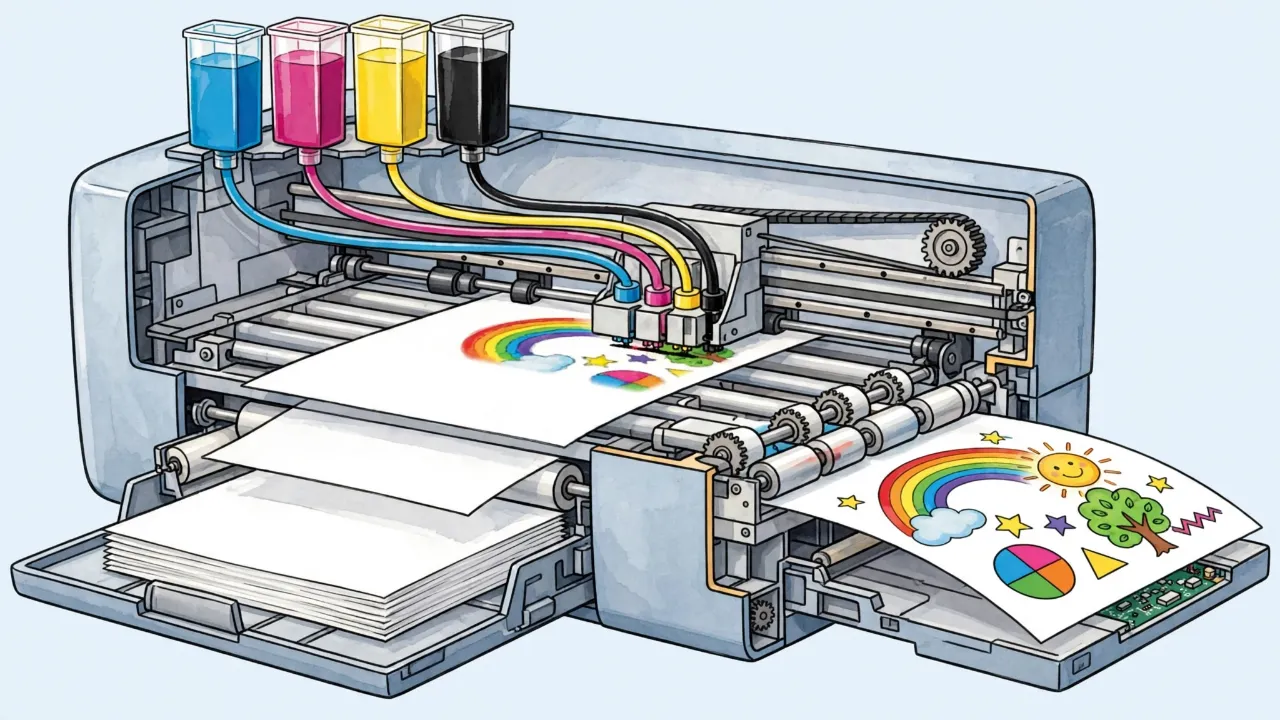
Printers spray tiny dots of color to make pictures. So many dots! 🔴🔵🟡
What Is a Printer?
A printer is a machine that puts words and pictures onto paper. You tell your computer what to print, and the printer makes it real.
How Does It Work?
Most home printers use tiny drops of ink from small tanks called cartridges. A little bar moves back and forth across the paper and sprays thousands of teeny drops. Together, the drops make words and pictures.
What Colors Does a Printer Use?
Only four: blue, pink, yellow, and black. By mixing them, the printer can make almost any color. It is like mixing paint. 🎨
Can Printers Make Other Things?
Some special printers, called 3D printers, squeeze out melted plastic in thin layers, one on top of another, until they build a whole toy. It is like a stack of very thin pancakes. 🥞
Before Printers: Copying by Hand
For thousands of years, the only way to make a copy of a book was to write it out by hand. Monks in monasteries spent years copying a single book, letter by letter. A Bible could take 2 to 3 years to finish. Books were so expensive that only kings, churches, and universities could own them.
The Printing Press Changes Everything
In the 1440s, a German man named Johannes Gutenberg invented the printing press. He carved individual letters onto small metal blocks. He could arrange these blocks to spell words, cover them in ink, and press them onto paper. One page could be printed hundreds of times!
Gutenberg's first big project was the Gutenberg Bible. He printed about 180 copies, which was incredible at the time. Today, only 49 copies survive, and each one is worth millions of dollars.
Modern Printers: Inkjet vs. Laser
Today, there are two main types of printers you will find at home or school:
- Inkjet printers spray tiny droplets of liquid ink onto paper. They are great for printing colorful photos and pictures. The droplets are smaller than the width of a human hair!
- Laser printers use a powder called toner instead of liquid ink. A laser beam draws the image onto a spinning drum, the toner sticks to the drawn parts, and then heat melts it onto the paper. Laser printers are faster and the pages do not smudge.
3D Printers: Printing Real Objects
3D printers do not print on paper at all. They build objects layer by layer. A 3D printer melts a thin string of plastic and squeezes it out through a tiny nozzle, like a very precise hot glue gun. Each layer is about as thick as a sheet of paper. Stack enough layers together and you can make toys, phone cases, tools, and even parts for rockets!
Why Printers Still Matter
Even though we read a lot on screens today, printers are still important. Schools print worksheets and tests. Hospitals print patient records. Artists print their artwork. And 3D printers are being used to build houses, create artificial bones for surgery, and even print food!
The Physics of Putting Ink on Paper
Every printer solves the same fundamental problem: transferring a digital pattern (a grid of pixels on a screen) into a physical pattern (marks on paper). The two dominant technologies take radically different approaches.
Inkjet: Controlled Explosions
Thermal inkjet printers (used by HP and Canon) work through rapid heating. A tiny resistor behind each nozzle heats up to about 300°C in microseconds. This vaporizes a thin layer of ink, creating a bubble that forces a droplet out of the nozzle at speeds up to 10 meters per second. The bubble collapses, fresh ink refills the chamber, and the process repeats thousands of times per second.
Piezoelectric inkjet printers (used by Epson) use a different mechanism. A piezoelectric crystal behind each nozzle flexes when voltage is applied, physically squeezing ink out. This allows more precise control of droplet size and avoids heating the ink, which can degrade photo-quality dyes.
Laser: Static Electricity and Light
Laser printers exploit electrostatics, the same force that makes a balloon stick to a wall after you rub it on your hair. The process, called xerography, works in six steps:
- Charging: A corona wire gives the photosensitive drum a uniform negative electrical charge
- Exposing: A laser beam scans across the drum, removing the charge wherever it strikes, creating an invisible electrostatic image
- Developing: Positively charged toner particles are attracted to the discharged areas of the drum
- Transferring: Paper passes against the drum, and a stronger charge pulls the toner from the drum onto the paper
- Fusing: The paper passes through heated rollers (about 200°C) that melt the toner into the paper fibers permanently
- Cleaning: A blade scrapes residual toner off the drum, and the cycle repeats
A printer rated at 1200 DPI (dots per inch) places 1,200 dots in each inch horizontally and vertically.
Dots per square inch = 1,200 × 1,200 = 1,440,000 dots
For a full 8.5" × 11" page: 1,440,000 × 93.5 = 134,640,000 dots per page!
That is nearly 135 million precisely placed marks, which is why printed text looks so sharp compared to a screen.
CMYK: The Four-Color Trick
Color printers use just four inks: Cyan, Magenta, Yellow, and Key (black). This is called subtractive color mixing. Each ink absorbs (subtracts) certain wavelengths of light and reflects others. Cyan absorbs red light, magenta absorbs green light, and yellow absorbs blue light. By layering these inks in varying amounts, the printer can reproduce millions of distinguishable colors.
The "K" (black) ink exists for practical reasons. Mixing cyan, magenta, and yellow together should theoretically produce black, but in practice it creates a muddy brown. Adding a dedicated black ink produces sharper text and saves the expensive color inks.
3D Printing: Additive Manufacturing
Traditional manufacturing is subtractive: you start with a block of material and cut away what you do not need. 3D printing is additive: you start with nothing and add material only where needed. This creates less waste and allows geometries that are impossible to machine, such as hollow structures, interlocking parts, and internal channels.
The most common 3D printing technology, FDM (Fused Deposition Modeling), melts thermoplastic filament and extrudes it through a nozzle that moves in three dimensions. Layer heights range from 0.05mm to 0.3mm. A typical print takes 2 to 12 hours depending on size and complexity.
Industrial 3D printers use SLS (Selective Laser Sintering), which fuses powdered metal or nylon with a laser, or SLA (Stereolithography), which cures liquid resin with UV light. These produce parts strong enough for aerospace, medical implants, and automotive applications.
Gutenberg's Real Innovation Was Not the Press
The standard narrative credits Johannes Gutenberg with inventing the printing press around 1440. This is misleading. Presses (screw mechanisms for applying pressure) existed for centuries in wine and olive oil production. Woodblock printing was practiced in China by the 9th century, and Korea developed movable metal type by the 13th century (the Jikji, printed in 1377, predates Gutenberg by 78 years).
Gutenberg's actual breakthrough was a system, not a single device. He developed: (1) an alloy of lead, tin, and antimony that could be cast into durable, uniform type pieces; (2) a hand mold that allowed rapid, consistent production of individual characters; (3) an oil-based ink that adhered to metal type (water-based inks used in Asian printing beaded on metal); and (4) a modified wine press adapted for even pressure across a type form. Each component existed in some form; Gutenberg integrated them into a reproducible manufacturing process.
The Ink Cartridge Problem
Consumer inkjet printers present one of the most studied examples of the razor-and-blades business model. Manufacturers sell printers at or below cost, then profit from replacement ink cartridges. The economics are remarkable:
- HP printer ink costs approximately $2,700 to $9,600 per gallon when purchased in standard cartridges, depending on the model. For comparison, a gallon of gasoline costs roughly $3.50, and a gallon of human blood costs about $1,500.
- The actual cost to manufacture ink is estimated at $0.50 to $5.00 per cartridge. The gross margin on ink exceeds 90%.
- Manufacturers use DRM chips on cartridges to prevent third-party refills. HP's "Dynamic Security" firmware updates have remotely disabled cartridges that lack HP's authentication chip, triggering FTC investigations and class-action lawsuits.
In 2023, HP generated approximately $17 billion in printing revenue, representing about 60% of the company's total. The printing division's operating margin (roughly 18-20%) subsidizes HP's lower-margin PC business. This creates a structural incentive to protect cartridge revenue through increasingly aggressive DRM, even at the cost of customer goodwill.
3D Printing: Disruption Topology
3D printing (additive manufacturing) follows a classic Christensen disruption pattern: initially inferior to established manufacturing on most metrics (speed, strength, surface finish, cost per unit), but superior on dimensions incumbents do not prioritize (customization, geometric complexity, zero-tooling production).
Current industrial applications represent genuine manufacturing shifts:
- Aerospace: GE's LEAP engine fuel nozzle, previously assembled from 20 separate parts, is now 3D-printed as a single piece. It is 25% lighter and five times more durable. GE has printed over 100,000 of these nozzles since 2016.
- Medical: Over 100,000 titanium hip implants have been 3D-printed by companies like Stryker. The porous surface structure, impossible to machine traditionally, promotes bone ingrowth. Patient-specific surgical guides are now 3D-printed routinely for complex orthopedic and craniofacial procedures.
- Construction: ICON's Vulcan printer has produced habitable houses in 24 to 48 hours using concrete extrusion. In 2023, ICON completed a 100-home community in Georgetown, Texas. The technology reduces construction waste by 30-60% compared to traditional framing.
C_additive = V × ρ × c_material + t_print × c_machine
C_subtractive = V_stock × ρ × c_material + t_setup × c_tooling + t_machine × c_machine
Additive wins when V/V_stock is small (complex geometry, high buy-to-fly ratio) or t_setup is large (low volume, frequent design changes)
Bioprinting: The Frontier
Bioprinters deposit living cells suspended in hydrogel scaffolds to fabricate tissue structures. As of 2026, researchers have successfully bioprinted:
- Skin grafts: Wake Forest Institute has printed multi-layered skin directly onto burn wounds in clinical trials
- Cartilage: 3D-printed ear cartilage implants reached human trials in 2022 (3DBio Therapeutics)
- Organ models: Functional miniature kidneys and liver tissue for drug testing (not yet transplantable)
Fully functional, transplantable organs remain 10 to 20 years away, primarily because vascularization (creating the network of blood vessels that keeps tissue alive) at organ scale has not been solved. The challenge is less about printing resolution and more about biology: cells need oxygen and nutrients within 200 micrometers of a blood vessel to survive.
Why Your Kid Asked About Printers
Printers are one of those objects kids encounter constantly (school worksheets, birthday party invitations, boarding passes) without ever thinking about how they work. The request might have been sparked by a paper jam, a "low ink" warning, or the sheer novelty of watching paper emerge with a drawing on it. Whatever the trigger, this is a surprisingly rich topic.
The Ink Tax
If you own an inkjet printer, you are likely aware of the pricing model. But the numbers are worth seeing explicitly. HP, Canon, Epson, and Brother collectively sell consumer inkjet cartridges at markups exceeding 1,000% over manufacturing cost. HP's printing division, which is primarily cartridge revenue, generates roughly $17 billion annually with operating margins near 20%. The printers themselves are sold at or below bill-of-materials cost.
The comparison that crystallizes this: HP printer ink, by volume, is more expensive than vintage Champagne, Chanel No. 5, and penicillin. The only consumer liquids consistently more expensive are certain specialty perfumes and scorpion venom (for pharmaceutical manufacturing).
This model persists because of lock-in through DRM. Modern cartridges contain authentication chips that communicate with the printer firmware. HP's "Dynamic Security" system has remotely bricked third-party cartridges through firmware updates, generating multiple class-action lawsuits (the most recent, Stover v. HP, settled in 2024 for $1.35 million). The EU's Ecodesign Regulation, effective 2025, now requires printers to accept non-OEM cartridges. The U.S. has no equivalent mandate.
Practical advice: If you print occasionally (fewer than 100 pages per month), a black-and-white laser printer eliminates ink-drying problems, cartridge DRM hassles, and per-page costs above $0.02. The Brother HL-L2350DW (or its current equivalent) has been the default recommendation in the printing enthusiast community for years. If you need color, Epson's EcoTank line uses refillable ink tanks instead of cartridges, with a cost per page roughly 90% lower than traditional cartridge models. The upfront price is higher ($200 to $400 vs. $50 to $100), but the total cost of ownership over three years is typically half.
3D Printers at Home: Worth It?
Consumer 3D printers have reached a maturity point where they are genuinely useful, not just hobbyist toys. A Bambu Lab A1 Mini ($199) or Creality Ender-3 V3 ($199) can produce functional replacement parts (broken appliance knobs, shelf brackets, cable organizers), educational models, and custom items.
The honest assessment for a parent considering one:
- Ages 7 to 10: Kids will be excited by the novelty, but design work requires CAD software (TinkerCAD is the most accessible). Expect heavy parental involvement in design and printer management. The educational value is real: spatial reasoning, iterative design, patience (prints take hours).
- Ages 10 to 14: This is the sweet spot. Kids can learn TinkerCAD or Fusion 360 independently, troubleshoot print failures, and produce items they actually use. The maker-education community has extensive free curricula.
- Safety: FDM printers have a heated nozzle (200 to 260°C) and a heated bed (50 to 100°C). Burns are the primary risk. Enclosed printers (Bambu Lab models) are safer. PLA filament is the safest material for home use; ABS releases fumes that require ventilation.
The Larger Story: Democratization of Production
Gutenberg's press democratized information. The personal computer and laser printer democratized publishing (desktop publishing in the 1980s eliminated entire professions in typesetting and paste-up). 3D printers are beginning to democratize manufacturing.
The pattern repeats: an expensive, expert-operated industrial technology becomes cheap and accessible enough for individuals. Each transition faces the same resistance (quality concerns, copyright enforcement, safety regulation) and the same resolution (the benefits of distributed production outweigh the costs of controlling it).
Whether your child becomes an engineer who designs production-grade 3D-printed components, an artist who uses resin printers to create sculptures, or simply a person who replaces a broken dishwasher part at 9 PM instead of waiting three weeks for a manufacturer's replacement, understanding printers is understanding a fundamental shift in how physical objects enter the world.
Sources
- Eisenstein, E. The Printing Press as an Agent of Change. Cambridge University Press (1979).
- Man, J. The Gutenberg Revolution. Bantam (2009).
- HP Inc. Annual Report, Fiscal Year 2023. SEC Filing 10-K.
- Consumer Reports. "Best Printers of 2025." Updated January 2025.
- Wohlers Associates. Wohlers Report 2025: 3D Printing and Additive Manufacturing Global State of the Industry.
- GE Additive. "LEAP Fuel Nozzle Case Study." (2024).
- Murphy, S.V. and Atala, A. "3D bioprinting of tissues and organs." Nature Biotechnology 32, 773-785 (2014).
- EU Ecodesign for Sustainable Products Regulation, (EU) 2024/1781.