
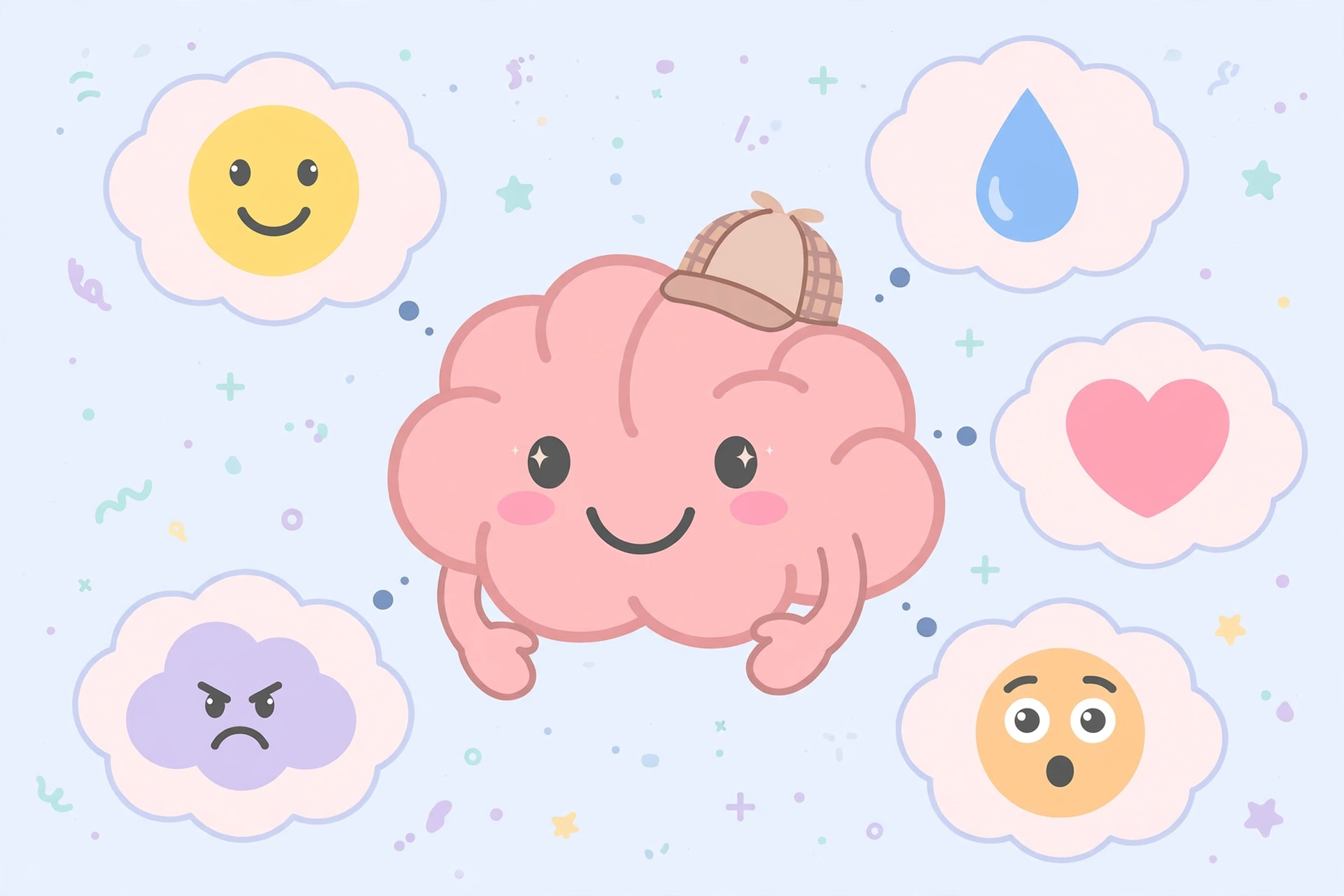
🧠💭😊
Psychology is a big word. It means learning how our thoughts and feelings work.
Your brain is the boss of your body. It tells you when you are happy, sad, or mad.
When you talk about your feelings, that is psychology too! 😊
What Is Psychology?
Psychology is the study of how people think and feel. A person who studies it is called a psychologist (sigh-CALL-uh-jist). Psychologists ask questions: "Why do we laugh?" or "Why are we scared of the dark?"
Your Brain Is a Message Center
Your brain is full of tiny parts called neurons, about 86 billion of them! They send messages to each other nonstop. That is how you remember your name and know cookies taste sweet.
Feelings Are Messages
Feelings are not good or bad. They are messages. Fear says, "Be careful!" Anger says, "That feels unfair!" Joy says, "This is wonderful!" Psychologists help people hear those messages clearly.
The Marshmallow Test
Once, scientists gave kids a choice: one marshmallow now, or two if you waited. Waiting was hard! But kids who waited often did better in school later. Practice waiting and your brain gets stronger like a muscle.
The Science of How We Think
Psychology is the science of how we think, feel, and act. It became a real science in 1879, when Wilhelm Wundt opened the first psychology lab in Germany and measured how fast people reacted to sounds. Nobody had ever measured the mind like that before.
Your Brain the Fortune Teller
Your brain has about 86 billion neurons, tiny cells that pass messages, and uses them to guess what happens next, nonstop. When you catch a ball, your brain predicts where it will land before your eyes see it. That is why magic tricks surprise you: the magician breaks your prediction. Psychologists study these guesses to learn how thinking works.
Pavlov's Drooling Dogs
Russian scientist Ivan Pavlov noticed his dogs drooled at the sight of food, and then at the footsteps of the person bringing it! He rang a bell before each meal, and soon the bell alone made them drool. Their brains had linked bell with food, a trick called classical conditioning. It happens to you too. If your family always plays the same song on road trips, hearing it at home can make you feel excited.
Why We Forget (and How to Remember)
In the 1880s, Hermann Ebbinghaus tested his own memory. He found that we forget most new things within a day unless we review them. The fix is spaced repetition: study a little, wait, and study again. Flashcards work because of this. Cramming the night before a test feels productive, but the memories fade fast.
Big Feelings Are Information
Paul Ekman photographed faces around the world and found six emotions everyone shows the same way: happiness, sadness, fear, anger, surprise, and disgust. Psychologists say emotions are information, not orders. You can feel angry without acting angry. Naming the feeling helps: "I feel frustrated" engages your thinking brain and calms the feeling part.
Try This!
Next time a big feeling shows up, try "name it to tame it." Say the feeling out loud: "I feel nervous." Then take three slow breaths. You just did real psychology on yourself.
Not Mind Reading: A Real Science
Psychology is not mind reading. Psychologists cannot tell what you are thinking, and anyone who claims they can is selling something. Psychology is the scientific study of mind and behavior. Psychologists run experiments, collect data, and change their minds when the evidence says they are wrong. That last part is what makes it science.
The field has branches. Clinical psychologists help people with anxiety, depression, and trauma. Cognitive psychologists study memory, attention, and decision making. Developmental psychologists study how minds change from babies to grandparents. Social psychologists study how groups change what individuals do. Neuroscientists study the brain itself, the 86-billion-neuron machine all the others are really about.
How Do Psychologists Know Anything?
Three tools do most of the work: experiments, observations, and surveys. In an experiment, you change one thing and watch what happens, keeping everything else the same. In an observation, you watch without interfering. In a survey, you ask. Each has traps. People lie on surveys (usually to look good). Observations cannot prove cause. And experiments in a lab sometimes do not match real life.
The biggest trap has a name: correlation is not causation. Ice cream sales and drowning deaths rise together every summer. Ice cream does not cause drowning. Hot weather causes both. Whenever two things move together, a psychologist asks: is there a third thing driving both?
Monkeys, Cloth Mothers, and Love
In the 1950s, Harry Harlow ran an experiment that sounds cruel today and taught us something huge. Baby monkeys were given two fake mothers: one made of wire that gave milk, one made of soft cloth that gave nothing. The babies spent almost all their time clinging to the cloth mother. Food was not what they needed most. Comfort was. The study changed how orphanages and hospitals treated babies. Holding matters.
The Marshmallow Test, Updated
You may have heard of the marshmallow test from the 1960s: kids who waited for two marshmallows did better in life. For decades, parents quoted it. Then in 2018, researchers ran a bigger, better version with 900 children. The effect mostly disappeared once they accounted for family background. Kids from stable, wealthier homes waited longer and also did better in school. The marshmallow was never the point. Trust was. A child who trusts that the second marshmallow is really coming can afford to wait. Honest science updates itself, even when the update is less exciting.
Mindset: The Story You Tell Yourself
Stanford psychologist Carol Dweck found that kids who believe ability can grow (a "growth mindset") handle failure better than kids who believe talent is fixed. The growth mindset kids saw a bad grade as information. The fixed mindset kids saw it as a verdict. Here is the catch Dweck herself now stresses: just saying "growth mindset" as a slogan does nothing. What works is teaching actual strategies, praising effort that uses good strategies, and treating the brain as something that changes with use. Because it does. Learning physically rewires neurons.
Psychology Is Checking Its Own Homework
Here is something most sciences will not admit out loud: psychology spent the 2010s discovering that many famous findings did not hold up when retested. A giant 2015 project re-ran 100 studies and got the same result only about a third of the time. Small samples, lucky results, and journals that only published exciting findings had filled the field with shaky claims. Psychologists responded by changing the rules: preregistering studies (announcing the plan before collecting data), sharing data openly, and running bigger replications. A science that fixes its own mistakes is a science you can trust more, not less.
A Brief, Honest History
Psychology officially began in 1879, when Wilhelm Wundt opened his Leipzig laboratory and started timing mental processes with brass instruments. His student Edward Titchener tried to break consciousness into raw elements, the way chemists break matter into atoms. It did not work. You cannot understand a symphony by listing its notes.
Then came Sigmund Freud, the most famous psychologist who was barely a scientist. Freud proposed the unconscious mind, repression, and childhood origins of adult trouble. His specific claims mostly failed testing. His cultural impact was enormous anyway: therapy as talking, dreams as meaningful, childhood as formative. Psychology kept the questions and threw out most of the answers.
The behaviorists rebelled next. John B. Watson and B.F. Skinner argued that only observable behavior counts as data, and that minds are black boxes we should ignore. They were wrong about ignoring the mind, but they discovered real laws. Skinner's reinforcement schedules still explain why slot machines and social media feeds are addictive: rewards delivered on unpredictable schedules produce the most persistent behavior. Check your phone much?
The cognitive revolution of the 1950s and 60s put the mind back in. Noam Chomsky showed that children learn language too fast for pure reward and punishment to explain it; something in the brain must come pre-structured. Ulric Neisser, George Miller, and others built models of memory and attention as information processing. Then Daniel Kahneman and Amos Tversky showed that this information processor is gloriously, predictably irrational.
How Rational Are You? (Not Very)
Kahneman and Tversky's prospect theory, published in 1979, is the most cited paper in the history of economics, and it is a psychology paper. Its core finding: losses hurt about twice as much as equal gains feel good. This loss aversion warps everything from investing to negotiating to why you cannot throw away a sweater you never wear. Their heuristics and biases program mapped dozens of mental shortcuts: anchoring (the first number you hear drags your estimate toward it), availability (vivid events feel more likely than they are, which is why people fear plane crashes more than car crashes), and confirmation bias (we notice evidence that agrees with us and glide past the rest).
These are not character flaws. They are features of a brain built for speed on the savanna, running modern software it was never designed for. Knowing about a bias does not make you immune to it, which is itself a finding (the bias blind spot: everyone else is biased; you are the exception).
Attachment: Your First Theory of Relationships
British psychiatrist John Bowlby proposed that babies form an internal working model of relationships from how caregivers respond. Consistent, warm responses build secure attachment: the child explores confidently because home base is safe. Inconsistent or cold responses build anxious or avoidant patterns. Mary Ainsworth's Strange Situation experiment (1978) classified these patterns by watching toddlers react to a parent leaving and returning. Longitudinal studies find these early patterns predict, modestly but really, adult relationship styles decades later. Modestly matters in science: human behavior has many causes, so any single factor explaining even 10 percent of the variance is a big deal.
Methods: How the Sausage Gets Made
Modern psychology runs on preregistration, power analysis, and effect sizes, and you should know what those mean before trusting any headline. Preregistration means posting your hypothesis and analysis plan publicly before collecting data, which stops researchers from quietly testing twenty ideas and publishing the one that worked. Power analysis means calculating in advance how many participants you need to detect a real effect; the old habit of testing 20 undergraduates produced mostly noise. Effect size means asking not just "is this real?" but "how big is it?" A study can find a statistically significant effect that is too tiny to matter in real life.
The replication crisis made all of this urgent. When the Open Science Collaboration re-ran 100 studies in 2015, only about 36 percent replicated cleanly. The field's response, preregistration, open data, registered reports where journals accept studies before results are known, has become a model other sciences are copying. Skepticism aimed at psychology's methods ended up improving science generally.
Does Therapy Work?
Yes, and we can say that with unusual confidence because therapy has been tested in thousands of randomized trials. Cognitive behavioral therapy (CBT), which trains people to notice and rework unhelpful thought patterns, performs about as well as medication for moderate depression and anxiety, with lower relapse rates after treatment ends. The common factors research adds a twist: a large share of therapy's benefit comes not from the specific technique but from the therapeutic alliance, feeling genuinely heard by another human. Which is either a profound insight or psychology rediscovering friendship with extra steps.
The Youngest Science and Its Growing Pains
Psychology is barely 150 years old, younger than the commercial light bulb, and it behaves like it: brilliant, overconfident, periodically embarrassed, and improving fast. No other science has so publicly audited its own failures as psychology did during the replication crisis of the 2010s. That audit is the best reason to take the field seriously. A discipline that discovers a third of its landmark findings do not replicate, says so in Science, and then rewrites its methods is practicing science at its most honest.
The field's subject matter explains both its messiness and its importance. Physics studies particles that do not care what you believe about them. Psychology studies creatures who change their behavior when they know they are being watched (the Hawthorne effect), who believe sugar pills cure headaches (placebo), and whose answers depend on how the question is framed (framing effects, the bedrock of behavioral economics). The observer is part of the system, permanently. This does not make psychology unscientific; it makes it the science of the hardest problem there is.
What Psychology Actually Knows
Strip away the pop psychology books and the TED talk simplifications, and the solid core is impressive. We know that spaced repetition beats cramming (Ebbinghaus, 1885, replicated endlessly). We know that loss aversion is real and roughly 2:1 (Kahneman and Tversky, 1979). We know that cognitive behavioral therapy works about as well as antidepressants for moderate depression with better long-term outcomes. We know that early childhood adversity predicts adult health problems in dose-response fashion (the ACE study, Felitti et al., 1998). We know that eyewitness testimony is far less reliable than juries believe (Elizabeth Loftus's misinformation effect research, 1970s onward, which has freed wrongly convicted people). We know that willpower behaves less like a muscle and more like a story we tell (the ego depletion literature largely failed replication, a useful cautionary tale about beautiful theories).
We also know the limits. Effect sizes in psychology are usually small to medium, which means any single finding explains a slice of behavior, never the whole pie. Human lives have too many interacting causes for monocausal stories. Anyone selling you the one key to happiness, productivity, or your child's future is selling, not science.
The Replication Reckoning
The Open Science Collaboration's 2015 attempt to replicate 100 psychology studies, with only about 36 percent reproducing, landed like a bomb precisely because psychology published it about itself. The causes were structural: journals preferred surprising positive results, researchers ran underpowered studies on small samples, and analytic flexibility let researchers quietly test many hypotheses and report the winner. The reforms since, preregistration, registered reports, open data and materials, multi-lab replications, larger samples, are now the strictest in any social science, and the natural sciences are adopting them. There is a serious argument that psychology is now the most methodologically self-aware empirical science, precisely because it got burned first.
Therapy, Wellness, and the Marketplace of the Mind
Therapy works; the wellness industry mostly does not, and the distinction matters. Randomized trials support CBT, exposure therapy for phobias and PTSD, and behavioral activation for depression. What lacks evidence: most "brain training" games (gains rarely transfer beyond the game itself), subliminal self-help audio, and the personality-test industrial complex built on instruments like Myers-Briggs, which has poor test-retest reliability and was never designed for hiring decisions. The public cannot easily tell these apart because they share vocabulary. "Evidence-based" is doing heavy lifting in psychology marketing; ask for the randomized trials.
The positive psychology movement deserves a nuanced verdict. Martin Seligman's program produced genuine findings on gratitude practices, explanatory style, and resilience. It also got flattened by the marketplace into "just think positive," which the research does not support and which can actively harm people by framing suffering as a personal failure of attitude. Toxic positivity is not a scientific term, but the phenomenon it names is real and worth resisting.
Why It Matters for Parents
If you are reading this on a children's science site, you are probably a parent, and psychology has unusually practical gifts for you. The marshmallow test's real lesson was not about willpower but about trust: children who believe the world keeps its promises can afford patience. Dweck's mindset research, properly understood, is not about praising everything but about praising strategy and treating ability as buildable. Harlow's monkeys taught hospitals to let parents hold premature babies, a practice called kangaroo care that measurably improves outcomes. Attachment research says the single highest-leverage thing you can do is be a predictable safe base: respond, repair after conflict, repeat for eighteen years. None of this requires perfection. The research concept of the "good enough" parent (Winnicott) exists precisely because children are resilient and repair matters more than flawlessness.
Sources
- Open Science Collaboration. "Estimating the reproducibility of psychological science." Science, 349(6251), 2015.
- Kahneman, D., & Tversky, A. "Prospect theory: An analysis of decision under risk." Econometrica, 47(2), 1979.
- Dweck, C. S. Mindset: The New Psychology of Success. Random House, 2006.
- Harlow, H. F. "The nature of love." American Psychologist, 13(12), 1958.
- Watts, T. W., Duncan, G. J., & Quan, H. "Revisiting the marshmallow test: A conceptual replication investigating links between early delay of gratification and later outcomes." Psychological Science, 29(7), 2018.
- Henrich, J., Heine, S. J., & Norenzayan, A. "The weirdest people in the world?" Behavioral and Brain Sciences, 33(2-3), 2010.
- Ebbinghaus, H. Memory: A Contribution to Experimental Psychology. 1885 (English translation, 1913).
- Felitti, V. J., et al. "Relationship of childhood abuse and household dysfunction to many of the leading causes of death in adults." American Journal of Preventive Medicine, 14(4), 1998.
- Loftus, E. F., & Palmer, J. C. "Reconstruction of automobile destruction: An example of the interaction between language and memory." Journal of Verbal Learning and Verbal Behavior, 13(5), 1974.