
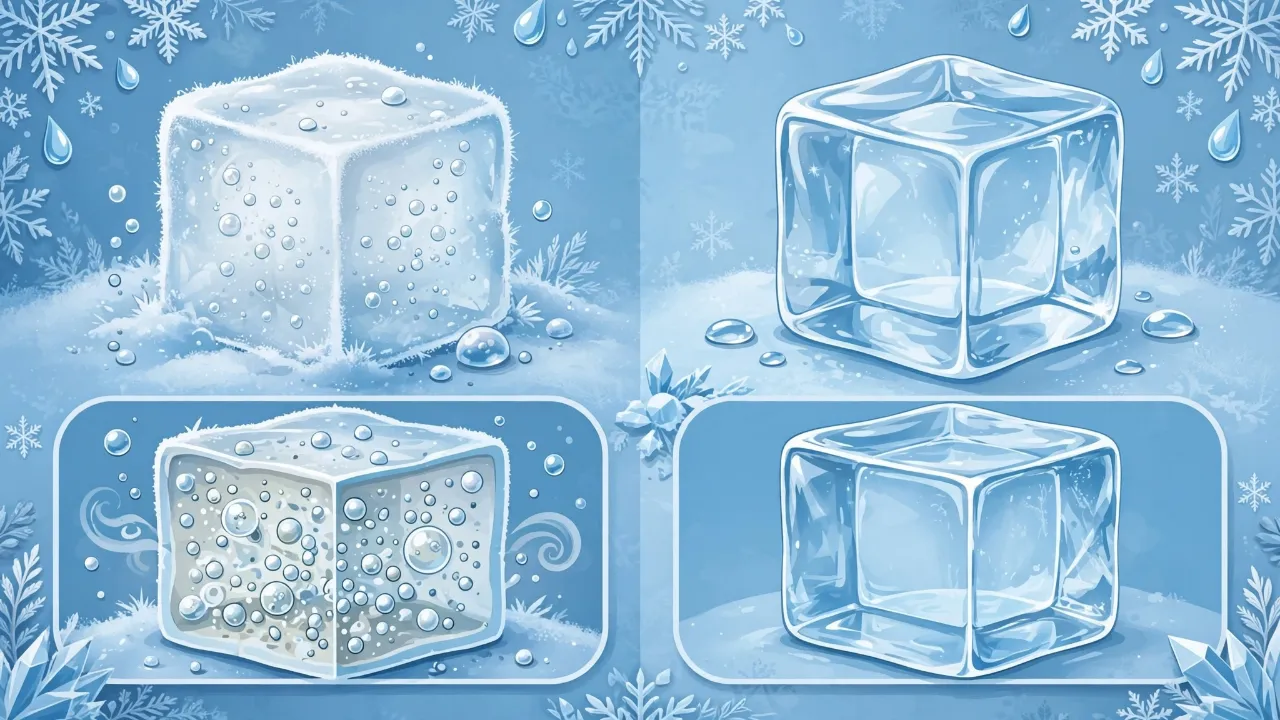
Ice Goes in Your Drink! 🧊
Ice is cold water that got hard. It makes your drink cold!
So Many Shapes!
Some ice is big squares. Some is tiny bits that are fun to chew!
Some stores have soft, chewy ice that soaks up your drink. YUM! 😋
Why Does Ice Look Different at Every Restaurant? 🧊
Have you noticed that restaurant ice looks different from place to place? Some places have big square cubes. Some have tiny crunchy pieces. Some have little half-moons!
What Are the Different Kinds?
Square cubes are what you have at home. They are big and melt slowly.
Half-moon ice is curved like a banana. Most restaurants use it!
Nugget ice is soft and crunchy and so fun to chew.
Crushed ice is broken into tiny pieces. Snow cones use it!
Why Does Some Ice Taste Better?
Nugget ice has tiny holes inside, like a sponge. Your drink soaks into the holes, so when you chew, the flavor comes out!
Which Ice Do You Like Best?
Next time you get a drink, look at the ice. Big? Small? Crunchy? Now you know why!
The Secret World of Restaurant Ice 🧊
Here is something most people never think about: the ice in your drink changes how it tastes. Different restaurants use different shapes of ice, and each shape does something different to your drink.
Meet the Ice Family
Standard cubes are the classic squares from your freezer. They melt at a medium speed and do a decent job keeping things cold.
Crescent (half-moon) ice is the most common restaurant ice. It is curved so drinks can flow around it easily, and it stacks well in a glass.
Nugget ice (also called pellet ice) is the fan favorite. Sonic Drive-In and Chick-fil-A both use it, and people go absolutely wild for it. It is made by compressing tiny flakes of ice together, which leaves little air pockets inside.
Crushed ice is exactly what it sounds like: ice that has been smashed into small, jagged pieces. Great for slushies and snow cones.
Ice spheres are big round balls of ice you might see at fancy restaurants. They look cool, but they also have a science purpose (more on that below).
Why Nugget Ice Tastes So Good
Nugget ice is full of tiny air pockets, almost like a frozen sponge. Your drink seeps into those pockets. When you bite down, all that soaked-up flavor bursts out. That is why chewing nugget ice from a lemonade tastes like lemonade, not just plain ice.
Why Big Ice Melts Slower
This part is about surface area (say: SER-fis AIR-ee-uh). Surface area means how much of the outside of something touches the drink. A big cube has less outside touching the drink compared to its size, so it melts slower. Tiny crushed ice has tons of surface area, so it melts fast and waters down your drink quickly.
That is why fancy bars use ice spheres. A sphere has the least surface area for its size of any shape. Less surface touching the drink means slower melting, which means your drink stays strong longer.
The Physics of Restaurant Ice
Every restaurant makes a choice about ice, and that choice quietly shapes how your drink tastes, how long it stays cold, and how fast it gets watered down. The science behind it comes down to one concept: the surface area to volume ratio.
The more surface area an object has compared to its volume, the faster heat transfers into it from the surrounding liquid. More heat transfer means faster melting. Faster melting means more dilution.
Ice Types, Ranked by Melt Speed
Crushed ice has the highest SA:V ratio. Tons of tiny pieces means enormous total surface area. It chills a drink almost instantly but dilutes it within minutes.
Nugget/pellet ice (Sonic, Chick-fil-A) is compressed ice flakes with internal air pockets. The porous structure gives it even more surface area than its external shape suggests, so it absorbs liquid and chills fast. The trade-off: it melts quickly too.
Crescent (half-moon) ice is the workhorse of the restaurant industry. Its curved shape lets liquid circulate around it, and it fills a glass efficiently. Mid-range melt speed.
Standard cubes have a moderate SA:V ratio and melt at a predictable pace. Reliable, nothing flashy.
Ice spheres have the lowest SA:V ratio of any shape. That is a mathematical fact: a sphere minimizes surface area for a given volume.
Surface Area = 4πr²
Volume = (4/3)πr³
SA:V = 3/r
For a cube with side length s:
Surface Area = 6s²
Volume = s³
SA:V = 6/s
For equal volumes, the sphere always wins. If both hold 100 cm³ of ice, the sphere's SA:V is about 1.24/cm while the cube's is about 1.29/cm. The difference grows with irregular shapes like crushed ice.
Why Nugget Ice Is a Flavor Sponge
Nugget ice is made by an auger system that scrapes ice from a frozen cylinder, then compresses the flakes through a tube. The compression leaves air gaps throughout the structure. When submerged in a drink, liquid wicks into those gaps through capillary action (the same force that makes water climb up a paper towel). That trapped liquid is why nugget ice "tastes like the drink" when you chew it.
Liquid moves through narrow spaces without gravity's help, pulled by adhesion (attraction between the liquid and the solid walls) and cohesion (attraction between liquid molecules). The tiny channels in nugget ice act like capillary tubes.
Clear vs. Cloudy Ice
Home freezer ice is cloudy because water freezes from all directions at once. Dissolved gases and minerals get pushed toward the center but can't escape, so they form tiny bubbles and white streaks. Commercial clear ice is made by directional freezing: water freezes from one side only (usually the top), and the advancing ice front pushes impurities and gases downward into the still-liquid water. The result is dense, crystal-clear ice that is structurally stronger and melts more slowly.
The Business Angle
Restaurants choose ice strategically. Crescent ice fills glasses with more ice and less drink, saving on beverage costs. Nugget ice makes customers feel like they are getting something special (Sonic built a brand around it). Cocktail bars invest in large-format clear ice to justify premium drink prices. The ice is never an accident.
Thermodynamics in Your Glass
The ice in a restaurant drink is an exercise in applied thermodynamics, materials science, and, quietly, economics. Each ice format represents a different optimization: maximum chill rate, minimum dilution, texture, or cost efficiency. Understanding why requires unpacking heat transfer, crystallography, and the physics of phase change.
Heat Transfer and the Melting Equation
When ice sits in a drink, heat flows from the warmer liquid into the colder solid. The rate of heat transfer depends on the temperature difference (Newton's law of cooling), the thermal conductivity of the materials, and the surface area of contact. Since the liquid and ice compositions are similar across contexts, the variable that matters most is geometry: specifically, the surface area to volume ratio.
dQ/dt = hA(Tliquid - Tice)
where h = convective heat transfer coefficient, A = contact surface area, and T values are temperatures. Larger A means faster heat transfer and faster melting. For a given mass of ice, the shape that minimizes A minimizes dilution rate.
The enthalpy of fusion for water is 334 J/g. To melt 100 g of ice at 0°C requires 33,400 J of energy absorbed from the drink. A sphere and a collection of crushed ice pieces with the same 100 g mass will both absorb the same total energy to fully melt, but the crushed ice absorbs it far faster because of its greater surface area. Faster energy absorption means faster cooling of the drink, but also faster dilution.
A Taxonomy of Restaurant Ice
Full cube (2.5 cm side): SA:V ≈ 2.4 cm-1. The home standard. Predictable melt rate, no special properties.
Crescent/half-moon: SA:V ≈ 3.0 cm-1. The restaurant industry default. The curved geometry allows liquid to flow around it, improving convective heat transfer slightly. It nests efficiently in glassware, displacing more liquid per unit volume than cubes. This is partly why fountain drinks at restaurants seem to have "more ice than drink."
Nugget/pellet (Scotsman, Manitowoc): SA:V ≈ 4-5 cm-1 (effective, accounting for porosity). Made by auger compression of ice flakes. Internal porosity of approximately 20-30% by volume creates a network of channels that absorb liquid via capillary action. The porous structure also means lower density (~0.7 g/cm³ vs ~0.917 g/cm³ for solid ice), so nugget ice floats higher and creates a satisfying crunch on bite. Chick-fil-A and Sonic both use this format, and both have cultivated customer loyalty partly on the ice alone.
Crushed: SA:V ≈ 6-10 cm-1 (highly variable by fragment size). Maximum chill rate, maximum dilution. Appropriate for drinks designed to be consumed quickly (juleps, frozen cocktails, tiki drinks).
Sphere (typically 5-6 cm diameter): SA:V ≈ 1.0-1.2 cm-1. Mathematically optimal for minimum surface area per unit volume. A 6 cm sphere has roughly 60% of the surface area of a cube with equivalent volume. This translates directly to slower melt rate and less dilution, which is why cocktail bars use spheres for spirit-forward drinks where dilution control matters.
Clear ice production exploits a principle called directional freezing. In nature, lake ice freezes from the top down, and the advancing solidification front pushes dissolved gases and minerals ahead of it. The result: the top layer is crystal clear, while impurities concentrate in the water below.
The Clinebell machine replicates this by freezing water in an insulated tank with cooling only from the bottom. A small pump circulates the water to prevent stratification. Over 24-48 hours, a clear block forms from the bottom up, with any cloudiness concentrated in the unfrozen water at the top. The block is then harvested and the cloudy water discarded.
Why does clarity matter beyond aesthetics? Clear ice is a single, well-ordered crystal structure with minimal grain boundaries. Cloudy ice contains trapped air pockets that act as stress concentrators and nucleation sites for fracture. Clear ice is therefore mechanically stronger and melts more uniformly, without the spalling and cracking that causes cloudy ice to lose mass in unpredictable bursts.
Cloudy vs. Clear: Crystallography
Water crystallizes in a hexagonal lattice structure (ice Ih at standard pressure). When freezing occurs rapidly from all directions (as in a home freezer), multiple crystal nucleation sites form simultaneously. The growing crystals meet at grain boundaries, trapping dissolved air (primarily N2 and O2) as bubbles. The result is polycrystalline ice with visible cloudiness.
Slow, unidirectional freezing allows a single crystallization front to advance. Dissolved gases are pushed ahead of the front because their solubility in ice is near zero. The result is a large, relatively monocrystalline mass with far fewer grain boundaries. This ice is denser, more transparent, and has a higher compressive strength.
The Economics
Restaurant ice selection is a business decision. A typical crescent ice machine produces 300-500 lbs/day and costs $2,000-4,000. A nugget ice machine of similar capacity runs $3,000-6,000. A Clinebell block ice machine costs $3,500+ and produces perhaps 60 lbs/day of clear ice, which then requires manual cutting. The price per pound of finished clear ice can exceed $1, compared to pennies for machine-made crescent ice.
Crescent ice's popularity is not about taste optimization. It is about cost: the shape displaces liquid efficiently (reducing beverage cost per serving), the machines are reliable and affordable, and the ice works acceptably for most applications. Nugget ice costs more to produce but generates customer loyalty that offsets the expense. Clear ice spheres are viable only in venues where customers pay $15+ per cocktail.
The Quiet Engineering of Restaurant Ice
There is a running joke among cocktail nerds that the most expensive ingredient in a good Old Fashioned is the ice. It is not entirely wrong. The ice program at a serious bar represents a meaningful capital investment, ongoing labor, and a considered stance on dilution curves and thermal management. But the physics extends well beyond craft cocktails. Every restaurant, from Sonic Drive-In to a Michelin-starred tasting menu, has made a decision about ice that shapes your experience in ways you probably haven't considered.
A Field Guide to Commercial Ice Formats
Standard full cube (approx. 2.5 cm): The baseline. Moderate surface-area-to-volume ratio (~2.4 cm-1), moderate melt rate. Home freezer default. Nothing remarkable, nothing terrible.
Crescent/half-moon: The American restaurant workhorse. Hoshizaki essentially standardized this format. The curved geometry nests in glassware without bridging (where cubes lock together and create air pockets that cause splashing), and it displaces a significant amount of liquid. This is, frankly, a feature for the operator: more ice in the glass means less beverage per serving. A 20 oz cup filled with crescent ice holds roughly 10-12 oz of liquid. That is a 40-50% displacement rate, and at fountain syrup costs of ~$0.05/oz, it adds up across millions of servings.
Nugget/pellet ice: The cult favorite. Manufactured by scraping ice from a frozen cylinder with an auger, then extruding the compressed flakes through a cylindrical die. The resulting pellets have approximately 20-30% air content by volume, creating a porous matrix that absorbs liquid through capillary wicking. The internal pore structure means effective SA:V ratios significantly exceed what the external geometry suggests. Sonic built an entire brand identity around their nugget ice (they sell bags of it), and Chick-fil-A's ice is consistently cited in customer satisfaction surveys as a differentiator. Scotsman and Manitowoc are the dominant manufacturers. Home units (the Opal by GE Profile, the Newair) run $400-600 and have become a minor cultural phenomenon.
Crushed: Maximum surface area, maximum chill rate, maximum dilution. Appropriate for applications where rapid dilution is a feature, not a bug: mint juleps (where you want the drink to evolve as you sip), tiki cocktails (where dilution is calibrated into the recipe), and convenience-store slushie machines.
Large-format clear ice (spheres, Collins spears, cubes 5+ cm): The minimum-dilution option. A 6 cm sphere has an SA:V ratio of ~1.0 cm-1, roughly 40% of a standard cube by this measure. For a 2 oz pour of bourbon, the difference between a sphere and three standard cubes is significant: approximately 30-40% less dilution over 20 minutes, based on calorimetric measurements published by Camper English at Alcademics.
The Thermodynamics, Quantified
The governing physics is straightforward but worth stating precisely. Heat transfer from liquid to ice is primarily convective, described by q = hA(T∞ - Ts), where h is the convective coefficient (dependent on whether the liquid is stirred or still), A is contact area, T∞ is bulk liquid temperature, and Ts is ice surface temperature (0°C at atmospheric pressure during active melting).
The enthalpy of fusion for water ice is 333.55 J/g. To melt 50 g of ice (a typical single-cocktail charge) requires absorption of ~16,678 J from the drink. Assuming an 80 mL pour at 25°C with the heat capacity of a water-ethanol solution around 3.8 J/(g·K), the drink temperature drops roughly 55°C worth of thermal energy, or practically to near 0°C. The question is never whether the ice will cool the drink. The question is how quickly, and how much meltwater you produce en route.
Camper English's controlled dilution experiments (2011-2013) measured meltwater mass over time for matched ice volumes in different formats. Key findings: a single large cube (5 cm) produced approximately 15 g of meltwater in 10 minutes at room temperature. The same mass of crushed ice produced roughly 35-40 g. A sphere of equivalent mass fell between the cube and the large cube, slightly outperforming the cube due to the geometric optimization. The practical takeaway: format matters, but mass matters more. Twice as much ice in any format will outperform half the ice in the "optimal" shape.
Crystallography: Why Clear Ice Performs Better
Water ice at standard pressure forms ice Ih, a hexagonal crystal structure where each oxygen atom is tetrahedrally coordinated with four hydrogen bonds. In slow, directional freezing, the solidification front advances as a planar interface, rejecting dissolved gases (primarily N2, O2, and CO2) and dissolved minerals ahead of the freezing boundary. The solubility of these gases in the solid ice lattice is effectively zero, so they accumulate in the remaining liquid phase until they either nucleate as bubbles (producing cloudiness if trapped) or escape from the free surface.
The Clinebell machine, the industry standard for commercial clear ice production, freezes water from the bottom up in an insulated, open-top tank over 48-72 hours. A circulation pump prevents thermal stratification and disrupts the diffusion boundary layer at the ice-water interface, enhancing gas rejection. The resulting block (~135 kg for a Clinebell CB300) is nearly optically clear through its full depth, with cloudiness confined to the last-frozen layer at the top, which is cut away.
Why does crystalline perfection affect melt behavior? Grain boundaries in polycrystalline (cloudy) ice are regions of structural disorder where intermolecular bonding is weaker. They serve as preferential sites for surface melting and mechanical failure. Trapped air bubbles act as stress concentrators under thermal stress (the outside of the ice warms before the inside, creating differential expansion). The result: cloudy ice tends to crack, spall, and shed fragments, causing uneven, faster-than-expected dilution. Clear ice, with its more uniform crystal structure, melts as a smooth, retreating surface.
The Mpemba Effect: A Brief Digression
There is a persistent claim that hot water freezes faster than cold water (the Mpemba effect, named after Tanzanian student Erasto Mpemba, who reported the observation in 1963). The phenomenon has been debated for decades and has resisted clean experimental replication. Proposed mechanisms include enhanced evaporative cooling (reducing mass), convection-driven supercooling differences, dissolved gas expulsion at higher temperatures, and hydrogen bond memory effects. A 2020 paper by Bechhoefer (Simon Fraser University) offered a theoretical framework based on anomalous relaxation in Markovian systems, but the effect's relevance to practical ice production is minimal. Commercial ice machines control water temperature precisely, and the effect (if real) is small enough to be irrelevant at production scale. Still, it keeps coming up in discussions of ice science, so it is worth acknowledging.
The Sonic Phenomenon
Sonic Drive-In's nugget ice has generated a remarkably intense consumer following. The company sells 10 lb bags of ice at its drive-throughs, and when Sonic partnered with GE Profile to sell the Opal countertop nugget ice maker, it sold out repeatedly. The appeal is partly textural (the soft, chewable consistency is closer to a frozen treat than to a hard ice cube), partly flavor-related (the porous absorption), and partly nostalgic (Sonic has served this ice since the 1950s). Chick-fil-A's nugget ice generates similar loyalty. Both chains source machines from Scotsman (now part of Ali Group), whose SCN series nugget ice machines dominate the commercial market.
The Economics Are the Point
Strip away the thermodynamics and what remains is a business decision. Hoshizaki's crescent ice machines are the most widely installed commercial ice machines in North America. They are reliable (stainless steel evaporator plates with a 5+ year typical lifespan), efficient (approximately 80-90 lbs/day per $1,000 of machine cost), and the crescent format conveniently maximizes ice-to-liquid displacement in a glass. The customer gets a cold drink. The operator saves on syrup and soda water. Everyone is satisfied, even if the ice itself is unremarkable.
Nugget ice machines cost 50-100% more per unit of production capacity and require more frequent maintenance (the auger mechanism wears). But the customer loyalty premium is real and measurable. Cocktail bars investing in Clinebell machines ($3,500+) and dedicating labor to hand-cutting clear ice (a skilled worker can produce perhaps 200 spheres per hour from a block) are making a calculated bet that the visual and functional premium justifies $15-20 cocktail pricing.
The honest summary: ice format is a meaningful variable in drink quality, but it is not the most important one. Temperature matters more than shape. Mass matters more than format. Clean, filtered water matters more than freezing method. The best ice is abundant, clean, and appropriate to the drink. Everything else is optimization at the margins, enjoyable but not essential.
- English, C. "Ice Dilution Experiments." Alcademics, 2011-2013. alcademics.com/ice
- Bechhoefer, J. "A fresh understanding of the Mpemba effect." Nature Reviews Physics, 2020.
- Jouzel, J. et al. "Orbital and Millennial Antarctic Climate Variability over the Past 800,000 Years." Science, 317(5839), 2007.
- Hobbs, P.V. Ice Physics. Oxford University Press, 2nd ed., 2010.
- Wilson, H.A. and Milner, H.R. "Crystal Growth of Ice." Philosophical Magazine, 1897.
- "Scotsman Ice Systems: Nugget Ice Technology." Ali Group Technical Publications.
- Mossop, S.C. "The Freezing of Supercooled Water." Proceedings of the Physical Society B, 1955.
- English, C. "Clear Ice Experiments." Alcademics, 2009-2014. alcademics.com/clear-ice