
🏝️🌺
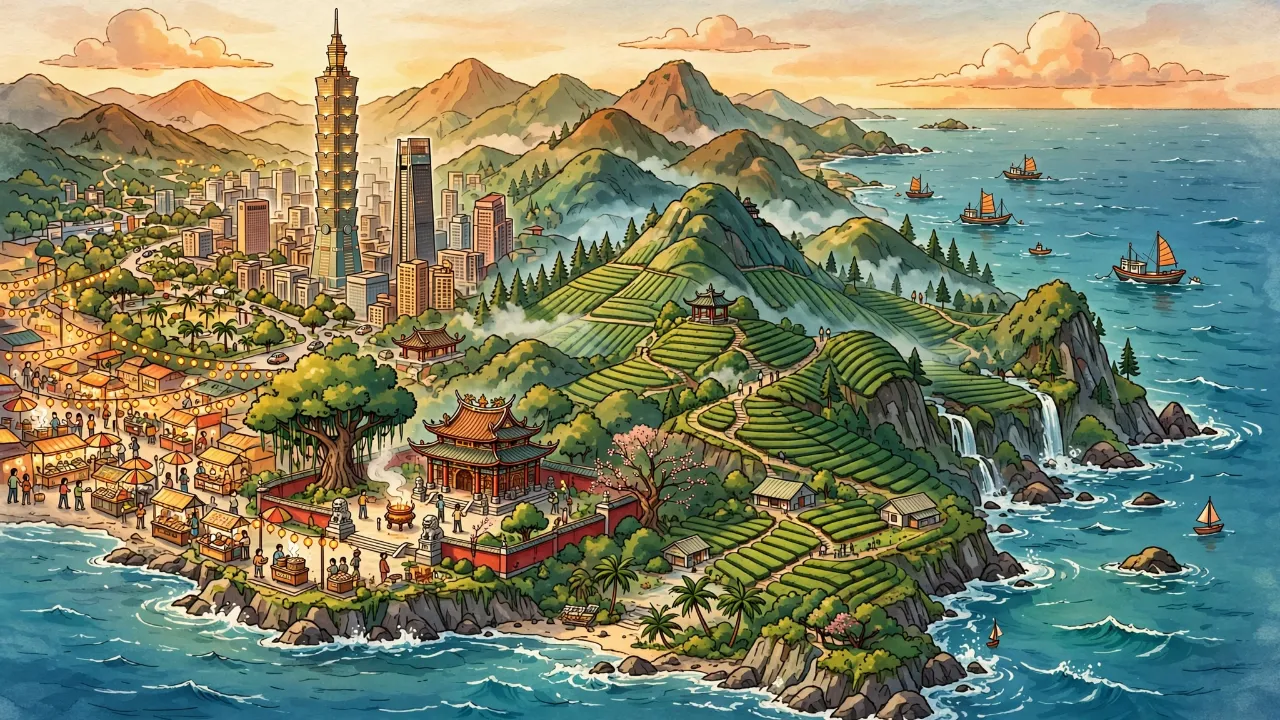
Taiwan is an island! It sits in the ocean near China. 🌊
There are tall, tall mountains and lots of green trees. 🌲⛰️
People there eat yummy noodles and dumplings. 🥟😋
Where Is Taiwan?
Taiwan is a big island in the Pacific Ocean, near the coast of China. It is about the size of Maryland, but more than 23 million people live there.
What Is It Like?
Taiwan has very tall mountains in the middle. The tallest, Jade Mountain, is almost as tall as the Rocky Mountains! The forests are full of butterflies. Taiwan has more kinds of butterflies than almost anywhere on Earth. 🦋
Night Markets!
The night market is like a giant outdoor fair with hundreds of food stands, games, and shops, all lit up with colorful lights. You can try bubble tea, stinky tofu, and tiny cakes shaped like animals. 🧋🏮
A Special Language
Most people in Taiwan speak Mandarin Chinese and write with characters instead of letters. Each character is like a tiny picture that means a word!
An Island of Extremes
Taiwan is a leaf-shaped island about 245 miles long, sitting where the Pacific Ocean meets the Philippine Sea. Despite being roughly the size of Maryland, it has over 200 mountain peaks above 3,000 meters (about 10,000 feet). Jade Mountain, the tallest, reaches 3,952 meters. That makes Taiwan one of the most mountainous islands on the planet.
Nature's Treasure Chest
Because Taiwan stretches from tropical lowlands to snowy mountain peaks, it has an incredible range of plants and animals. Over 400 species of butterflies live on the island, earning it the nickname "Butterfly Kingdom." There are also animals found nowhere else, like the Formosan black bear and the Mikado pheasant, a shimmering dark-blue bird that lives in misty mountain forests.
Night Markets and Bubble Tea
Taiwan is famous for its night markets, open-air bazaars that come alive after sunset. Shilin Night Market in Taipei has over 500 stalls selling everything from grilled squid to wheel cakes. And yes, bubble tea (also called boba) was invented in Taiwan in the 1980s. A tea shop in Taichung started adding chewy tapioca balls to iced tea, and it spread around the world. 🧋
Technology Powerhouse
Taiwan makes most of the world's advanced computer chips. A company called TSMC (Taiwan Semiconductor Manufacturing Company) produces the tiny processors inside smartphones, laptops, and game consoles. Without Taiwan, it would be very hard to build the devices we use every day.
A Complicated History
Taiwan was home to indigenous peoples for thousands of years before Dutch and Spanish colonizers arrived in the 1600s. Later it was ruled by China's Qing Dynasty, then by Japan from 1895 to 1945. After World War II, the Republic of China (ROC) government moved to Taiwan, and the island has governed itself ever since. Today, most countries do not officially recognize Taiwan as a separate country, but it operates independently with its own government, military, and passport.
Geography and Geology
Taiwan occupies a geologically dramatic position at the convergence of the Eurasian Plate and the Philippine Sea Plate. This collision zone, active for roughly 5 million years, has produced one of the youngest and steepest mountain ranges on Earth. The Central Mountain Range runs nearly the entire north-south length of the island, with peaks exceeding 3,000 meters just 50 kilometers from the coast.
The island experiences an average of 15,000 to 18,000 earthquakes annually. The devastating Chi-Chi earthquake of September 21, 1999 (magnitude 7.3) killed over 2,400 people and reshaped national building codes and disaster preparedness.
Biodiversity Hotspot
Taiwan's compact size belies its ecological diversity. Elevation zones range from tropical coral reefs at sea level to alpine tundra above 3,500 meters. The island hosts approximately 4,000 vascular plant species (about 26% endemic), over 400 butterfly species, 87 mammal species, and roughly 670 bird species (including migrants). The Formosan landlocked salmon, a glacial relict population, survives in cold mountain streams, making it one of the southernmost populations of Pacific salmon in the world.
The Semiconductor Miracle
Taiwan produces over 60% of the world's semiconductors and more than 90% of the most advanced chips (those at 7 nanometers or below). TSMC, founded in 1987 by Morris Chang, pioneered the "pure-play foundry" model: instead of designing and manufacturing its own chips, it manufactures chips designed by other companies like Apple, Nvidia, and AMD.
This dominance has made Taiwan's semiconductor industry a geopolitical flashpoint. The "silicon shield" thesis argues that the world's dependence on Taiwan's chips deters military conflict, because any disruption would cascade through global supply chains for phones, cars, medical devices, and defense systems.
Culture and Identity
Taiwan's cultural identity blends indigenous Austronesian heritage, centuries of Chinese influence, 50 years of Japanese colonial rule (1895 to 1945), and a half-century of authoritarian KMT governance that gave way to full democracy in the 1990s. This layering makes Taiwan's culture distinct from mainland China's, a fact that shapes ongoing political tensions.
The island's 16 officially recognized indigenous tribes (approximately 2.4% of the population) speak Austronesian languages related to those of Polynesia, the Philippines, and Madagascar. Genetic and linguistic evidence suggests Taiwan may have been the origin point of the entire Austronesian expansion that populated the Pacific Islands starting around 4,000 years ago.
Night Market Economics
Taiwan's approximately 300 night markets are not just cultural attractions but significant economic engines. Shilin Night Market alone draws roughly 10,000 to 15,000 visitors nightly. The night market model works because of low overhead (open-air stalls, shared infrastructure), specialization (many vendors sell one item perfected over decades), and a cultural norm of eating out. The average Taiwanese household spends about 35% of its food budget on meals eaten outside the home, one of the highest rates in the world.
Geological Origins and Seismic Reality
Taiwan's geological story is one of active orogeny at a complex plate boundary. The island sits at the junction of the Ryukyu Trench (where the Philippine Sea Plate subducts beneath the Eurasian Plate) and the Manila Trench (where the process reverses). This "polarity flip" produces exceptional tectonic complexity, with crustal shortening rates of approximately 80 mm/yr across the island, among the highest on Earth.
The resulting topography is extreme: Taiwan has more land area above 3,000 meters than any other island in the western Pacific, yet its coastal plains can be just kilometers from those peaks. Denudation rates of 3 to 6 mm/yr (driven by typhoon rainfall of up to 3,000 mm in 48 hours) create a geomorphic system in near-equilibrium between tectonic uplift and erosive removal, a dynamic that makes the island a natural laboratory for studying mountain-building processes.
The Austronesian Cradle Hypothesis
Linguist Robert Blust's "Out of Taiwan" model, now broadly supported by genetic and archaeological evidence, posits Taiwan as the homeland from which Austronesian-speaking peoples dispersed across the Pacific beginning around 4,000 to 5,000 years ago. The evidence is compelling:
- Taiwan's indigenous languages represent 9 of the 10 primary branches of the Austronesian language family. All non-Taiwanese Austronesian languages fall within a single tenth branch (Malayo-Polynesian).
- Mitochondrial DNA haplogroup analysis shows maximum diversity in Taiwan, consistent with a population bottleneck during maritime dispersal.
- Archaeological sequences in Taiwan (Dabenkeng culture, ~5,000 BP) predate related sites in the Philippines (Cagayan Valley, ~4,000 BP) and Remote Oceania (~3,200 BP).
This makes Taiwan's indigenous peoples the living root of a language family spoken by approximately 400 million people across half the globe, from Madagascar to Easter Island.
Semiconductor Geopolitics and the Silicon Shield
TSMC's dominance in advanced semiconductor fabrication (92% market share at ≤7 nm as of 2025) has transformed Taiwan from a Cold War-era strategic outpost into the single most critical node in the global technology supply chain. The concentration risk is staggering: a prolonged disruption to TSMC's fabs would halt production of virtually all high-end processors, GPUs, and AI accelerators worldwide.
The United States' CHIPS Act ($52.7 billion) and TSMC's Arizona fabs represent an attempt to "friendshore" advanced chip production. But TSMC founder Morris Chang himself has expressed skepticism that Arizona operations can match Taiwan's cost structure and workforce depth. TSMC employs approximately 73,000 people in Taiwan, many with PhDs in semiconductor physics, operating in a cluster ecosystem that took four decades to build.
Democratic Transition
Taiwan's transition from authoritarian single-party rule to vibrant multiparty democracy is one of the most successful such transitions in modern history. The key milestones:
- 1947: The February 28 Incident (228 Massacre), in which KMT forces killed an estimated 18,000 to 28,000 Taiwanese civilians, beginning the "White Terror" period.
- 1949: The ROC government, losing the Chinese Civil War, retreats to Taiwan. Martial law imposed.
- 1979: The Kaohsiung Incident galvanizes the democracy movement after opposition activists are arrested and tried in military courts.
- 1987: Martial law lifted after 38 years, the longest period of martial law in modern history.
- 1996: First direct presidential election. Lee Teng-hui wins amid Chinese missile tests in the Taiwan Strait (the Third Taiwan Strait Crisis).
- 2000: First peaceful transfer of power to opposition party (DPP's Chen Shui-bian defeats KMT).
Today, Taiwan consistently ranks as one of the freest societies in Asia, with robust press freedom, an independent judiciary, and legal recognition of same-sex marriage (the first in Asia, since 2019).
Cross-Strait Relations
The People's Republic of China claims Taiwan as a province and has not renounced the use of force to achieve "reunification." Taiwan's population increasingly identifies as distinctly Taiwanese rather than Chinese: polls by National Chengchi University's Election Study Center show that those identifying as "Taiwanese only" rose from 17.6% in 1992 to over 67% by 2024, while "Chinese only" fell from 25.5% to under 3%.
The strategic ambiguity maintained by the United States, acknowledging Beijing's position without endorsing it, while selling Taiwan defensive weapons under the Taiwan Relations Act (1979), has been the baseline framework for nearly five decades. Whether this equilibrium can hold as China's military capabilities grow and semiconductor competition intensifies is one of the defining geopolitical questions of this era.
An Island That Shapes the World
Taiwan occupies a peculiar position in global affairs: a self-governing democracy of 23.5 million people that most of the world does not officially recognize as a country, yet whose semiconductor industry underpins virtually every piece of advanced technology on the planet. Understanding Taiwan requires holding several threads simultaneously: deep geological history, an indigenous population whose linguistic legacy stretches across the Pacific, colonial layering, a turbulent 20th-century political journey, and a present defined by semiconductor physics and great-power rivalry.
The Physical Island
Taiwan's topography is a product of ongoing collision between the Eurasian and Philippine Sea Plates. The Central Mountain Range contains over 200 peaks above 3,000 meters, with Jade Mountain (Yushan) at 3,952 meters. Crustal shortening across the island occurs at approximately 80 mm/year, one of the highest rates of any active mountain belt. The resulting erosion, amplified by an average of 3 to 5 typhoons per year depositing extreme rainfall, produces denudation rates that rank among the world's highest. The island is, in geomorphic terms, a mountain range being built and torn down simultaneously.
This geological violence has practical consequences. The 1999 Chi-Chi earthquake (Mw 7.3) was the deadliest natural disaster in Taiwan's modern history, killing 2,415 people and destroying or severely damaging over 100,000 buildings. The disaster prompted a comprehensive overhaul of building codes and led to the creation of one of the world's densest seismographic networks (over 700 stations for an island of 36,000 km²), giving Taiwan a seismic early warning capability measured in seconds to tens of seconds before shaking arrives.
The Austronesian Homeland
Perhaps Taiwan's most underappreciated distinction is its role in the Austronesian expansion. The island's 16 recognized indigenous tribes speak languages representing 9 of the 10 primary branches of the Austronesian family. The tenth branch, Malayo-Polynesian, encompasses every Austronesian language spoken outside Taiwan, from Malay to Hawaiian to Malagasy. This pattern of maximum diversity at the origin, a signature of historical population genetics, has been confirmed by mitochondrial and Y-chromosome studies.
The practical implication: approximately 400 million people across half the planet's longitude speak languages that trace back to Taiwan's western plains roughly 5,000 years ago. Yet Taiwan's indigenous peoples, who represent about 2.4% of the island's current population, have faced centuries of marginalization. Post-1949 KMT policies suppressed indigenous languages and imposed Mandarin education. Recognition and restoration efforts are ongoing but uneven, a parallel to indigenous rights struggles worldwide.
From Martial Law to Marriage Equality
Taiwan's democratic arc is remarkable for its speed and depth. The island endured 38 years of martial law (1949 to 1987), during which the KMT-run "White Terror" imprisoned an estimated 140,000 people and executed 3,000 to 4,000 for real or suspected opposition activities. The transition to democracy was largely peaceful, driven by a pragmatic calculation by KMT reformers (especially President Lee Teng-hui, himself Taiwanese) that managed liberalization was preferable to revolutionary upheaval.
The result, three decades later, is a society that Freedom House ranks among the most free in Asia, with a vibrant free press, an independent Constitutional Court, and a series of progressive social milestones: same-sex marriage legalized in 2019 (the first in Asia), robust environmental protections, and universal healthcare through the National Health Insurance system (single-payer, covering 99.9% of the population, with administrative costs under 2% of total expenditure).
The Semiconductor Question
TSMC's position is historically anomalous. No single company in any industry has ever commanded such a high market share of a component so critical to so many sectors simultaneously. At 92%+ of advanced logic chips (≤7 nm), TSMC's fabs in Hsinchu, Tainan, and Kaohsiung are, in a literal sense, irreplaceable in the near term. Intel's foundry ambitions, Samsung's Pyeongtaek expansion, and SMIC's catch-up efforts are all at least 3 to 5 years from comparable capability at scale, and TSMC continues to advance (its 2 nm node entered risk production in 2025).
The geopolitical dimension is straightforward. China's stated goal of eventual unification, combined with an accelerating military modernization focused on Taiwan contingency scenarios (the PLA's annual amphibious landing exercises, missile buildup opposite the Strait, gray-zone incursions into Taiwan's ADIZ), means that TSMC's fabs sit inside the most consequential military risk zone in the global economy. The "silicon shield" is both Taiwan's greatest deterrent asset and its most significant source of vulnerability, because it gives external powers a material interest in the island's defense but also makes the island a target.
Food Culture as Social Infrastructure
Taiwan's food culture deserves attention beyond the usual tourism framing. The island's approximately 300 night markets represent a genuinely different model of urban food production: decentralized, hyper-specialized (many stalls serve one dish, refined over generations), low-overhead (shared infrastructure, open-air), and deeply integrated into daily life rather than being a special occasion. Taiwanese households spend roughly 35% of their food budget on meals eaten outside the home, reflecting both economic structure (dual-income households with long working hours) and cultural preference.
The global impact is visible: bubble tea (invented in Taichung in the 1980s, now a multi-billion-dollar global industry), beef noodle soup, xiao long bao, and the entire genre of Taiwanese street food have shaped eating habits across Asia and increasingly worldwide. The less visible contribution is in food safety governance. After a series of food scandals in the early 2010s (most notably the 2014 recycled cooking oil crisis), Taiwan implemented one of the world's strictest food traceability regimes, requiring QR-code-level tracking from farm to vendor for most major food categories.
Sources
- Blust, R. "The Austronesian Homeland: A Linguistic Perspective." Asian Perspectives 26 (1985): 45-67.
- Bellwood, P. First Farmers: The Origins of Agricultural Societies. Blackwell (2005).
- Addison, C. Silicon Shield: Taiwan's Protection Against Chinese Attack. Fusionpress (2001).
- Miller, C. Chip War: The Fight for the World's Most Critical Technology. Scribner (2022).
- Rigger, S. Why Taiwan Matters: Small Island, Global Powerhouse. Rowman & Littlefield (2011).
- Hung, J-J., et al. "The Seismotectonics of Taiwan." Annual Review of Earth and Planetary Sciences 42 (2014): 353-378.
- National Chengchi University Election Study Center. "Taiwanese/Chinese Identification Trend Distribution in Taiwan (1992-2024)."
- TSMC Annual Report 2025. Taiwan Semiconductor Manufacturing Company.
- Wu, N-J. Formosa Betrayed. Taiwan Publishing Company (1950, reprinted 2003).
- Freedom House. "Freedom in the World: Taiwan Country Report" (2025).