
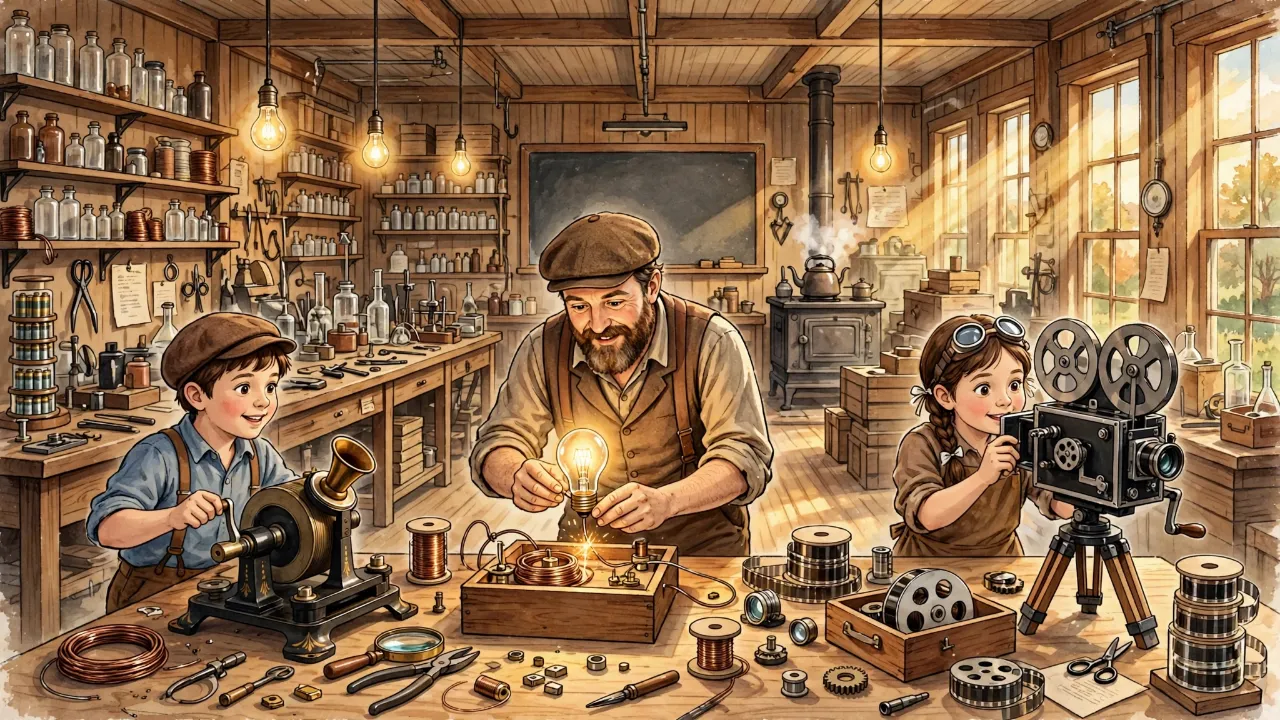
Thomas and the Light 💡
Thomas Edison made light bulbs that stayed on for a long time. Now people can see at night.
When he was a boy, his ears stopped working well. He kept trying anyway, again and again.
Good ideas do not need perfect ears.
Who Was Thomas Edison?
Thomas Edison was born in 1847 in Ohio. When he was about 12, he started to lose his hearing. The world grew very quiet for him. But he kept learning and never quit.
How Did He Start Inventing?
As a teenager, Thomas sent messages on a machine called a telegraph. It sends words through wires with clicks. Thomas could feel the clicks with his fingers, even when he could not hear them.
What Did He Make?
Edison made a light bulb that could glow for hours. He tested more than a thousand materials before he found the right one. He also made a machine that could record your voice and play it back.
Why Does He Matter?
Before Edison, people lit their homes with candles and gas lamps. Edison gave us electric light. He held 1,093 patents, which means 1,093 inventions.
A Kid Who Would Not Sit Still
Thomas Alva Edison was born on February 11, 1847, in Milan, Ohio. His teachers thought he was a terrible student, and one teacher called him "addled," which means confused and slow. His mother pulled him out of school after just three months and taught him at home, letting him read whatever he wanted and giving him a chemistry set that sparked a lifelong obsession with experiments. By age 10, Thomas had built his own laboratory in the basement, filled with jars of chemicals and contraptions that occasionally alarmed the neighbors.
The Train, the Boy, and the Telegraph
At age 12, Edison got a job selling newspapers and snacks on a train between Port Huron and Detroit. One day at a station, he spotted a toddler named Jimmie MacKenzie wandering onto the tracks as a freight car rolled toward him, and Edison sprinted across the platform and grabbed the child just in time, yanking him clear of the wheels. Jimmie's grateful father, the station telegrapher J.U. MacKenzie, offered to teach Thomas how to use the telegraph, and that single offer of gratitude changed the entire course of Edison's life.
Edison became one of the fastest telegraph operators in the country, able to receive and transmit messages at speeds that astonished his supervisors. But around this same time, his hearing grew worse. Some historians think scarlet fever damaged his ears, while others point to repeated ear infections. Edison himself once claimed a conductor yanked him onto a train by his ears, though doctors doubt that alone caused the damage. Whatever the reason, by his teenage years he could barely hear normal conversation, and the world grew quieter around him every year.
Making the Light Bulb Actually Work
Edison did not invent the light bulb, which is one of the most common misconceptions in the history of science. Humphry Davy had demonstrated an electric arc lamp in 1802, and Warren de la Rue built a platinum filament bulb in 1840, decades before Edison's breakthrough. What Edison did was make the light bulb practical for ordinary people. His team tested over 3,000 different filament materials at his Menlo Park laboratory in New Jersey, systematically cataloging every failure. In October 1879, a carbonized bamboo filament burned for over 1,200 hours. But Edison went further: he built power stations, wiring systems, meters, and switches so people could actually USE electric light in their homes, and the entire integrated system was his real genius.
More Than Just Light
Edison held 1,093 U.S. patents, a number so large it averages out to a new invention every three weeks for the span of his entire working life. He invented the phonograph (the first machine to record and play back sound), improved the telephone so dramatically that it became commercially useful, created an early movie camera called the Kinetoscope, and built the first commercial power station on Pearl Street in Manhattan in 1882. He slept only 3 to 4 hours a night and took short naps during the day, and his Menlo Park lab was called the "invention factory" because it produced a new patent roughly every two weeks for over a decade.
The Dropout Who Built the Modern World
Thomas Alva Edison (February 11, 1847 to October 18, 1931) had roughly three months of formal education before his mother pulled him out of school, after a teacher at the Port Huron, Michigan school declared him "addled" and difficult to manage in a classroom setting. His mother, Nancy Elliott Edison, a former teacher herself, withdrew him and provided his entire education at home. She gave him R.G. Parker's School of Natural Philosophy at age nine, which contained experiments the reader could perform at their kitchen table or in their backyard. Edison later said, "My mother was the making of me. She understood me; she let me follow my bent."
The Telegraph Years: 1863 to 1869
After J.U. MacKenzie taught him telegraphy in gratitude for saving his son's life, Edison spent six years as an itinerant telegraph operator, moving between cities across the Midwest and Canada while honing his skills at every stop. His hearing loss, which worsened throughout his teens, paradoxically helped: the telegraph's sharp electrical clicks were easier to distinguish in a noisy office when you could feel the sounder's vibrations directly through the desk rather than relying on what your ears could pick out of the ambient noise.
Edison was not content to just operate the telegraph. His first patent (U.S. Patent 90,646, granted June 1, 1869) was an electronic vote recorder that he expected state legislatures to adopt enthusiastically, since it promised to make voting faster and more accurate. Nobody wanted it. Congress actually preferred slow vote counts because the delays gave legislators time to lobby colleagues during the roll call, which meant the very inefficiency Edison had tried to eliminate was the feature that politicians valued most. Edison reportedly vowed never again to invent something nobody wanted, and from that point forward, he focused exclusively on commercial viability.
The Incandescent Lamp: Why It Was Hard
The principle of incandescent lighting was deceptively simple: pass electricity through a thin conductor until it glows white-hot, producing visible light from the thermal energy of electrical resistance. The problem was keeping the conductor from burning up. In air, any filament hot enough to glow will oxidize and disintegrate within seconds, which is why dozens of inventors before Edison had demonstrated brief, spectacular flashes that were useless for practical illumination. Edison's key insight was the vacuum: using better pumps than his predecessors had access to, his team achieved vacuums of one-millionth of an atmosphere inside glass bulbs, slowing oxidation enough for filaments to survive for hundreds and eventually thousands of hours.
The filament search was systematic and exhausting, consuming years of labor and thousands of individual experiments that each had to be carefully documented. Edison's team tested platinum, nickel, carbon, cotton thread, fishing line, cardboard, cedar shavings, coconut hair, and thousands of other materials before finding their answer. The October 21, 1879 breakthrough used a carbonized cotton thread filament that lasted 13.5 hours, and within months, carbonized bamboo from Japan lasted over 1,200 hours, which was finally long enough for commercial deployment.
1,093 U.S. patents over a roughly 60-year career (1869 to 1931)
That is approximately 18 patents per year, or one new patent every 20 days.
For comparison, the average prolific inventor today holds 50 to 100 patents in a full career.
The Current Wars
Edison championed direct current (DC) for electrical distribution, while his former employee Nikola Tesla and industrialist George Westinghouse promoted alternating current (AC), setting the stage for one of the most consequential and bitter technological rivalries in American history. The physics favored AC: it could be "stepped up" to high voltages for long-distance transmission using transformers, then stepped back down for safe household use, which meant a single power station could serve customers miles away rather than just the few blocks that DC could reach without catastrophic energy losses. Edison fought viciously, even publicly electrocuting animals to demonstrate AC's danger, a tactic now considered one of the darker and more shameful chapters in his otherwise remarkable career. He lost. The modern power grid runs on AC. But Edison's Pearl Street Station (1882) proved the concept of centralized electrical generation and distribution to paying customers, which was the real revolution regardless of current type.
Hearing Loss and Adaptation
Edison's hearing deteriorated gradually from around age 12, and by adulthood, he was nearly deaf in both ears, able to perceive only the loudest sounds held close to his head. He refused to use hearing aids, claiming his condition helped him think by eliminating the distractions that plagued other people. He tested phonograph recordings by biting into the wooden case to feel vibrations transmitted through his teeth and jawbone, which is bone conduction, the same principle used in modern bone-anchored hearing aids and some wireless headphones marketed to runners and cyclists. His deafness also shaped his inventions in ways that are often overlooked: the phonograph's design emphasizes vibration amplitude over tonal subtlety, which is exactly what a hearing-impaired creator would optimize for when the only feedback channel available is tactile rather than auditory.
Systematic Invention and the Menlo Park Model
Before Edison, the word "inventor" evoked a lone genius in a workshop. After Edison, it evoked a team in a lab. His Menlo Park facility, established in 1876 in rural New Jersey, employed roughly 25 full-time researchers including Charles Batchelor (chief experimenter), John Kruesi (master machinist), Francis Upton (Princeton-trained mathematician), and dozens of others. Edison directed their work, but the innovations emerged from collaboration. This distinction matters: Edison's greatest invention may not have been any single device but the institutional structure that produced them.
The lab's output was staggering. Between 1876 and 1882, Menlo Park produced the carbon-button telephone transmitter (which made Alexander Graham Bell's telephone commercially viable), the phonograph, the incandescent lamp system, and early work on electrical generation. Edison filed 400 patents during this period alone.
The Incandescent Lamp: Engineering, Not Just Science
Edison's competitors (Joseph Swan in England, Heinrich Gobel in Germany, and at least 20 others) all demonstrated incandescent filaments before or concurrently with Edison. Swan actually demonstrated a working lamp in Newcastle in February 1879, months before Edison's October breakthrough. Edison eventually merged his company with Swan's to form Edison and Swan United Electric Light Company (Ediswan) in Britain. The historical record does not support "Edison invented the light bulb." It supports "Edison engineered a commercially viable incandescent lighting system."
The vacuum problem illustrates the depth of engineering involved. Hermann Sprengel's mercury pump (1865) could achieve vacuums of about one-thousandth of an atmosphere. Edison's glassblower, Ludwig Boehm, modified the Sprengel design to reach one-millionth of an atmosphere, a thousand-fold improvement. Without this advance, no filament material would have lasted more than minutes. The pump was as critical as the filament, but it never appears in the popular narrative.
Pearl Street Station: Proof of Concept for Centralized Power
On September 4, 1882, Edison flipped the switch at the Pearl Street Station in lower Manhattan, powering 400 lamps in 85 customers' buildings within a one-mile radius. The station used six "Jumbo" dynamos (named after P.T. Barnum's elephant, each weighing 27 tons) to generate 100 kilowatts of DC power at 110 volts.
The economics were tight. Edison priced electricity to compete with gas lighting at roughly $0.24 per kilowatt-hour (in 1882 dollars, equivalent to approximately $7.50 today). The station ran at a loss for its first two years. But it proved that centralized generation and distribution was technically feasible, which attracted the investment capital that built the modern electrical grid.
The Phonograph: Accidental Breakthrough
In November 1877, Edison shouted "Mary had a little lamb" into a machine with a needle, a diaphragm, and a tin-foil cylinder, and the needle etched grooves corresponding to the sound waves into the soft metal surface. When he ran the needle back over the grooves, the machine played the words back in a scratchy but unmistakable reproduction of his own voice. Edison was reportedly startled that it worked on the first try, having expected weeks of refinement before achieving anything close to intelligible playback.
The phonograph was the first device in human history to record and reproduce sound, which meant that before 1877, every piece of music, every speech, every conversation, every lullaby sung to a child existed only in the moment of its utterance and then vanished forever. The phonograph made sound permanent, which is perhaps the most profound technological shift in human communication since the invention of writing. Edison initially envisioned it as a business dictation tool, and its transformation into an entertainment device happened despite his instincts, not because of them, which is one of the great ironies of his career as a man who prided himself on understanding commercial demand.
Edison's Limitations
Edison was not a physicist and distrusted mathematical theory, working almost entirely by empirical trial and error in a way that drove theoretically trained scientists to distraction. Nikola Tesla, who worked briefly for Edison in 1884, later said: "If Edison had a needle to find in a haystack, he would proceed at once with the diligence of the bee to examine straw after straw until he found the object of his search. I was a sorry witness of such doings, knowing that a little theory and calculation would have saved him ninety percent of his labor." Tesla's critique had genuine merit, because Edison's brute-force methodology was effective but enormously wasteful, and his filament search alone consumed thousands of man-hours that a systematic understanding of material science could have reduced dramatically.
Edison was also brutal to competitors, and the historical record documents his public electrocution of animals during the Current Wars, his failure to credit collaborators (notably Nikola Tesla's contributions to DC dynamo design), and his pattern of aggressively litigating patent disputes in ways designed to exhaust opponents financially rather than establish legal merit. These actions reveal a man whose genius was matched by ruthlessness, and history should hold both qualities simultaneously rather than airbrushing either one away.
The Myth and the Man
Thomas Alva Edison occupies an unusual position in the history of technology, because he is simultaneously overrated (he did not invent the light bulb, the motion picture camera, or the idea of electrical power distribution, all of which had prior claimants with legitimate priority) and underrated (he invented the industrial research laboratory, the first practical recording device, and the concept of systems engineering as applied to consumer infrastructure, none of which receive adequate popular recognition). The popular narrative gives him too much credit for individual inventions and not enough for the organizational innovation that made those inventions matter, which is a misunderstanding that persists in nearly every children's textbook published in the past century.
The Hearing Loss Question
Edison's progressive hearing loss, which began around age 12 and left him profoundly deaf by middle age, remains incompletely understood by medical historians who have examined the available evidence from over a century ago. Suggested causes include scarlet fever (which he contracted as a child), chronic otitis media (middle ear infections, common in the 19th century before antibiotics), mastoiditis (an infection of the bone behind the ear that can cause permanent damage), and possibly otosclerosis (abnormal bone growth in the middle ear that progressively immobilizes the ossicles). Edison's own story about a conductor pulling him aboard a train by his ears is generally regarded by medical historians as a contributing anecdote rather than a primary cause, though it may have worsened already-compromised hearing.
What is not debatable is how completely and creatively Edison adapted to his condition. He developed a working method built around visual observation, tactile feedback, and written communication that turned a disability into what he insisted was an advantage. He tested phonograph recordings by biting into the device's wooden casing, using bone conduction through his jaw to perceive sound when his ears could not, and this technique gave him a form of acoustic perception that, while limited, was sufficient for the work. His laboratory notebooks (preserved at the Edison National Historical Park in West Orange, New Jersey) run to approximately 3,500 notebooks containing five million pages of notes, sketches, and calculations, all produced by a man who communicated primarily through writing because he could not easily participate in spoken conversation, which means these notebooks are not merely a record of his work but the primary medium through which he conducted it.
Menlo Park: The Real Innovation
The Menlo Park laboratory, built in 1876, was Edison's most consequential creation, though it appears on no list of his inventions and holds no patent number. Before Menlo Park, invention was artisanal: individual craftspeople or self-funded gentlemen tinkered in workshops, following their curiosity wherever it led, with no systematic structure for translating ideas into commercial products. Edison industrialized the process by hiring specialists (Batchelor for experimentation, Kruesi for machining, Upton for mathematics), equipping them with the best available instruments, stocking a library of scientific literature, and setting them to work on problems with clear commercial targets rather than pure scientific curiosity.
The model worked spectacularly. Menlo Park's patent output averaged one new patent every 11 days during its peak years, a pace that no individual inventor before or since has sustained. When Edison moved to a larger facility in West Orange, New Jersey in 1887, he scaled the model further: ten buildings, 60 full-time researchers, and a budget that would be equivalent to roughly $20 million annually in current dollars, making it the first facility that resembled what we now call a corporate research and development campus.
Bell Laboratories (founded 1925), Xerox PARC (1970), and the Skunk Works (1943) all trace their organizational DNA to Edison's insight that invention could be managed as a systematic process rather than waited upon as an act of individual genius, and the modern corporate R&D department is Edison's true invention, even if no patent bears that description and no schoolchild learns about it in the same breath as the light bulb.
The Incandescent System: What Edison Actually Did
The incandescent lamp had at least 23 prior claimants before Edison's 1879 demonstration. Humphry Davy's arc lamp (1802), Warren de la Rue's platinum filament in a vacuum tube (1840), Joseph Swan's carbonized paper filament (demonstrated February 1879 in Newcastle), Heinrich Gobel's carbonized bamboo filament in a vacuum (claimed as early as 1854, though the claim is disputed), and many others all preceded Edison's work. Patent litigation on the incandescent lamp consumed decades and the historical record remains contested.
Edison's contribution was the system. His patent 223,898 (January 27, 1880) covered a high-resistance filament lamp designed to operate in a parallel circuit. This was the key architectural decision. Gas lighting ran on a serial model: one fixture connected to the next, so if one went out, the entire line went dark. Edison recognized that electric lighting must allow individual lamps to be switched independently. A parallel circuit achieved this, but it required high-resistance filaments (to limit current draw per lamp and thereby reduce the copper needed for wiring, the single largest cost in the system).
He then built every other component required: dynamos matched to the lamp load, underground conductors insulated with linseed oil and paraffin, junction boxes, safety fuses, and a metering system to bill customers by usage. The Pearl Street Station (September 4, 1882) was not a demonstration; it was a commercial operation serving paying customers from day one. Within a year, Edison had 508 subscribers connected to 12,732 lamps in lower Manhattan.
The War of the Currents: Edison's Worst Chapter
Edison's promotion of direct current and his campaign against alternating current represents the intersection of genuine engineering judgment (DC was simpler and safer at the distribution scales of 1882), economic self-interest (his entire infrastructure investment was DC-based), and moral failing (the deliberate public electrocution of animals to discredit AC). Harold Brown, an engineer with ties to Edison's company, used AC to execute Topsy the elephant at Coney Island in 1903 and to develop the electric chair for New York State. Whether Edison directly ordered these demonstrations or merely tacitly supported them remains debated, but his financial and logistical backing is documented.
The physics was never on Edison's side for long-distance transmission. Transformers (which only work with AC) allow voltage step-up for efficient long-distance transmission and step-down for safe household delivery. DC transmission loses energy to resistive heating proportional to distance. Tesla and Westinghouse's 1895 Niagara Falls AC power station demonstrated the superiority of AC definitively. Edison General Electric merged with Thomson-Houston in 1892 to form General Electric, dropping "Edison" from the name. Edison's personal involvement in electrical power diminished thereafter.
1,093 Patents: Quantity and Quality
Edison's patent portfolio is often cited as evidence of singular genius, but the number deserves more context than it typically receives. Many patents were incremental improvements or defensive filings designed to block competitors rather than protect genuine innovations, which is a standard corporate strategy that Edison pioneered as effectively as he pioneered the phonograph. Edison employed attorneys whose primary function was patent prosecution, and his laboratory's output was deliberately structured to maximize patentable claims from every line of research. This is not dishonesty or padding; it is rational intellectual property strategy that every major technology company practices today. But it means the raw patent count overstates the number of truly novel inventions by a significant margin.
The indisputably transformative patents include the phonograph (U.S. 200,521, 1878), the carbon-button telephone transmitter (U.S. 474,230, 1892, though the underlying invention dates to 1877 and was the component that made Alexander Graham Bell's telephone commercially viable), the incandescent lighting system (U.S. 223,898, 1880), and the Kinetoscope (U.S. 493,426, 1893). The phonograph alone would have secured Edison's place in history, because it was the first technology to decouple sound from time: before 1877, every sound that had ever been made by any human being, any animal, any instrument, any voice singing to a child, was gone the moment it occurred, and after 1877, sound could persist across generations, which changed the relationship between human experience and the passage of time in ways we are still discovering.
Sources
1. Randall Stross, The Wizard of Menlo Park (Crown, 2007).
2. Paul Israel, Edison: A Life of Invention (Wiley, 1998).
3. Neil Baldwin, Edison: Inventing the Century (University of Chicago Press, 2001).
4. Edison Papers Project, Rutgers University (edison.rutgers.edu).
5. U.S. Patent and Trademark Office historical patent records.
6. Jill Jonnes, Empires of Light: Edison, Tesla, Westinghouse, and the Race to Electrify the World (Random House, 2003).
7. W. Bernard Carlson, Tesla: Inventor of the Electrical Age (Princeton University Press, 2013).
8. National Park Service, Thomas Edison National Historical Park archives, West Orange, NJ.