
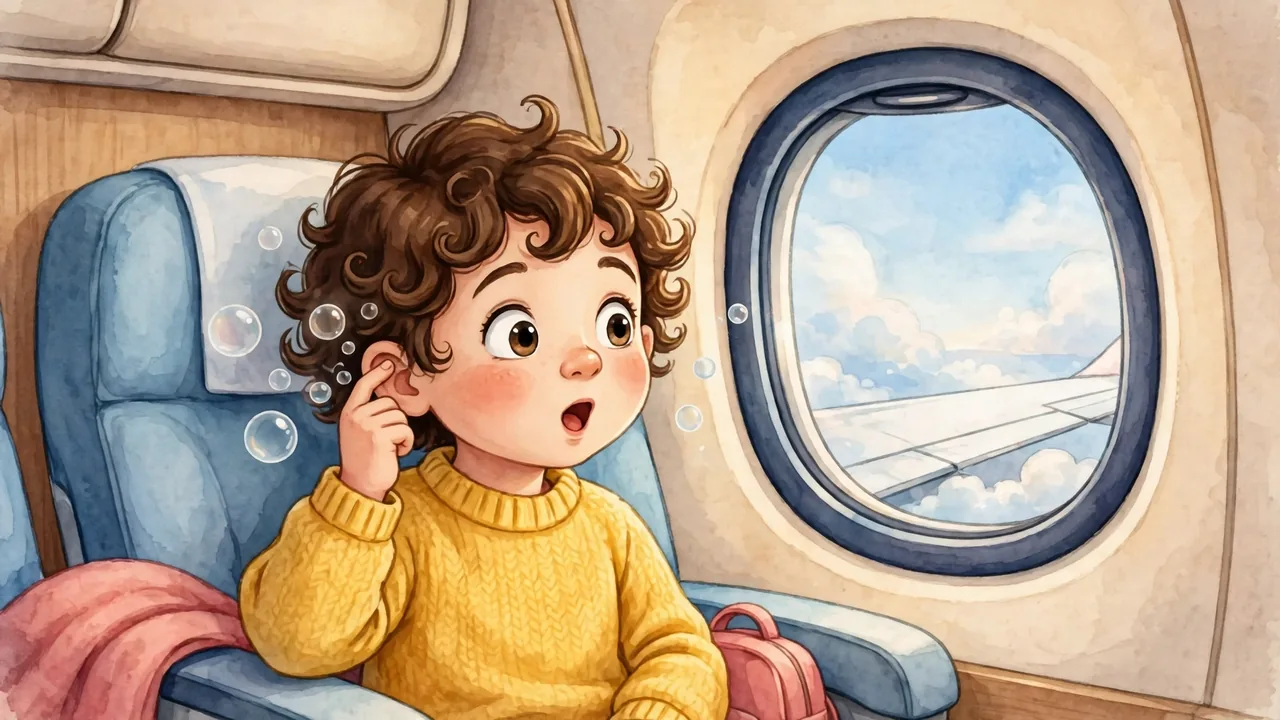
✈️ The plane flies up, up, up!
The air gets thin up high.
Your ears feel full. Then... POP! 💥
Take a sip of water. Do a big yawn.
Now your ears feel just fine. 👂
When a plane flies up into the sky, the air gets thinner and thinner. Air pushes on everything, even on you. That push is called pressure.
Deep inside your ear is a tiny pocket of air. The pocket wants its air to match the air in the plane. When the plane climbs up or floats down, the tiny tunnel opens and lets air move. The moving air makes a pop!
Pop! If you have ever flown on a plane, you know the feeling. As the plane climbs into the sky or sinks back down to land, your ears feel stuffed, sounds go muffly, and then, pop, everything sounds clear again. That pop is your body fixing an air problem, and it is cleverer than it sounds.
A Tiny Pocket of Air in Your Ear
Behind your eardrum sits a small space called the middle ear. It is full of air, and it works best when the air inside pushes exactly as hard as the air outside your ear. On the ground, the two pushes match, so your ears feel normal and you hear clearly.
The Secret Tunnel
A slim tunnel links the middle ear to the back of your nose. It is called the eustachian tube (say it: yoo-STAY-shee-un). Most of the time the tunnel stays closed. It swings open for a split second when you swallow or yawn, letting a tiny puff of air sneak in or out.
Why the Pop Happens
When a plane climbs, the air in the cabin gets thinner, so it pushes less. The air trapped in your middle ear now pushes harder than the cabin air, and it escapes out through the tunnel. That escape is the pop. When the plane comes down to land, the cabin air pushes harder and harder instead, and air must sneak back into your middle ear to catch up.
Tricks That Help
Swallow, yawn, or wiggle your jaw. Chew gum or suck on a candy if you are allowed. Sip water little by little as the plane lands. For older kids, there is a special trick: pinch your nose shut, close your mouth, and blow very, very gently, like you are trying to blow up the world's smallest balloon. Never blow hard. If your ears feel sore, tell a grown-up. The stuffed feeling usually melts away soon after you land.
Your ears are pressure detectors. Every flight puts them to work, because the air pressing on your eardrum near the top of a climb is wildly different from the air pressing on it at the airport, and your body has to rebalance that pressure again and again or your hearing goes dull and your ears begin to ache.
The Middle Ear: A Sealed Pocket with a Door
The part of your ear that matters here is not the part you can see. Behind the eardrum, a thin membrane stretched across the ear canal, sits a pea-sized cavity called the middle ear, and it is filled with air at whatever pressure your body last set. Sound works because the eardrum vibrates freely, and it vibrates freely only when the air pressure on both sides stays nearly equal.
The Eustachian Tube
One narrow passage, the eustachian tube, connects the middle ear to the nasopharynx, the space behind your nose. An Italian anatomist, Bartolomeo Eustachi, described the tube in the 1560s, and it has carried his name ever since. Most of the time the tube lies collapsed and shut. Swallowing and yawning fire small muscles that tug it open for a fraction of a second, just long enough for a small puff of air to move through.
Going Up Is Easy. Coming Down Is Not.
As a plane climbs and cabin pressure falls, the air in your middle ear is suddenly pushing outward harder than the cabin air pushes in, and expanding air can force the tube open from the inside, which is why ears usually clear themselves on the way up with a few painless pops. Descent reverses the problem completely, because cabin pressure rises, the eardrum gets pushed inward, and the soft tube acts like a flap that resists opening from that side, so the muscles of swallowing have to do the work on purpose. The same physics inflates a sealed snack bag, which puffs up tight at cruising altitude and goes slack again on the ground, because the air sealed inside it back at the airport obeys exactly the same law as the air sealed inside your head.
Why It Hurts, and How to Fix It
Pain is a pressure difference that stayed too long. A tube swollen shut by a cold lets the gap grow until the eardrum is stretched tight and hearing goes muffled, a condition doctors call ear barotrauma. Pilots and flight attendants lean on the same fixes your family does, because the physics does not care who you are.
Swallow hard, yawn wide, chew gum, or sip water during the descent, which is when the pressure changes fastest. Older kids and adults can try the Valsalva maneuver: pinch the nose shut, close the mouth, and blow gently to raise the pressure behind the nose until the ears clear, keeping the blow gentle, because a forceful one can injure the very eardrum it is meant to save.
Next flight, pay attention during the last twenty minutes before landing. Every swallow in that stretch is a tiny experiment in gas physics, running inside your own head.
The popping in your ears during a flight is the audible signature of a pressure differential resolving itself. The system that resolves it, a collapsible tube of cartilage and muscle running from the middle ear to the back of the nose, has been understood in outline since the sixteenth century, and it still fails often enough that ear pain ranks among the most common medical complaints of air travel.
Pressure, Altitude, and the Pressurized Cabin
Atmospheric pressure is simply the weight of the air column above a surface, and it falls predictably with altitude: roughly 101 kilopascals at sea level, about 75 kilopascals at 2,400 meters, and near 24 kilopascals at the 10,700 meters where airliners cruise. No passenger cabin holds sea-level pressure at cruising altitude, because the fuselage would have to withstand that full pressure difference for every hour of its working life. Engineers instead maintain a cabin altitude of 1,800 to 2,400 meters, a negotiated compromise between structural stress and human comfort, and they schedule the pressure change gradually across the climb and the descent, stretching over twenty minutes or more a transition that, left unpressurized, would expose passengers to the full thin-air physiology of a high mountain summit, where an unacclimatized person can lose useful consciousness in minutes.
Anatomy of an Equalization
The middle ear is a rigid, air-filled cavity of roughly two milliliters in adults, vented by a single structure: the eustachian tube. Its cartilaginous portion opens when the tensor veli palatini muscle contracts, which happens reflexively during swallowing and yawning. During ascent, expanding middle-ear air vents passively at small pressure differentials, which is why most passengers notice nothing more than occasional soft pops on the way up. During descent the geometry turns against you, because rising ambient pressure presses the eardrum inward while the tube's soft walls are pressed together by the same pressure, so equalization demands active muscular opening, and mucosal swelling from a cold or allergies can seal the tube shut entirely.
When Equalization Fails: Barotrauma
A differential that cannot resolve stretches the tympanic membrane, draws fluid into the middle-ear lining, and in severe cases perforates the drum or bleeds into the cavity. Clinicians grade this barotitis media on a scale from simple redness of the drum to perforation. Children are disproportionately affected because the pediatric eustachian tube is shorter, narrower, and more horizontal than the adult version, draining poorly and collapsing more readily under pressure. That anatomical detail, more than anything else, explains the crying baby during descent.
The Engineering Half of the Problem
Cabin pressurization is a settlement negotiated between the airframe and the eustachian tube. Outflow valves meter the cabin's rate of climb and descent to the equivalent of a few hundred feet per minute, slow enough for healthy ears to keep pace. Newer composite fuselages tolerate higher pressure differentials without the fatigue penalties of aluminum, which is why recent airliners hold cabin altitudes near 1,800 meters and measurably reduce passenger symptoms. The failures that remain are biological rather than mechanical: congested tubes, passengers asleep through the descent who stop swallowing, and infants who cannot be instructed to yawn. Pressure-regulating earplugs attack the problem from the other side, using a tiny ceramic filter to throttle the rate of pressure change at the ear canal, buying a sluggish tube the extra seconds it needs.
- Eustachi, Bartolomeo, Opuscula anatomica (1564), the first published description of the auditory tube that now carries his name
- Valsalva, Antonio Maria, De aure humana tractatus (1704), the treatise that describes the maneuver divers and pilots still use
- United States Standard Atmosphere (1976), published by NOAA, NASA, and the Air Force, the source of the pressure-by-altitude values used here
- Mayo Clinic, "Airplane ear," an overview of ear barotrauma causes, symptoms, and prevention for travelers
If a child near you has ever wailed during the last twenty minutes of a flight, you have witnessed a plumbing problem. The cry is rarely hunger or tiredness alone; it is usually a small tube in the ear failing to do, on schedule, the one job it exists for. Adults feel the same physics as a fullness, a muffling, a stubborn refusal to pop, and the occasional sharp reminder that the eardrum is a membrane with opinions.
What Is Actually Happening
Behind the eardrum sits the middle ear, a rigid pocket of air connected to the back of the nose by the eustachian tube. Hearing works cleanly only when the air pressure inside that pocket matches the pressure outside the drum, and the tube is the sole vent through which the two sides negotiate. Airliners cruise where the outside pressure is about a quarter of what it is at sea level, so cabins are pressurized to the equivalent of a mountain town, 1,800 to 2,400 meters up, and the pressure change is metered out gradually. Gradual is not the same as gentle enough for every ear. The same quiet negotiation runs constantly in ordinary life, in elevators and mountain switchbacks and the last meters of a dive, and it almost never draws attention to itself until a swollen tube, a sleeping passenger, or a descent begun with a head cold turns a routine pressure change into twenty minutes of escalating discomfort.
Why Descent Is the Hard Part
Ascent mostly takes care of itself. As cabin pressure falls, the air trapped in the middle ear expands and pushes its way out through the tube, which yields easily from the inside. Descent stacks the geometry the other way: rising cabin pressure drives the eardrum inward while pressing the tube's soft walls together, so the vent must be opened actively, by the muscles that fire when you swallow or yawn. Sleeping passengers stop swallowing. Congested passengers may not be able to open the tube at all, and the resulting pressure gap, sustained for twenty minutes, is what clinicians call ear barotrauma. Physics does not negotiate.
Why Children Struggle More
The pediatric eustachian tube is shorter, narrower, and closer to horizontal than the adult version, which makes it slower to drain and quicker to collapse. Add a daycare cold, which swells the lining of an already narrow passage, and descent becomes a genuinely painful experience rather than a curious one. Babies cannot fake a yawn. This is also why the standard advice is mechanical rather than medicinal: feed babies during descent, because swallowing is the pump; keep older children awake and sipping, chewing, or yawning through the last half hour; and treat a flight booked over a bad ear infection as a conversation worth having with a pediatrician before, not after, the trip.
What Helps, Honestly Assessed
Swallowing, yawning, chewing, and sipping all work by the same route: they contract the muscle that opens the tube. The Valsalva maneuver, a gentle blow against a pinched nose and closed mouth, works from the pressure side and is appropriate for adults and older children who can be trusted to keep it gentle, because a hard blow can injure the ear it is meant to relieve. Pressure-regulating earplugs slow the rate of change at the ear canal and buy a slow tube more time. Timing matters more than tools. What the evidence does not support is the idea that a healthy ear needs any of this on the ground, because the system equalizes constantly and silently in daily life, every time you swallow, and it only becomes a subject of family debate at altitude, where the pressure outside the drum is changing faster than a congested tube can answer. Pain, discharge, dizziness, or hearing that stays muffled well after landing is a different category of problem, and it belongs in front of a clinician rather than in a travel tips column.
💬 Talk About It
- For preschoolers: "Can you do a giant yawn like a lion? That is how you help your ears on a plane."
- For kindergartners: "Why do you think the tiny tunnel in your ear stays closed most of the time?"
- For elementary: "A bag of chips puffs up tight on a plane but is soft on the ground. What is the connection to your ears?"
- For middle school: "Divers equalize every meter or so on the way down. Why do they have to do it so much more often than airplane passengers?"
Sources
- Mayo Clinic, "Airplane ear": causes, symptoms, self-care, and when to seek care. mayoclinic.org.
- Cleveland Clinic, "Ear Barotrauma": medical reference on pressure injury to the middle ear. clevelandclinic.org.
- U.S. Standard Atmosphere, 1976 (NOAA, NASA, U.S. Air Force): pressure values by altitude.
- Eustachi, B., Opuscula anatomica, 1564: first published description of the auditory tube.
- Valsalva, A. M., De aure humana tractatus, 1704: describes the maneuver bearing his name.