
Bread Hates the Fridge 🍞
Old bread goes hard. That is stale bread. The fridge is cold, and cold makes bread go stale faster.
Keep bread on the counter. To save it for later, put it in the freezer. ❄️
Stale bread gets soft again in a warm oven.
Why Does Bread Get Hard? 🍞
When bread sits out, it slowly gets hard and crunchy. We call that "stale." But here is a surprise: bread does NOT go stale because it dries out!
Tiny Building Blocks
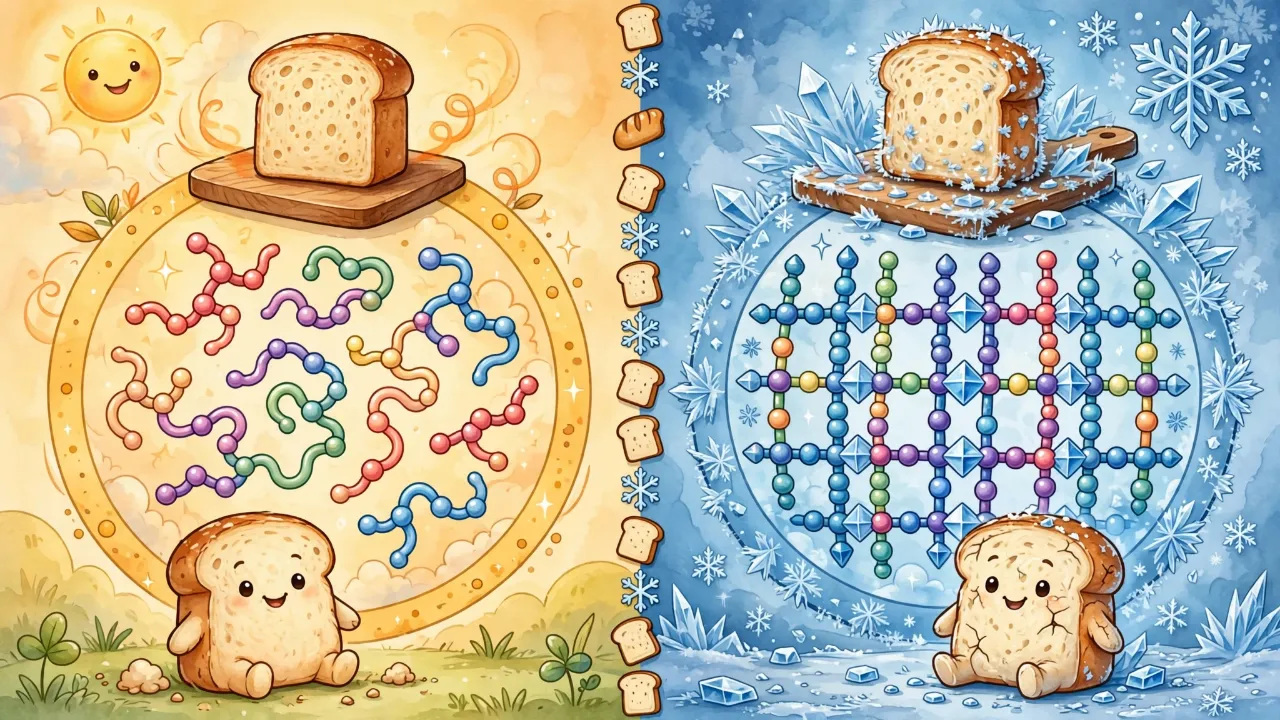
Bread is made of tiny things called starch. When bread is fresh, the starch is soft and squishy. But over time, the starch pieces line up like little crystals. That makes the bread feel hard.
Cold Makes It Faster!
The fridge is cold but not freezing. That temperature is the WORST for bread. The starch pieces line up super fast in the cold fridge. On the counter, it happens slower. In the freezer, it almost stops!
Try This!
Next time bread gets stale, ask a grown-up to heat it in the oven at 350 degrees. The heat breaks apart those crystals and the bread gets soft again! Science is cool!
🔬🍞
The Fridge Lie 🍞❄️
Most people put bread in the fridge to keep it fresh. Makes sense, right? The fridge keeps other food fresh. But bread is different, and the science is actually really cool.
It's Not About Drying Out
Scientists did an experiment. They sealed bread in airtight bags so zero moisture could escape. The bread STILL went stale. That proved staling is not about drying out. Something else is happening inside the bread.
Starch Crystals
Bread is mostly starch. When you bake bread, the heat melts the starch into a soft, squishy form. But after baking, the starch molecules slowly rearrange themselves back into hard crystals. Scientists call this "retrogradation."
Think of it like a puzzle. Baking scrambles the puzzle pieces. Over time, they slowly find their way back together.
Why the Fridge Is the Worst
Fridge temperature (about 40°F or 4°C) is the PERFECT temperature for starch crystals to form. It is the fastest staling zone. The counter is slower. The freezer nearly stops it completely because the molecules can barely move.
What Actually Works
- Eat it fast: Keep bread on the counter and eat within 2-3 days
- Freeze it: Slice first, then freeze. Toast slices straight from frozen.
- Reheat stale bread: 350°F in the oven for 10 minutes reverses the crystal formation
- Never refrigerate: The fridge is bread's worst enemy
The Science of Staling
Daniel Gritzer at Serious Eats ran a controlled experiment: baguettes stored four ways (unwrapped, paper, plastic wrap, aluminum foil) at three locations (counter, fridge, freezer). The results were clear and repeatable.
Retrogradation: The Real Mechanism
Bread staling is primarily caused by starch retrogradation, not moisture loss. During baking, starch granules absorb water and gelatinize, creating the soft crumb structure. After baking, amylose (linear starch chains) and amylopectin (branched chains) gradually recrystallize.
Amylose retrogrades within hours. Amylopectin takes days. The amylopectin recrystallization is what you experience as staling over a 2-5 day period.
Temperature Matters
- Fridge (4°C): Maximum staling rate. Provides enough molecular mobility for recrystallization but not enough to keep molecules disordered.
- Room temp (20-25°C): Moderate staling. Higher temperature partially inhibits crystal nucleation.
- Freezer (-18°C): Near-zero staling. Molecular motion essentially stops.
- Oven (175°C+): Reverses staling by re-gelatinizing the starch.
Practical Takeaway
Slice bread the day you buy it. Freeze individual slices in a zip-lock bag with air squeezed out. Toast directly from frozen. Never put bread in the fridge.
Starch Retrogradation Chemistry
Bread staling is a crystallization phenomenon in the starch fraction of the crumb, not a dehydration problem. Harold McGee documented this in On Food and Cooking: even bread sealed with zero moisture loss goes stale on the same timeline.
Two Phases of Retrogradation
Wheat starch is approximately 25% amylose and 75% amylopectin.
- Amylose retrogradation occurs within the first 24 hours. The linear chains hydrogen-bond into double helices, forming a semi-crystalline network.
- Amylopectin retrogradation occurs over 1-7 days. The branched chains slowly recrystallize into B-type crystalline polymorphs. This is the main mechanism of perceived staleness.
The Temperature Paradox
Crystallization kinetics follow a bell curve between the glass transition temperature (Tg) and the melting temperature (Tm). At fridge temperature (~4°C), you are near the peak of the nucleation rate curve. At room temperature, further from peak. At freezer temperature, molecular mobility effectively ceases.
Reversibility
Reheating above ~60°C re-melts the amylopectin crystals. This is why oven reheating at 175°C genuinely reverses staleness. However, each melt-recrystallize cycle degrades the starch structure slightly.
Starch Retrogradation: Amorphous to Crystalline Phase Transition
The common belief that bread stales due to moisture loss is incorrect. Staling is a starch recrystallization phenomenon where gelatinized (amorphous) starch reverts to a partially crystalline state through retrogradation. Harold McGee established this in On Food and Cooking.
Molecular Mechanism
Wheat flour starch comprises ~25% amylose (linear alpha-1,4-glucan chains, DP 500-6000) and ~75% amylopectin (branched alpha-1,4/1,6-glucan, MW 107-109).
Phase 1 (0-24h): Amylose chains form double-helical junction zones through intermolecular hydrogen bonding.
Phase 2 (1-7 days): Amylopectin outer chains (DP 15-20) slowly recrystallize into B-type crystalline polymorphs. This follows Avrami kinetics: 1 - X(t) = exp(-ktn), where n is approximately 1.0 for amylopectin retrogradation.
Temperature Dependence
The Avrami rate constant k peaks between -1°C and +7°C, making standard refrigerator temperature (4°C) nearly optimal for staling. This follows classical polymer crystallization theory: rate maximizes between Tg (~-5°C for bread crumb) and Tm (~55-65°C for retrograded starch).
Gritzer's Empirical Validation
Daniel Gritzer (Serious Eats) tested 12 conditions: 4 wrapping methods x 3 storage environments. Storage temperature was the dominant variable. All refrigerated samples ranked below their room-temperature counterparts regardless of wrap. Freezer + foil samples, reheated at 175°C, were nearly indistinguishable from fresh in blinded tasting.
Source
Based on Daniel Gritzer, Does Refrigeration Really Ruin Bread? (Serious Eats), and Harold McGee, On Food and Cooking (Scribner, 2004), Ch. 10.