
😴🌙
When it gets dark, your body gets sleepy. Time for bed!
Sleep helps you grow big and strong. 💪
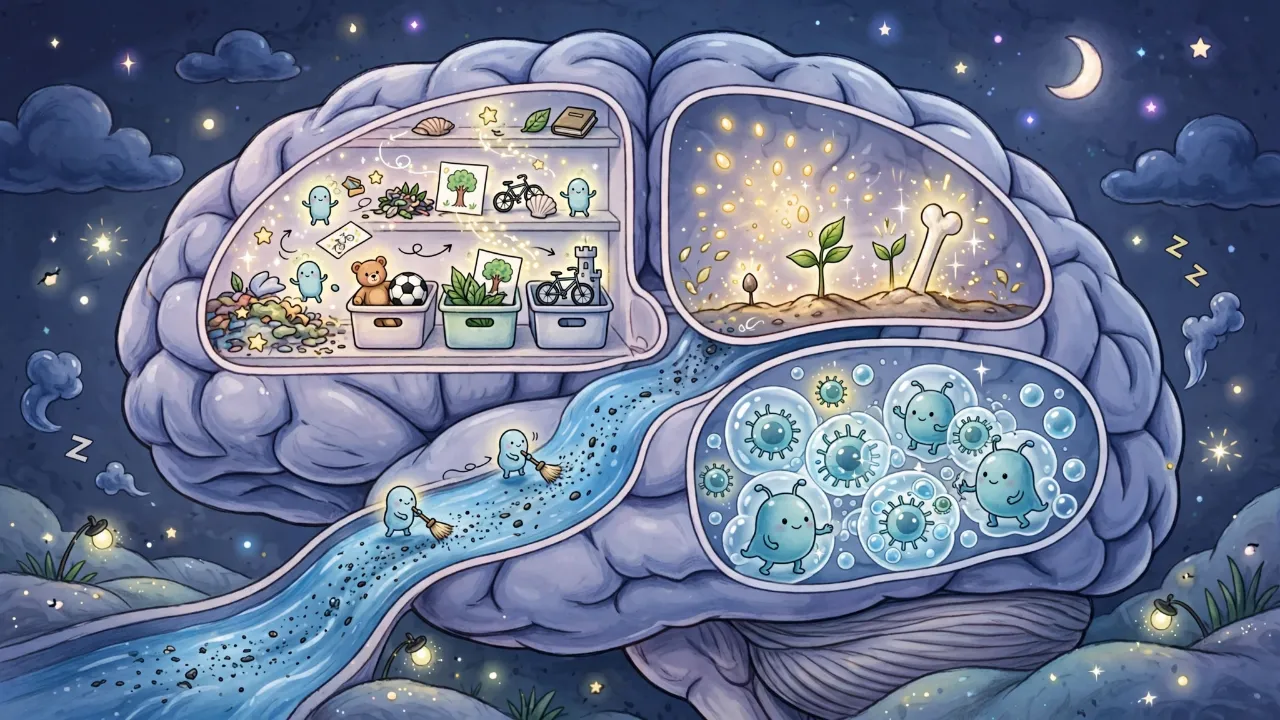
Your brain needs sleep too. It saves the fun things you learned today! 🧠✨
Sleep on time and you wake up happy! 😊
Sweet dreams! 🌟
Why Does Your Body Need Sleep?
Sleep is like charging a battery. When you play all day, your body uses up its energy. At night, sleep fills it back up for a brand new day.
What Happens While You Sleep?
Your body is busy. Your bones and muscles are growing. Your brain sorts through everything you learned today and puts it away neatly, like toys back on a shelf. 🧸
Why Does Bedtime Matter?
Your body has an inside clock. Going to bed at the same time every night keeps that clock running smoothly. If you stay up too late, the clock gets confused.
How Much Sleep Do Kids Need?
Kids your age need about 10 to 13 hours of sleep every night. 🌙
Sleep Is Not Just "Doing Nothing"
It might seem like nothing happens when you sleep, but the opposite is true. Your body runs a whole repair crew at night. Muscles that got sore from running around? Fixed. A scratch on your knee? Healing faster while you sleep. Your immune system, the part of your body that fights germs, gets stronger at night too.
Your Brain Needs Sleep to Learn
Here is something amazing: your brain replays the things you learned during the day while you sleep. It is like watching a movie of your own memories. This process moves information from short-term memory (where things are stored temporarily) to long-term memory (where things stick around for good). If you studied spelling words before bed, your brain practices them while you sleep!
Why Going to Bed on Time Really Matters
Your body makes a chemical called melatonin that makes you feel sleepy. It starts releasing melatonin when it gets dark outside. If you stay up late staring at a bright screen, the light tricks your brain into thinking it is still daytime, and the melatonin slows down. Then you lie in bed wide awake even though you are tired.
Going to bed at the same time each night trains your body to start the sleepy process on schedule. Kids who keep a regular bedtime fall asleep faster, sleep more deeply, and wake up in a better mood.
What Happens When You Do Not Get Enough Sleep?
Not enough sleep can make it harder to pay attention in class, harder to control your emotions (ever noticed you cry more easily when you are tired?), and harder to fight off colds. Over time, kids who do not sleep enough can have trouble with schoolwork and feel stressed more often.
How Much Do You Need?
Kids ages 6 to 12 need 9 to 12 hours of sleep every night, according to the American Academy of Pediatrics. That means if you need to wake up at 7:00 AM, you should be asleep by 9:00 PM at the latest.
The Architecture of a Night's Sleep
Sleep is not one uniform state. Your brain cycles through distinct stages roughly every 90 minutes. Non-REM sleep has three stages: light sleep (N1), deeper sleep (N2), and the deepest slow-wave sleep (N3). Then comes REM sleep (Rapid Eye Movement), when most vivid dreaming happens. Each stage serves a different purpose, and skipping any of them has consequences.
Growth Hormone and Deep Sleep
About 75% of your daily growth hormone is released during deep N3 sleep. Growth hormone does exactly what it sounds like: it tells your bones and muscles to grow. This is why sleep is especially critical during adolescence, when growth spurts happen. Cutting sleep short often means cutting into the deep-sleep stages where most of this hormone is released.
Memory Consolidation
During slow-wave sleep, your hippocampus (a seahorse-shaped structure deep in your brain) replays the day's experiences and transfers important information to the neocortex for long-term storage. During REM sleep, your brain processes emotional experiences and makes creative connections between ideas. Students who sleep after studying consistently outperform those who cram through the night.
The Circadian Rhythm Shift
During puberty, the timing of melatonin release shifts later by 1 to 3 hours. This is not laziness. It is biology. Your body genuinely is not ready for sleep until later. Unfortunately, school start times have not caught up with this science. The American Academy of Sleep Medicine recommends that middle and high schools start no earlier than 8:30 AM, but most still start before 8:00 AM.
Screen Time and Melatonin Suppression
Blue light from phones, tablets, and laptops suppresses melatonin production. A Harvard study found that blue light exposure before bed shifts the circadian clock by 90 minutes and cuts REM sleep. The standard advice is no screens for at least 30 minutes before bed. Night-mode filters help somewhat, but they do not fully solve the problem because even dim light from a screen signals wakefulness.
Sleep Debt Is Real
You cannot simply "make up" lost sleep by sleeping in on weekends. Irregular sleep patterns, sometimes called "social jet lag," disrupt your circadian rhythm. Studies show that teenagers with inconsistent bedtimes (varying by more than 2 hours) have worse academic performance and higher rates of mood disorders compared to teens who keep a consistent schedule, even if total sleep hours are similar.
Neuroscience of Sleep: Why Your Brain Cannot Skip It
During wakefulness, neurons accumulate metabolic waste products, including beta-amyloid (the same protein implicated in Alzheimer's disease). The glymphatic system, discovered in 2012 by Maiken Nedergaard's lab at the University of Rochester, clears this waste during sleep. Cerebrospinal fluid flows through the brain's interstitial spaces at rates up to 60% higher during sleep than during wakefulness, flushing out toxins. Chronic sleep deprivation allows these waste products to accumulate, which may contribute to long-term neurodegeneration.
The Hypothalamic-Pituitary Axis and Growth
Growth hormone (GH) secretion follows a pulsatile pattern, with the largest pulse occurring within the first hour of slow-wave sleep. The hypothalamus releases Growth Hormone-Releasing Hormone (GHRH) in synchrony with deep-sleep EEG patterns. Sleep deprivation flattens these pulses. In adolescents, who are in their peak growth period, this is particularly consequential. Studies have shown that children with chronic sleep restriction exhibit measurably lower GH levels over 24-hour periods.
Immune Function and Sleep
Sleep deprivation suppresses the immune system in measurable ways. T-cell adhesion (the ability of immune cells to attach to and destroy infected cells) drops significantly after even one night of poor sleep, as demonstrated in a 2019 study in the Journal of Experimental Medicine. Production of cytokines, the signaling proteins that coordinate immune responses, decreases with reduced sleep. People who sleep fewer than 6 hours per night are 4.2 times more likely to catch a cold when exposed to a rhinovirus than those sleeping 7 or more hours, according to research published in Sleep (2015).
Cognitive and Emotional Consequences
The prefrontal cortex, responsible for decision-making, impulse control, and emotional regulation, is disproportionately impaired by sleep loss. The amygdala, the brain's threat-detection center, becomes hyperreactive. The result: sleep-deprived teenagers show up to 60% greater amygdala reactivity to negative stimuli, while the prefrontal cortex's ability to modulate that response is diminished. This is why everything feels worse when you are tired. It is not a character flaw. It is neuroscience.
The Bedtime Problem: Why Consistency Beats Duration
Research from the Journal of Sleep Research (2017) found that bedtime regularity is a stronger predictor of academic performance than total sleep duration. Students with consistent bedtimes (within a 30-minute window) had GPAs 0.5 points higher on average than students who varied their bedtime by 2+ hours, even when total sleep hours were comparable. The explanation lies in circadian alignment: a consistent schedule synchronizes the release of cortisol (the wakefulness hormone) and melatonin (the sleep hormone), optimizing both sleep quality and daytime alertness.
How Much Sleep Do Teenagers Actually Need?
The American Academy of Sleep Medicine recommends 8 to 10 hours for ages 13 to 18. The National Sleep Foundation's 2015 expert panel concurred. Only about 27% of U.S. high school students report getting 8 or more hours on school nights. The gap between what adolescent brains need and what they get is one of the most widespread public health problems nobody talks enough about.
A Parent's Guide to Children's Sleep
Sleep is the single most undervalued input in child development. While nutrition, exercise, and education receive enormous parental attention, sleep often gets treated as negotiable. The evidence says otherwise.
The Numbers
The American Academy of Pediatrics (2016) and American Academy of Sleep Medicine provide age-specific recommendations: 10-13 hours for ages 3-5, 9-12 hours for ages 6-12, and 8-10 hours for ages 13-18. These ranges include naps for younger children. Meeting these consistently is associated with better attention, behavior, learning, emotional regulation, and physical health. Falling below them is associated with increased risk of injuries, hypertension, obesity, depression, and self-harm in adolescents.
Why Bedtime Consistency Matters More Than You Think
A 2013 study in the Journal of Epidemiology and Community Health followed 10,230 children in the UK Millennium Cohort Study. Children with irregular bedtimes at age 3 had significantly lower scores in reading, math, and spatial reasoning by age 7 compared to children with consistent bedtimes. The effect was cumulative and dose-dependent: the more years of irregular bedtimes, the worse the cognitive outcomes. The encouraging finding: children who switched from irregular to regular bedtimes showed measurable improvements.
The Growth Hormone Connection
For parents of children being evaluated for short stature or growth concerns, sleep quality is directly relevant. Approximately 75% of growth hormone secretion occurs during deep (N3) sleep. Chronic sleep restriction, fragmented sleep, or obstructive sleep apnea can reduce GH output and may contribute to growth faltering. Pediatric endocrinologists routinely assess sleep quality as part of growth evaluations, and optimizing sleep is sometimes recommended as a first-line intervention before pharmacological treatment.
Practical Strategies That Work
Set a non-negotiable bedtime. Children thrive with clear boundaries. Pick a time that allows for the recommended hours of sleep given your child's wake-up time, and stick to it within a 15-minute window every night, including weekends.
Create a wind-down routine. 30-45 minutes of consistent pre-sleep activities (bath, brushing teeth, reading together) signals the brain that sleep is coming. The routine itself becomes a circadian cue.
Manage light exposure. Dim household lights in the hour before bed. Remove screens from bedrooms entirely. If older children use devices in the evening, enforce a hard cutoff 30-60 minutes before bedtime. Blue-light filters are a partial solution, not a complete one.
Keep the room cool, dark, and quiet. Optimal sleep temperature for children is 65-70°F (18-21°C). Blackout curtains help, especially in summer when daylight extends past bedtime.
Model the behavior. Children whose parents maintain regular sleep schedules are significantly more likely to do the same. If your child sees you scrolling your phone at midnight, no amount of lecturing about bedtime will land.
Sources
- Paruthi, S. et al. "Recommended Amount of Sleep for Pediatric Populations: A Consensus Statement." Journal of Clinical Sleep Medicine 12(6):785-786 (2016).
- Kelly, Y. et al. "Changes in bedtime schedules and behavioral difficulties in 7 year old children." Pediatrics 132(5):e1184-e1193 (2013).
- Xie, L. et al. "Sleep drives metabolite clearance from the adult brain." Science 342(6156):373-377 (2013).
- Prather, A.A. et al. "Behaviorally Assessed Sleep and Susceptibility to the Common Cold." Sleep 38(9):1353-1359 (2015).
- Dimitrov, S. et al. "Gαs-coupled receptor signaling and sleep regulate integrin activation of human antigen-specific T cells." Journal of Experimental Medicine 216(3):517-526 (2019).
- Van Der Werf, Y.D. et al. "Sleep benefits subsequent hippocampal functioning." Nature Neuroscience 12:122-123 (2009).
- Phillips, A.J.K. et al. "Irregular sleep/wake patterns are associated with poorer academic performance and delayed circadian and sleep/wake timing." Scientific Reports 7:3216 (2017).
- Nedergaard, M. & Goldman, S.A. "Glymphatic failure as a final common pathway to dementia." Science 370(6512):50-56 (2020).
- Owens, J.A. et al. "School Start Times for Adolescents (Policy Statement)." Pediatrics 134(3):642-649 (2014).