
🦷😁
You have teeth in your mouth. They help you eat food!
When you grow big, new teeth come in at the very back. They are called wisdom teeth. 🌟
Sometimes a dentist needs to take them out. That is OK!
What Are Wisdom Teeth?
Wisdom teeth are the very last teeth that grow in your mouth. They show up way in the back, behind all your other teeth. Most people get four of them.
When Do They Come In?
Wisdom teeth do not come in when you are a kid. They wait until you are a teenager or a young grown-up, usually around age 17 to 21. That is a long time from now!
Why Are They Called "Wisdom" Teeth?
They are called wisdom teeth because they come in when you are older and (hopefully) a little wiser! Wisdom means knowing a lot of things.
Do They Hurt?
Sometimes wisdom teeth do not have enough room to grow. When that happens, a dentist can help. Many people have their wisdom teeth taken out, and they feel much better after! 🦷✨
Your Mouth Has a Full Set of Teeth
Adults have 32 teeth in total. The first 28 teeth come in during childhood and the early teen years. The last four are the wisdom teeth, also called third molars. They sit at the very back corners of your mouth, two on top and two on the bottom.
Why Do We Have Them?
Thousands of years ago, humans ate tough foods like raw roots, nuts, and dried meat. They needed big, strong jaws and lots of grinding teeth to chew all that food. Wisdom teeth were a big help back then. Today, we cook our food and use forks and knives, so our jaws have gotten smaller over time. But the wisdom teeth keep showing up anyway!
When There Is Not Enough Room
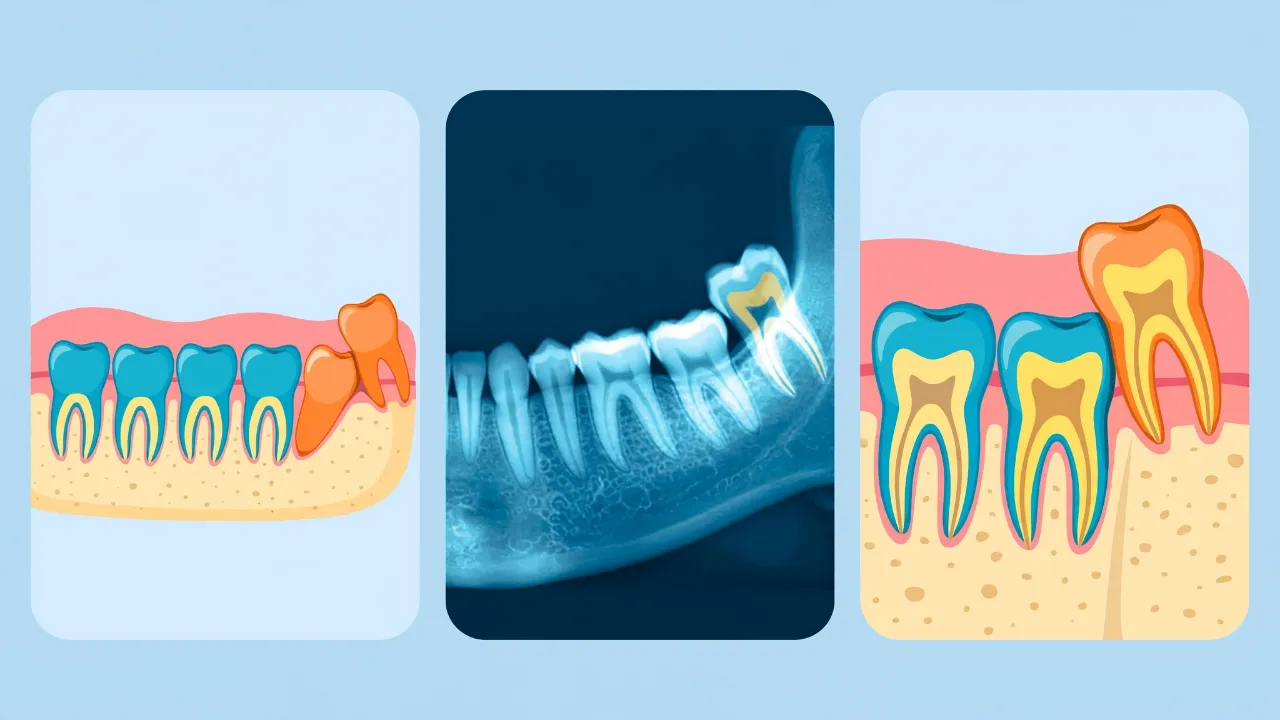
Because modern jaws are smaller, wisdom teeth often do not have space to grow in properly. When a tooth gets stuck under the gum or pushes against other teeth, dentists call it impacted. An impacted wisdom tooth can cause pain, swelling, and even infection if it is not treated.
Taking Them Out
About 10 million wisdom teeth are removed in the United States every year. The procedure is very common, and most people recover in a few days. After surgery, people eat soft foods like ice cream and soup, which is not the worst thing in the world!
Third Molars: An Evolutionary Leftover
Wisdom teeth are technically the third set of molars, designated M3 in dental notation. Most people develop four, but the number varies: some people grow one, two, or three, and an increasing percentage of the global population develops none. This variation is itself evidence of evolution in progress.
Why Our Ancestors Needed Them
Early hominids like Australopithecus (who lived 2-4 million years ago) had massive jaws that comfortably fit 32 teeth. Their diet of uncooked plants, raw meat, and fibrous roots required extensive grinding. Third molars provided crucial additional chewing surface area. As humans developed cooking (roughly 400,000-1 million years ago) and eventually agriculture (about 10,000 years ago), food became softer. Jaws shrank, but wisdom teeth kept developing because evolution works slowly.
The Impaction Problem
Studies estimate that 65-72% of people have at least one impacted wisdom tooth. Impaction happens when the tooth cannot fully emerge through the gum because there is not enough space in the jaw. Impacted teeth can be:
- Mesioangular: angled toward the front of the mouth (the most common type, about 43%)
- Vertical: oriented correctly but stuck below the gum
- Horizontal: lying on their side (the most likely to cause problems)
- Distoangular: angled toward the back of the jaw
To Extract or Not to Extract?
This is one of the biggest debates in modern dentistry. The American Association of Oral and Maxillofacial Surgeons recommends removing wisdom teeth that show signs of disease or have a high risk of future problems. However, many dentists worldwide argue against prophylactic extraction (removing healthy teeth "just in case"). The U.K.'s National Institute for Health and Care Excellence (NICE) stopped recommending routine extraction of asymptomatic wisdom teeth in 2000, and extraction rates in Britain dropped 30% without any increase in complications.
The Genetics of Missing Wisdom Teeth
The PAX9 and MSX1 genes play key roles in tooth development. Mutations in these genes can prevent wisdom teeth from forming entirely. The prevalence of congenital absence (called agenesis) varies by population: about 10-25% of European-ancestry individuals lack at least one wisdom tooth, compared to nearly 45% in some Indigenous populations. This variation likely reflects dietary differences across evolutionary history.
The Evolutionary Biology of Third Molars
Wisdom teeth provide one of the cleanest case studies in human vestigiality. The third molar was fully functional in early Homo species, whose prognathic (forward-projecting) jaws provided ample arch length. The shift toward orthognathic (flat-faced) jaw structure in Homo sapiens created a spatial constraint that renders the M3 increasingly obsolete.
What makes this particularly interesting from an evolutionary perspective is the speed of change. The reduction in human jaw size has occurred primarily in the last 10,000-12,000 years, coinciding with the agricultural revolution. This is extremely rapid by evolutionary standards. The mismatch between jaw size and tooth count represents what evolutionary biologists call a lag: the genetic program for M3 development has not yet caught up to the morphological changes in jaw architecture.
Molecular Genetics of Tooth Agenesis
Third molar agenesis (congenital absence) is a polygenic trait influenced by multiple developmental genes. PAX9 (chromosome 14q13.3) is a paired box transcription factor critical for molar development; loss-of-function mutations produce selective agenesis of posterior teeth, with M3 disappearing first. MSX1 (chromosome 4p16.1) similarly regulates odontogenic mesenchyme. BMP4 signaling gradients establish the anterior-posterior patterning of the dental arch, with M3 positioned at the lowest-concentration end of the gradient, making it the most vulnerable to perturbation.
The Prophylactic Extraction Debate
The controversy over routine wisdom tooth extraction illustrates broader tensions in evidence-based medicine. In the United States, approximately 10 million M3 extractions are performed annually at a cost exceeding $3 billion. The procedure carries risks: inferior alveolar nerve damage (1-5% temporary, 0.02-0.04% permanent paresthesia), dry socket (2-5%), and rare but serious complications including jaw fracture and death from anesthesia.
The question is whether these risks are justified for asymptomatic teeth. A 2020 Cochrane systematic review found "insufficient evidence" to support or refute prophylactic extraction. The review noted that the quality of available evidence was low, with no properly randomized controlled trial comparing extraction to retention with long-term follow-up. This evidence vacuum has allowed practice patterns to diverge: the U.S. extracts aggressively, while the U.K. (following NICE guidelines since 2000) and Scandinavia adopt a watchful-waiting approach.
Cross-Cultural and Population Variation
M3 agenesis rates vary dramatically across populations, reflecting distinct evolutionary pressures:
European ancestry: 10-25%
African ancestry: 1-2%
East Asian ancestry: 25-35%
Inuit/Indigenous Arctic: 40-45%
Mexican Indigenous: <5%
The Inuit case is instructive. Traditional Inuit diets (raw fish, dried meat, blubber) required extensive mastication, yet Inuit populations show the highest M3 agenesis rates globally. One hypothesis is that the extreme cold selected for flatter faces (reducing surface area for heat loss), which incidentally reduced jaw size and created strong selection pressure against M3 retention. This would be an example of pleiotropic selection: the adaptive trait (facial morphology for cold tolerance) carries a correlated effect (reduced M3 development) as a developmental byproduct.
Future Directions
Several research teams are investigating biological tooth regeneration using stem cell approaches. If successful, the entire framing shifts: rather than removing vestigial M3s, clinicians could potentially grow replacement teeth on demand, making the evolutionary fate of wisdom teeth clinically irrelevant. In the nearer term, improved 3D imaging (cone-beam CT) and AI-assisted prediction models are enabling more precise risk assessment for individual patients, potentially reducing unnecessary extractions while identifying high-risk cases earlier.
Wisdom Teeth: Evolution's Slow Exit
Third molars occupy a peculiar position in human biology: they are simultaneously one of the most common sources of dental morbidity and one of the clearest examples of ongoing human evolution. For parents, the practical question is usually "when should my kid get these out?" But the deeper story involves evolutionary biology, medical economics, and a surprisingly contentious debate within dentistry about whether we are overtreating a natural condition.
The Evolutionary Context
The human jaw has decreased in size approximately 5-10% over the last 10,000 years, a period coinciding with the agricultural revolution and the subsequent shift to processed, cooked foods. This reduction is remarkably fast by evolutionary standards and has outpaced the genetic program for tooth development, which still codes for 32 teeth in most individuals.
The result is a mismatch: about 65-72% of the global population develops at least one impacted third molar. This is not a "defect" but rather the predictable consequence of two biological systems (jaw morphology and tooth development) evolving at different rates. The trend toward complete M3 agenesis is accelerating; some projections suggest that by 2100, the majority of humans in industrialized populations will not develop wisdom teeth at all.
The Extraction Question: Following the Evidence
American dentistry has long favored early prophylactic extraction, typically between ages 16 and 22. The rationale is straightforward: younger patients heal faster, roots are less developed (easier surgery), and early removal prevents potential future complications. This logic is intuitive but empirically unsubstantiated.
A 2020 Cochrane review (the gold standard for medical evidence synthesis) found no high-quality evidence supporting prophylactic extraction of asymptomatic, disease-free wisdom teeth. The U.K.'s NICE issued guidelines against routine extraction in 2000, and a subsequent 20-year natural experiment showed no increase in wisdom-tooth-related pathology. Finland and Sweden follow similar conservative protocols.
The American counterargument centers on long-term risk: even asymptomatic M3s have a lifetime probability of developing pericoronitis (infection around a partially erupted tooth), cysts, or caries. Longitudinal data from the U.S. suggest that about 30% of retained asymptomatic M3s eventually require extraction for symptomatic reasons within 20 years. Critics note that this means 70% never require intervention, and the cumulative complication risk from the extraction itself (nerve damage, dry socket, infection) may exceed the risk of retention.
What Parents Should Know
The honest answer is that the evidence does not clearly favor either routine extraction or routine retention. Reasonable clinicians disagree. What the evidence does support:
- Symptomatic or diseased M3s should be extracted. This is uncontroversial.
- Fully erupted, functional, cleanable M3s can be retained. Regular monitoring is sufficient.
- Impacted M3s in adolescents present a judgment call. Discussion with an oral surgeon about individual anatomy (root development, proximity to the inferior alveolar nerve, angulation) is more useful than blanket recommendations.
- Panoramic X-rays around age 16-18 provide the necessary information to make an informed decision.
The financial dimension is worth acknowledging: the U.S. wisdom tooth extraction industry generates $3+ billion annually. Oral surgeons have an economic incentive toward extraction that does not exist in systems like the NHS, where surgeons are salaried. This does not mean American oral surgeons are acting in bad faith, but it does mean that patients should seek opinions from both a general dentist and a surgeon, and should ask specifically about the evidence for extraction of asymptomatic teeth.
The Bigger Picture
Wisdom teeth are a small but vivid illustration of a larger truth: the human body is not designed. It is a palimpsest of evolutionary compromises, each generation's anatomy slightly out of sync with its environment. We walk upright on a spine originally adapted for quadrupedal locomotion (hence back pain). We see through eyes wired backward (the retina's photoreceptors face away from incoming light). And we grow teeth that no longer fit in our jaws.
For children learning about their bodies, wisdom teeth offer an accessible entry point into evolutionary thinking: why does my body have parts it does not need? The answer, that evolution works by modifying what already exists rather than designing from scratch, is one of the most powerful ideas in all of science.
Sources
- Kavanagh, K.D., Evans, A.R., & Jernvall, J. "Predicting evolutionary patterns of mammalian teeth from development." Nature 449:427-432 (2007).
- Dodson, T.B. & Susarla, S.M. "Impacted wisdom teeth." BMJ Clinical Evidence 2014:1302 (2014).
- Ghaeminia, H. et al. "Surgical removal versus retention for the management of asymptomatic impacted wisdom teeth." Cochrane Database of Systematic Reviews 5:CD003879 (2020).
- National Institute for Health and Care Excellence (NICE). "Guidance on the Extraction of Wisdom Teeth." Technology Appraisal 1 (2000).
- Carter, K. & Worthington, S. "Morphologic and demographic predictors of third molar agenesis: a systematic review and meta-analysis." Journal of Dental Research 94(7):886-894 (2015).
- Silvestri, A.R. & Singh, I. "The unresolved problem of the third molar: would people be better off without it?" Journal of the American Dental Association 134(4):450-455 (2003).
- Lieberman, D.E. The Evolution of the Human Head. Harvard University Press (2011).
- Boughner, J.C. "Dental development in the context of hominid evolution." American Journal of Physical Anthropology 162(S64):88-89 (2017).